

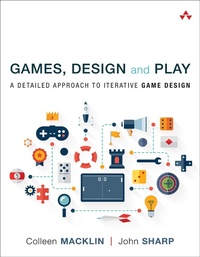
Games, Design and Play
A detailed approach to iterative game design
1st Edition
Published on 19. May 2016
288 pages
978-0-13-439218-9 (ISBN)
Description

The play-focused, step-by-step guide to creating great game designs
This book offers a play-focused, process-oriented approach for designing games people will love to play. Drawing on a combined 35 years of design and teaching experience, Colleen Macklin and John Sharp link the concepts and elements of play to the practical tasks of game design. Using full-color examples, they reveal how real game designers think and work, and illuminate the amazing expressive potential of great game design.
Focusing on practical details, this book guides you from idea to prototype to playtest and fully realized design. You'll walk through conceiving and creating a game's inner workings, including its core actions, themes, and especially its play experience. Step by step, you'll assemble every component of your "videogame," creating practically every kind of play: from cooperative to competitive, from chance-based to role-playing, and everything in between.
Macklin and Sharp believe that games are for everyone, and game design is an exciting art form with a nearly unlimited array of styles, forms, and messages. Cutting across traditional platform and genre boundaries, they help you find inspiration wherever it exists.
Games, Design and Play is for all game design students, and for beginning-to-intermediate-level game professionals, especially independent game designers. Bridging the gaps between imagination and production, it will help you craft outstanding designs for incredible play experiences!
Coverage includes:
Understanding core elements of play design: actions, goals, rules, objects, playspace, and players
Mastering "tools" such as constraint, interaction, goals, challenges, strategy, chance, decision, storytelling, and context
Comparing types of play and player experiences
Considering the demands videogames make on players
Establishing a game's design values
Creating design documents, schematics, and tracking spreadsheets
Collaborating in teams on a shared design vision
Brainstorming and conceptualizing designs
Using prototypes to realize and playtest designs
Improving designs by making the most of playtesting feedback
Knowing when a design is ready for production
Learning the rules so you can break them!
This book offers a play-focused, process-oriented approach for designing games people will love to play. Drawing on a combined 35 years of design and teaching experience, Colleen Macklin and John Sharp link the concepts and elements of play to the practical tasks of game design. Using full-color examples, they reveal how real game designers think and work, and illuminate the amazing expressive potential of great game design.
Focusing on practical details, this book guides you from idea to prototype to playtest and fully realized design. You'll walk through conceiving and creating a game's inner workings, including its core actions, themes, and especially its play experience. Step by step, you'll assemble every component of your "videogame," creating practically every kind of play: from cooperative to competitive, from chance-based to role-playing, and everything in between.
Macklin and Sharp believe that games are for everyone, and game design is an exciting art form with a nearly unlimited array of styles, forms, and messages. Cutting across traditional platform and genre boundaries, they help you find inspiration wherever it exists.
Games, Design and Play is for all game design students, and for beginning-to-intermediate-level game professionals, especially independent game designers. Bridging the gaps between imagination and production, it will help you craft outstanding designs for incredible play experiences!
Coverage includes:
Understanding core elements of play design: actions, goals, rules, objects, playspace, and players
Mastering "tools" such as constraint, interaction, goals, challenges, strategy, chance, decision, storytelling, and context
Comparing types of play and player experiences
Considering the demands videogames make on players
Establishing a game's design values
Creating design documents, schematics, and tracking spreadsheets
Collaborating in teams on a shared design vision
Brainstorming and conceptualizing designs
Using prototypes to realize and playtest designs
Improving designs by making the most of playtesting feedback
Knowing when a design is ready for production
Learning the rules so you can break them!
More details
Edition
1. Auflage
Language
English
Place of publication
Boston
United States
Publishing group
Pearson Education (US)
Target group
Professional and scholarly
File size
7,89 MB
ISBN-13
978-0-13-439218-9 (9780134392189)
Copyright in bibliographic data and cover images is held by Nielsen Book Services Limited or by the publishers or by their respective licensors: all rights reserved.
Schweitzer Classification
Other editions
Additional editions
Book
07/2016
Addison Wesley
€55.00
Shipment within 15-20 days
Persons
Colleen Macklin is a game designer and an Associate Professor in the school of Art, Media and Technology at Parsons The New School for Design, where she has been teaching interaction and game design for over 20 years. Macklin is also founder and co-director of PETLab (Prototyping Education and Technology Lab), a lab that develops games for experimental learning and social engagement. PETLab projects include disaster preparedness games and sports with the Red Cross, the urban activist game Re:Activism and the physical/fiscal sport Budgetball. PETLab has also published game design curricula for the Boys & Girls Club. She is a member of the game design collective Local No. 12, best known for their social card game, the Metagame. Her work has been shown at Come Out and Play, UCLA Art|Sci Center, The Whitney Museum for American Art and Creative Time.
John Sharp is a designer, art historian, curator and educator with over twenty five years of involvement in the creation and study of art and design. He is the Associate Professor of Games and Learning at Parsons The New School for Design. Along with Colleen Macklin, John co-directs PETLab (Prototyping, Education and Technology Lab), a research group focused on games and their design as a form of social discourse. John is also a member of the game design collective Local No. 12 along with Colleen Macklin and Eric Zimmerman (Arts Professor, New York University Game Center), a company focused on finding play in cultural practices. Along with Peter Berry, John is a partner in Supercosm, where he focuses on interaction and game design for arts and education clients.
John Sharp is a designer, art historian, curator and educator with over twenty five years of involvement in the creation and study of art and design. He is the Associate Professor of Games and Learning at Parsons The New School for Design. Along with Colleen Macklin, John co-directs PETLab (Prototyping, Education and Technology Lab), a research group focused on games and their design as a form of social discourse. John is also a member of the game design collective Local No. 12 along with Colleen Macklin and Eric Zimmerman (Arts Professor, New York University Game Center), a company focused on finding play in cultural practices. Along with Peter Berry, John is a partner in Supercosm, where he focuses on interaction and game design for arts and education clients.
Content
Part IConcepts
1Games, Design and Play
2Basic Game Design Tools
3The Kinds of Play
4The Player Experience
Part IIProcess
5The Iterative Game Design Process
6Design Values
7Game Design Documentation
8Collaboration and Teamwork
Part IIIPractice
9Conceptualizing Your Game
10Prototyping Your Game
11Playtesting Your Game
12Evaluating Your Game
13Moving from Design to Production
Works Cited
Glossary
Index
1Games, Design and Play
2Basic Game Design Tools
3The Kinds of Play
4The Player Experience
Part IIProcess
5The Iterative Game Design Process
6Design Values
7Game Design Documentation
8Collaboration and Teamwork
Part IIIPractice
9Conceptualizing Your Game
10Prototyping Your Game
11Playtesting Your Game
12Evaluating Your Game
13Moving from Design to Production
Works Cited
Glossary
Index
