

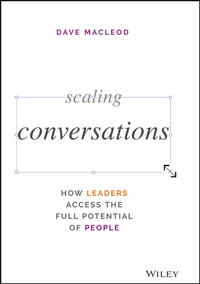
Scaling Conversations
Description

Scaling Conversations: How Leaders Access the Full Potential of People delivers invaluable strategies for how leaders can make their communications more inclusive and access the voices of those employees who rarely feel empowered to speak up. As constituent numbers scale, leaders have traditionally struggled to make communications a conversation with the entire organization, settling instead for small focus groups, talking at people in town halls, and delivering surveys after the fact. The result is exclusive, narrow decision-making that disengages and under-utilizes talent and human capital. And now, as the remote environment grows, the challenge and imperative for engaging conversations on a wider scale is even greater.
Scaling Conversations provides the solution. Having led a remote team for over a decade and having worked with thousands of leaders across North America, Dave MacLeod teaches you how to:
* Scale your business by listening to the voices that really matter
* Access and maximize the human capital in your organization
* Make decisions that create unity and move the group forward
* Decrease employee turnover caused by poor communication
Within these pages, you'll learn how to better facilitate conversations with a wider and more representative array of clients and employees, and not just the loudest ones in the town hall meeting or Slack channel. Perfect for any leader who's responsible for understanding what employees are really feeling and thinking, Scaling Conversations also belongs on the bookshelves of anyone who wants to learn how to discover what the "silent majority," who are often drowned out by the loudest people in the room, actually believes.
More details
Other editions
Additional editions
Person
Content
Part I What's in a Conversation?
Chapter 1 What's a Conversation? 3
Chapter 2 Why Do We Need to Scale Conversations? 9
Chapter 3 Components of a Conversation 21
Chapter 4 Why Are Conversations Hard to Scale in Person? 33
Chapter 5 Why Are Conversations So Hard to Scale Online? 41
Chapter 6 Typical Mistakes Leaders Make at Scale 47
Part II How to Scale Conversations Effectively
Chapter 7 Components of a Successful Scaled Conversation 65
Chapter 8 The Hierarchy of Questions 79
Chapter 9 Components of Good Questions for Scaled Conversations 107
Chapter 10 Synthesizing Scaled Conversations 119
Chapter 11 Scaling Conversations in Action: Diversity, Inclusion, Mental Health, Equity 139
Acknowledgments 163
About the Author 167
Index 169
THE LIMIT OF OUR COMPETITIVE ADVANTAGE
We humans are uniquely wired for empathy, facial recognition, and language. Our ability to collaborate with one another, beyond our relative groups, is widely recognized as the key ingredient of what has driven so much of our amazing progress as a species. Long ago humans were, fortunately, able to recognize the mutual benefit of our interdependence. Rather than just brutally compete with each other at all times, we took an interest in the well-being of others to improve our own lives. Initially we applied this to feeding ourselves and to simple ways of interacting beyond our family members. Over time, we developed deeper and deeper ways of collaborating more effectively. Again, for our own gain.
As our societies developed, we were pretty successful at collaboration: We embraced our ability to empathize and consider the points of view of others; we leveraged our ability to recognize each other and remember who we had made agreements with; and we refined our language to improve how we created things that mutually benefitted all of us. Soon enough we spread to all corners of the planet and created a global ability to share our feelings and opinions, watch sports and buy things from one another, using screens in our pockets. The language and technology we use to better cooperate with one another continues to evolve to this day as we all keep working to solve problems that threaten our species in small and large ways.
It would be great if we could simply spend a lot of time discovering and celebrating our incredible ability to work together as a species, but unfortunately, and obviously, we have used those same abilities to divide and polarize.
Along with our favorable wiring, as a species we are also wired in extremely unhelpful ways. Often described as two different "kinds of brain," along with our ability to learn and be creative, we have parallel survival instincts that hijack our capacity to empathize and communicate effectively. When we perceive a threat, humans react similarly to many other animal groups: We respond by fighting, fleeing or freezing. This happens in both well- and less-understood ways.
On the well-understood side, sometimes relatively simple "threats" can cause two perfectly reasonable adults to be suddenly angry and unable to inhabit the same room. Sometimes, reading an email or social post that seems threatening can destroy an entire relationship. Different views on religion, philosophy and politics can make people so divided they can't even hear one another, never mind collaborate. You can easily think of hundreds of human behaviors that decrease our ability to work well together.
On the less-understood side, unconscious biases can cause people to misinterpret and react poorly to one another based on things they don't clearly realize. Extroverts and introverts require different environments to allow effective communication. Systemic racism has created mechanisms to ensure privileged people have more ability to influence than people with a different skin color. Social media is built to silo people and amplify extreme voices in an echo chamber.
For nearly every communication ability we can point to, as a species, we can also single out a failure to communicate that threatens our organizations, our society and, ultimately, our world. The remedy for this is to continue to improve our ability to share our voice, listen to one another, and discover common ground and insight to our mutual benefit. Simply, we need to converse better.
Over the years, humans have innovated to overcome our unfavorable wiring and our inability to converse in large groups. To try to ensure we get as much benefit as possible from group conversations we have invented talking sticks, council etiquette, and, in more recent times, Robert's Rules of Order-an adaptation of the rules and practice of Congress to address the needs of non-legislative societies published by US Army Officer Henry Martyn Robert in 1876. Many organizations train people in collaborative negotiation, conflict resolution and group meeting facilitation. Recognizing our inability to converse effectively in large groups, leaders in all sectors of society try to add structures to get the best out of groups and avoid the worst behaviors and outcomes.
The problem is that none of these systems scale up.
The talking stick, and its culture of respecting every voice, is probably still the most effective invention but doesn't help a group that can't sit together. Our current attempts at scaling communications digitally, to include many people, give unfair voice to small groups, divide people into silos, and create echo chambers within threads and channels of similarly minded people.
The communication challenges facing our organizations and our society are increasingly urgent and we need to focus on what has always given us an advantage as a species: Our ability to converse. As a leader, you need to improve your ability to lead mutually beneficial interactions in which people feel heard, insights emerge, and trust increases. Our organizations are getting more complex, our population is growing, and therefore our ability to converse effectively needs to scale just as fast, or faster.
I'm currently the CEO of a fast-growing technology company in the conversation space, but I didn't grow up in tech. Quite the opposite. As a young adult living in British Columbia, Canada, I worked for many years in the late 1990s and early 2000s as an experiential educator and an outdoor adventure guide at a place called Educo Adventure School. As a group of young leaders, tasked with carrying the flame of an outdoors school founded in the early 1960s, we did our best to draw out the unique leadership qualities of young people as we climbed ropes and mountains, experienced sweat lodges with Secwepemc leaders and explored group communication through good times and challenges. While the rappelling, climbing, zip-lining and river-paddling provided an exciting platform to bring young people together, the lessons in self-expression and group communication are the lasting aspects of a decade of involvement in experiential education. It had a profound impact on my life and my desired career.
Being an outdoor facilitator is gratifying, and a whole lot of fun, but it is also seasonal and doesn't pay too well. As I reached my mid-twenties, I left the outdoors school world and ventured into creating new year-round businesses focused on human potential.
Fast-forward a few years and I was operating a small leadership development and consulting company focused on event facilitation and workshop development and delivery. I won a contract with a health organization that gave me the audacious and slightly uncomfortable title of Community Development Leader. In this initiative I was tasked broadly with increasing the health of young people in the Cariboo and Chilcotin regions of British Columbia by finding places to invest small amounts of capital which could have a large impact. Key to the success of this initiative was leading conversations to learn what people felt would inspire increased health based on their local knowledge. This was meant to be a grassroots initiative; in my region it focused both on First Nation communities and small municipalities.
As part of the process of distributing funds I facilitated a number of conversation-based meetings to decide how to do this in the most impactful way. I soon became painfully aware of individuals and organizations with vested interests who dominated agendas with their personal mandates. Academically, I understood interest groups and mandates, but experience is the very best teacher. These people and groups arrived at planning meetings with the pre-established goal of securing additional dollars for their existing projects. To be sure, many others arrived simply to learn, to join the conversation, and try to facilitate a group outcome. Unfortunately, those people were in the minority.
I wanted to involve everyone in a real conversation, and not just provide a platform for the loudest voices. So, I had to innovate.
Along my educational journey as a group facilitator, I came across a game called "35." It was exactly the tool I needed in this situation. The idea was simple: To learn what a group values, you ask an open question and give everyone a recipe card or sticky note to write down their answer. A common question was: "What is the most important thing we need to talk about today?" Each person wrote their answer down and did not sign their name. The cards were then shuffled around the room by people exchanging them with one another, one at a time, until they were told to stop. Each person then looked at their card and rated the idea out of seven. This shuffling and rating happened five times. At the end of this ordered chaos, I collected the cards and counted backwards from 35 to find the highest-rated cards. The agenda was then formed based on the top-rated items.
By adding this structure to a conversation, everyone who came to the event had a chance to contribute their thinking and for their thoughts to be validated and evaluated. This transparent process revealed what mattered to the group. People with special interests couldn't disproportionately affect the event by hijacking the agenda or overwhelming the conversation. Everyone felt included in the process because it was deemed "fair."
This consistently successful activity fascinated me: It became the first step along...
