

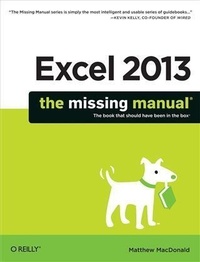
Excel 2013: The Missing Manual
Published on 18. April 2013
1020 pages
978-1-4493-5952-2 (ISBN)
Description

The worlds most popular spreadsheet program is now more powerful than ever, but its also more complex. Thats where this Missing Manual comes in. With crystal-clear explanations and hands-on examples, Excel 2013: The Missing Manual shows you how to master Excel so you can easily track, analyze, and chart your data. Youll be using new features like PowerPivot and Flash Fill in no time.The important stuff you need to know:Go from novice to ace. Learn how to analyze your data, from writing your first formula to charting your results.Illustrate trends. Discover the clearest way to present your data using Excels new Quick Analysis feature.Broaden your analysis. Use pivot tables, slicers, and timelines to examine your data from different perspectives.Import data. Pull data from a variety of sources, including website data feeds and corporate databases.Work from the Web. Launch and manage your workbooks on the road, using the new Excel Web App.Share your worksheets. Store Excel files on SkyDrive and collaborate with colleagues on Facebook, Twitter, and LinkedIn.Master the new data model. Use PowerPivot to work with millions of rows of data.Make calculations. Review financial data, use math and scientific formulas, and perform statistical analyses.
More details
Other editions
Additional editions
Matthew MacDonald
Excel 2013: The Missing Manual
Book
05/2013
1st Edition
O'Reilly
€37.50
Shipment within 10-20 days
Content
- Intro
- The Missing Credits
- Intro: Introduction
- Part One: Worksheet Basics
- Chapter 1: Creating Your First Spreadsheet
- Starting a Workbook
- Adding Information to a Worksheet
- Using the Ribbon
- Using the Status Bar
- Going Backstage
- Saving Files
- Opening Files
- Chapter 2: Adding Information to Worksheets
- Adding Different Types of Data
- Handy Timesavers
- Dealing with Change: Undo, Redo, and AutoRecover
- Spell-Check
- Adding Hyperlinks
- Chapter 3: Moving Data
- Selecting Cells
- Moving Cells Around
- Adding and Moving Columns or Rows
- Chapter 4: Managing Worksheets
- Worksheets and Workbooks
- Find and Replace
- Chapter 5: Formatting Cells
- Formatting Cell Values
- Formatting Cell Appearance
- Chapter 6: Smart Formatting Tricks
- The Format Painter
- Styles and Themes
- Conditional Formatting
- Chapter 7: Viewing and Printing Worksheets
- Controlling Your View
- Printing
- Controlling Pagination
- Part Two: Formulas and Functions
- Chapter 8: Building Basic Formulas
- Creating a Basic Formula
- Functions
- Formula Errors
- Logical Operators
- Formula Shortcuts
- Copying Formulas
- Chapter 9: Math and Statistical Functions
- Rounding Numbers
- Groups of Numbers
- General Math Functions
- Trigonometry and Advanced Math
- Advanced Statistics
- Chapter 10: Financial Functions
- The World of Finance
- Financial Functions
- Depreciation
- Other Financial Functions
- Chapter 11: Manipulating Dates, Times, and Text
- Manipulating Text
- Manipulating Dates and Times
- Chapter 12: Lookup, Reference, and Information Functions
- The Basic Lookup
- Advanced Lookups
- Information Functions
- Tutorial: Generating Invoices from a Product Catalog
- Chapter 13: Advanced Formula Writing and Troubleshooting
- Conditions in Formulas
- Descriptive Names for Cell References
- Variable Data Tables
- Controlling Recalculation
- Solving Formula Errors
- Part Three: Organizing Your Information
- Chapter 14: Tables: List Management Made Easy
- The Basics of Tables
- Sorting a Table
- Filtering a Table
- Dealing with Duplicate Rows
- Performing Table Calculations
- Chapter 15: Grouping and Outlining Data
- Basic Data Grouping
- Grouping Timesavers
- Chapter 16: Templates
- Using the Office Online Templates
- Rolling Your Own Templates
- Part Four: Charts and Graphics
- Chapter 17: Creating Basic Charts
- Charting 101
- Basic Tasks with Charts
- Practical Charting
- Chart Types
- Chapter 18: Formatting and Perfecting Charts
- Chart Styles and Layouts
- Adding Chart Elements
- Formatting Chart Elements
- Improving Your Charts
- Advanced Charting
- Chapter 19: Inserting Graphics
- Adding Pictures to a Worksheet
- Excel's Clip Art Library
- Drawing Shapes
- SmartArt
- Chapter 20: Visualizing Your Data
- Data Bars
- Color Scales
- Icon Sets
- Sparklines
- Part Five: Sharing Data with the Rest of the World
- Chapter 21: Protecting Your Workbooks
- Understanding Excel's Safeguards
- Data Validation
- Locked and Hidden Cells
- Chapter 22: Worksheet Collaboration
- Your Excel Identity
- Preparing Your Workbook
- Distributing Your Workbook
- Adding Comments
- Tracking Changes
- Sharing Your Workbook
- Reviewing Workbooks with Inquire
- Chapter 23: Using Excel on the Web
- Putting Your Files Online
- Using the Excel Web App
- Sharing Your Files
- Chapter 24: Exchanging Data with Other Programs
- Sharing Information in Windows
- Embedding and Linking Objects
- Transferring Data
- Part Six: Advanced Data Analysis
- Chapter 25: Scenarios and Goal Seeking
- Using Scenarios
- Using Goal Seek
- Solver
- Chapter 26: Pivot Tables
- Summary Tables Revisited
- Building Pivot Tables
- Multi-Layered Pivot Tables
- Fine-Tuning Pivot Table Calculations
- Filtering a Pivot Table
- Pivot Charts
- Chapter 27: Analyzing Databases
- Excel and Databases
- Creating a Data Connection
- The Data Model: Boosting Pivot Tables
- Chapter 28: Analyzing XML and Web Data
- Understanding XML
- Retrieving Information from XML
- Creating Web Queries
- Connecting to Online Data Services with OData
- Part Seven: Programming Excel
- Chapter 29: Automating Tasks with Macros
- Macros 101
- The Macro Recorder
- Macro Security
- Creating Practical Macros
- Chapter 30: Programming Spreadsheets with VBA
- The Visual Basic Editor
- Understanding Macro Code
- Exploring the VBA Language
- Part Eight: Appendix
- Appendix A: Customizing the Ribbon
- Adding Your Favorites to the QAT
- Personalizing the Ribbon
- Index
