

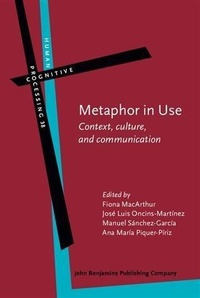
Metaphor in Use
Context, culture, and communication
1st Edition
Published on 17. October 2012
X, 379 pages
978-90-272-7346-8 (ISBN)
Description

Metaphor is a fascinating phenomenon, but it is also complex and multi-faceted, varying in how it is manifested in different modes of expression, languages, cultures, or time-scales. How then can we reliably identify metaphors in different contexts? How does the language or culture of speakers and hearers affect the way metaphors are produced or interpreted? Are the methods employed to explore metaphors in one context applicable in others? The sixteen chapters that make up this volume offer not only detailed studies of the situated use of metaphor in language, gesture, and visuals around the world - providing important insights into the different factors that produce variation - but also careful explication and discussion of the methodological issues that arise when researchers approach metaphor in diverse 'real world' contexts. The book constitutes an important contribution to applied metaphor studies, and will prove an invaluable resource for the novice and experienced metaphor researcher alike.
More details
Other editions
Additional editions
Fiona MacArthur | Jose Luis Oncins-Martinez | Manuel Sanchez-Garcia
Metaphor in Use
Context, culture, and communication
Book
10/2012
John Benjamins Publishing Co
€100.70
Shipment within 10-15 days
Persons
Content
- Metaphor in Use
- Editorial page
- Title page
- LCC data
- Table of contents
- List of contributors
- Acknowledgements
- Introduction
- 1. Background
- 2. The contributions to this volume
- 2.1 Part 1: Contexts of research
- 2.2 Part 2: Contexts of production
- 2.3 Part 3: Contexts of interpretation
- 2.4 Part 4: Metaphor, topic, and discourse
- 2.5 Part 5: Metaphor and culture
- 2.6 Part 6: Afterword and prospects for future research
- References
- Part 1. Contexts of research
- Chapter 1. An assessment of metaphor retrieval methods
- 1. Introduction
- 2. Metaphor retrieval procedures examined in this chapter
- 3. Reading portions of the corpus for candidates
- 4. Concordancing: Search term choice
- 5. Clustering
- 6. WordSmith Tools keywords
- 7. Metaphor Candidate Identifier
- 8. Semantic relatedness
- 9. Conclusion
- References
- Chapter 2. Metaphor in discourse
- 1. MIP and linguistic metaphor identification
- 2. MIP and metaphor in discourse
- 3. MIP and other manifestations of metaphor
- 4. Issue 1: Source or target domain?
- 5. Issue 2: Literal or metaphorical comparison?
- 6. Issue 3: Analysis of proper names
- 7. Issue 4: Cultural references
- 8. Conclusions
- References
- Chapter 3. Metaphor identification in Dutch discourse
- 1. Introduction
- 1.1 Studies in metaphor
- 1.2 MIP Pragglejaz: An explicit method
- 1.3 MIPVU: Additions and alterations
- 2. Dutch discourse and metaphor identification
- 2.1 Dutch discourse
- 2.2 Differences in deciding about words
- 2.3 A more basic meaning: The dictionary problem
- 2.4 Other metaphor forms: Checklists in Dutch?
- 3. Conclusion
- References
- Chapter 4. Locating metaphor candidates in specialized corpora using raw frequency and keyword lists
- 1. Introduction
- 2. What is a metaphor?
- 3. Locating metaphors in text
- 4. Locating metaphor candidates
- 4.1 Background
- 4.2 Preliminaries
- 4.3 Establishing the thematic content of the specialized corpus
- 4.4 Grouping and classifying low frequency content words
- 5. Further technicalities
- 5.1 A note on high and low frequencies
- 5.2 Comparing corpora
- 6. Conclusions
- References
- Part 2. Contexts of production
- Chapter 5. Metaphor variation across L1 and L2 speakers of English
- 1. Introduction
- 2. Linguistic metaphor and embodied experience
- 3. Cross-linguistic influence and transfer
- 4. General method and material
- 5. How often are the terms 'path', 'road', and 'way' used in metaphorical ways?
- 6. How are metaphorical 'paths', 'roads', and 'ways' described?
- 7. How are spatial relationships including 'paths', 'roads', or 'ways' described?
- 8. What do we do 'on', 'along', or 'near' the metaphorical 'path', 'road', and 'way'?
- 9. Conclusion
- References
- Corpora:
- Chapter 6. Metaphorical expressions in L2 production
- 1. Introduction
- 2. Background
- 3. Research questions
- 4. Data
- 5. Metaphorical sense
- 6. The base line: The use of ta in L1 = Norwegian
- 7. The use of ta in L2 = Norwegian
- 8. Comparison between the Norwegian-as-L1 group and the Norwegian-as-L2 groups
- 9. Conclusion
- References
- Chapter 7. Researching linguistic metaphor in native, non-native, and expert writing
- 1. Introduction
- 2. Procedures for linguistic metaphor identification
- 2.1 Key starting points
- 2.2 The MIV procedure
- 2.3 Inter-rater reliability
- 2.4 A combination of procedures
- 2.5 The linguistic form of metaphor
- 3. Results and discussion
- 3.1 The nature of linguistic metaphor in student and expert writing
- 3.2 Quantifying linguistic metaphors in student and expert writing
- 3.3 The lexico-grammatical forms of linguistic metaphor
- 4. Conclusions
- References
- Part 3. Contexts of interpretation
- Chapter 8. Appreciation and interpretation of visual metaphors in advertising across three European countries
- 1. Introduction
- 2. Visual metaphors
- 3. Research questions
- 4. Appreciation
- 4.1 Experiment 1
- 4.2 Experiment 2
- 5. Interpretive diversity
- 6. Conclusion and discussion
- References
- Chapter 9. English native speakers' interpretations of culture-bound Japanese figurative expressions
- 1. Introduction
- 2. Conventional metaphors in Japanese and the feasibility of their 'raw' translation
- 3. The study
- 3.1 Methodology
- 3.2 The test items
- 4. Results, analysis, and discussion
- 4.1 Phenomena observed in the ENSs' interpretations and regional differences (RQ 1)
- 4.2 Qualitative analysis of the items and their interpretations
- 4.3 Strategies used in the interpretations (RQ2)
- 5. Conclusions
- References
- Appendix A.
- Appendix B.
- Appendix C
- Chapter 10. The limits of comprehension in cross-cultural metaphor
- 1. Cross-language and internal variants of metaphor creation
- 2. Context in comprehension
- 3. Metaphor networking
- 4. Metaphor in drugs terminology
- 5. Shared cross-language concepts in drugs metaphors
- 6. Non-contextual factors that aid cross-language comprehension
- 6.1 Conventional metaphors
- 6.2 Similar analogies
- 6.3 Cultural overlap
- 7. Cross-language universals in conceptual networks: Individual creations
- 8. Universals in generalized networks
- 9. The limits of comprehension: Variation in cross-language networks
- 10. Native versus non-native comprehension
- 11. Conclusions
- References
- Part 4. Metaphor, topic, and discourse
- Chapter 11. Conceptual types of terminological metaphors in marine biology
- 1. Introduction
- 2. Methodology
- 2.1 Text selection and corpus description
- 2.2 Corpus processing
- 3. Analysis
- 3.1 Experientialism and metaphorization
- 3.2 Image metaphors vs. multiple-correspondence metaphors
- 4. Conclusions
- References
- Chapter 12. Gestures, language, and what they reveal about thought
- 1. Introduction
- 2. Background
- 2.1 Gesture
- 2.2 Metaphor
- 2.3 Metaphor, gesture, and thought
- 2.4 Gesture classification systems
- 2.5 Metaphor identification methods
- 3. Method
- 3.1 The participants and setting
- 3.2 Procedure
- 3.3 Identifying and coding gestures
- 3.4 Identifying metaphorically used words
- 3.5 Reliability of metaphor and gesture coding
- 4. Results
- 4.1 Deictics
- 4.2 Iconics
- 4.3 Metaphorics
- 5. Discussion and conclusion
- References
- Part 5. Metaphor and culture
- Chapter 13. Armed with patience, suffering an emotion
- 1. Introduction
- 2. Background: The linguistic data
- 3. Ontologies of çile 'suffering' and sabır 'patience'
- 3.1 A case of çile
- 3.2 A case of sabır
- 3.3 The origins of çile and sabır
- 4. Çile and sabır: The targets
- 5. life: A patiently paced painful journey
- 6. moral strength: All you need
- 7. less strength, more emotion
- 8. Conclusion
- References
- Chapter 14. Trolls
- 1. Introduction
- 2. The method used for finding troll examples
- 3. A first outline of Swedish troll meanings
- 4. Cultural traditions and linguistic relativity
- 5. Traditional trolls in Swedish culture and idiomatic expressions
- 6. The Swedish troll image today and its linguistic occurrence
- 7. The metaphoricity scale: From descriptive dependence to mainly attitudinal force
- 8. Trolls in English
- 9. Conclusion
- References
- Chapter 15. A computational exploration of creative similes
- 1. Introduction
- 2. Corpus I: Simple comparisons
- 2.1 Compiling lists of simple similes
- 2.2 Annotating the data
- 2.3 Simple elaborations
- 2.4 Subversive elaborations
- 3. Corpus II: Complex comparisons
- 3.1 Compiling lists of complex similes
- 3.2 Annotating the data
- 4. Comparing corpora
- 5. Empirical analysis: Irony and affect
- 5.1 Quantifying attitude
- 5.2 Irony and affect
- 6. Discussion
- 6.1 Ironic interactions
- 6.2 Support structures for irony
- 7. Conclusions
- References
- Part 6. Afterword and prospects for future research
- Chapter 16. Metaphors, snowflakes, and termite nests
- 1. Introduction
- 2. An initial speculative analogy
- 3. Snow flakes and termite nests
- 4. An overview of self-organization
- 5. Self-organization and metaphor
- 5.1 Multiple attractors
- 5.2 Hierarchies of time-scales
- 5.3 Dynamical processing
- 5.4 Global emergence, top down causality, and instability
- 6. Conclusion
- References
- Name index
- Terms index
