

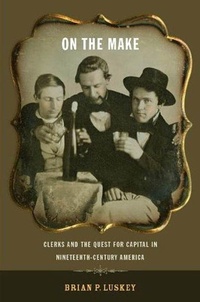
On the Make
Clerks and the Quest for Capital in Nineteenth-Century America
1st Edition
Published on 1. January 2010
277 pages
978-0-8147-5348-4 (ISBN)
Description

In the bustling cities of the mid-nineteenth-century Northeast, young male clerks working in commercial offices and stores were on the make, persistently seeking wealth, respect, and self-gratification. Yet these strivers and "counter jumpers" discovered that claiming the identities of independent men-while making sense of a volatile capitalist economy and fluid urban society-was fraught with uncertainty.
In On the Make, Brian P. Luskey illuminates at once the power of the ideology of self-making and the important contests over the meanings of respectability, manhood, and citizenship that helped to determine who clerks were and who they would become. Drawing from a rich array of archival materials, including clerks' diaries, newspapers, credit reports, census data, advice literature, and fiction, Luskey argues that a better understanding of clerks and clerking helps make sense of the culture of capitalism and the society it shaped in this pivotal era.
In On the Make, Brian P. Luskey illuminates at once the power of the ideology of self-making and the important contests over the meanings of respectability, manhood, and citizenship that helped to determine who clerks were and who they would become. Drawing from a rich array of archival materials, including clerks' diaries, newspapers, credit reports, census data, advice literature, and fiction, Luskey argues that a better understanding of clerks and clerking helps make sense of the culture of capitalism and the society it shaped in this pivotal era.
Reviews / Votes
"On the Make is essential reading not only for the history of clerks, but as well for the history of manhood, urban life, and class development in antebellum America." - Sharon Ann Murphy (The Historian) "In this fascinating portrait of American striving, Luskey locates the origins of white-collar culture in the precarious world of the antebellum clerk. Luskeys clerks are the forerunners of the men in the gray flannel suits, the ancestors of todays corporate managers, and his examination of their search for success in the uncertain markets of the nineteenth century expands our understanding of how the middle-class was made. Broadly interdisciplinary in scope and eloquent in the telling, On the Make is a valuable addition to the growing list of books that illuminate the cultural and social history of American business." - Timothy B. Spears,author of Chicago Dreaming "More clearly than any previous scholar, Luskey has answered the question & What, exactly, was a clerk? Forced to do a wide variety of manual labor, they wore white collars, but in Luskeys clever turn of phrase, the collars often werent all that white. Nor were all clerks created equal. As both clerks and their employers were well aware, many had limited opportunities for upward mobility. This is not just first rate social history that makes an important contribution to our understanding of the consolidation of class in the nineteenth century, but also first rate cultural history that skillfully teases out the ambiguities of the clerks place in nineteenth-century popular culture." - Amy Greenberg,author of Manifest Manhood and the Antebellum American EmpireMore details
Series
Language
English
Place of publication
New York
United States
Target group
Professional and scholarly
File size
1,95 MB
ISBN-13
978-0-8147-5348-4 (9780814753484)
Copyright in bibliographic data and cover images is held by Nielsen Book Services Limited or by the publishers or by their respective licensors: all rights reserved.
Schweitzer Classification
Other editions
Additional editions
Book
12/2011
New York University Press
€39.50
Shipment within 15-20 days
Book
01/2010
New York University Press
€83.99
Shipment within 15-20 days
Person
Brian P. Luskey is Assistant Professor of History at West Virginia University.
Content
- Intro
- Contents
- Acknowledgments
- Introduction: Puzzled about Identity
- 1 What Is My Prospects?
- 2 The Humble Laborer in the White Collar
- 3 Homo Counter-Jumperii
- 4 Striving for Citizenship
- 5 The Republic of Broadcloth
- 6 The Swedish Nightingale and the Peeping Tom
- Conclusion: Once More, Free
- Notes
- Index
- A
- B
- C
- D
- E
- F
- G
- H
- I
- J
- K
- L
- M
- N
- O
- P
- R
- S
- T
- V
- W
- Y
- Z
- About the Author
