

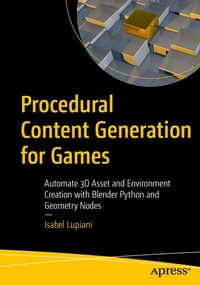
Procedural Content Generation for Games
Description

Learn to procedurally generate 3D content for your next game or simulation using the Blender Python API and geometry nodes. Automate parts of your asset creation pipeline while producing a starter library of environments, weapons, and other objects ready to use in your next Unreal project.
You will start by getting comfortable with generating geometry in Blender Python by automating hand modeling basics, like blocking out weapon meshes by combining primitives and manipulating them with your favorite operators and modifiers. After that you'll take a deep dive in geometry nodes and tackle projects such as adding Voronoi cracks and creating sliceform versions of any mesh. Building on your Blender Python skills, you'll progress to fractal methods for generating realistic terrain, followed by grammar-based approaches such as L-systems for producing lifelike plants. Prefer environments based on real-world locations? Find out how to generate 3D contents based on GIS data, such as city skylines from building footprints, and 3D terrain from Digital Elevation Models (DEM). Along the way, you will also learn techniques for incorporating parametric modeling into your procedural system to optionally control chosen aspects of the generation process, to ensure that only meaningful variations coherent with the overall design are produced.
Whether you are looking to generate stylized content that aligns with your artistic vision, or realistic environments true to their real-world counterparts, this book will add a variety of practical (and fun) techniques to your procedural generation arsenal.
What You Will Learn
? Automate 3D modeling steps traditionally done by hand with the Blender Python API and geometry nodes
? Access Blender features such as nodes, modifiers, and operators from scripts
? Programmatically generate stylized as well as realistic game assets and environments
? Combine parametric modeling with procedural generation to control chosen aspects of the creative process and influence the types of variations in the output
Who Is This Book For
This book is for software developers who want to procedurally generate 3D assets and environments for their game or simulation project. Readers with high-level understanding of the 3D content pipeline and either already using Blender or are interested in learning the basics on their own would benefit from the book. In addition, the ideal readers will already know some Python basics or are motivated to pick them up along the way from resources outside the book.
More details
Other editions
Additional editions
Person
Isabel Lupiani is a software engineer by day and maker by night, who enjoys handcrafting 3D models as much as procedurally generating them. She received her MS in Computer Science from Georgia Tech and has worked at several game studios in the past as an AI engineer for PC/Xbox games. Her book credits include Blender Scripting with Python: Automate Tasks, Write Helper Tools, and Procedurally Generate Models in Blender 4 . Isabel most recently worked as a Lead AI Engineer in the simulation industry.
Content
Chapter 1: Overview of Procedural Content Generation Methods.- Chapter 2: Blender Python Game Weapon Generator: Part 1.- Chapter 3: Blender Python Game Weapon Generator: Part 2.- Chapter 4: Generating Materials with Geometry Nodes, Python, and Shader Nodes.- Chapter 5: Editing and Generating Meshes with Geometry Nodes.- Chapter 6: Fractal Terrain Generation.- Chapter 7: L-Systems for Plant Generation.- Chapter 8: GIS Based Generation Part 1 - Skylines from Building Footprints.- Chapter 9: GIS Based Generation Part 2 - Terrain from Digital Elevation Models (DEM).- Chapter 10: Import Generated Geometry Into Unreal.
