

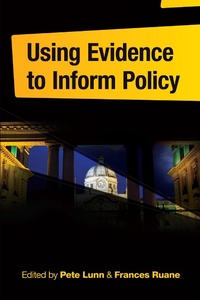
Using Evidence to Inform Policy
Description

Using Evidence to Inform Policy is a unique examination of how evidence can be used to improve policymaking, especially in challenging economic times.
There is a need for transparency in government and policy decisions. Research and evidence can help to provide this transparency, and Using Evidence to Inform Policy outlines how. However, the book also demonstrates the complexity of the relationship between evidence and policy, arguing that in most cases good policy cannot be determined by evidence alone.
Using Evidence to Inform Policy demonstrates the breadth and value of the contribution that evidence can make to policy. It presents eleven studies drawn from recent Economic and Social Research Institute (ESRI) research projects, illustrating different aspects of the relationship between evidence and policy, and how these vary by policy area. Using examples, the book demonstrates how national and international research can be used to good effect in policymaking.
The theme of how evidence can influence policy is examined with reference to Ireland and the international experience and in a wide range of areas, including the economy, public infrastructure, innovation, competition, the labour market, financial regulation, healthcare, housing, education, government spending, public services and earnings.
Each chapter tackles a question that's relevant to policymaking now, for example, how to protect consumers of financial services; what is the public's perception of public services and their implications for public sector reform?; how to explain changes in earnings and labour costs during the recession; what is the evidence for providing economic security through competition and regulatory policy?; do active labour market policies activate?; how to boost innovation and productivity in enterprises.
The book is relevant to all those taking courses in economics, sociology, political science, governance, social policy and Irish Studies at postgraduate and undergraduate level, as well as civil servants, politicians, policymakers, researchers and analysts in the public sector.
More details
Other editions
Additional editions
Persons
Content
- Cover
- Title Page
- Contents
- Preface
- Dedication
- 1. When and How Can Evidence Inform Policy? Pete Lunn, Frances Ruane
- 2. Using Evidence to Improve Evaluation Methods for Public Infrastructure Edgar Morgenroth
- 3. Should Loan-to-Value Ratios be Limited? The International Evidence David Duffy
- 4. The Potential Role of Pay-for-Performance in Irish Healthcare: Lessons from the International Evidence Anne Nolan, Jacqueline O'Reilly, Samantha Smith, Aoife Brick
- 5. Learning from the Evidence: Using Educational Research to Inform Policy Emer Smyth, Selina McCoy
- 6. Boosting Innovation and Productivity in Enterprises: What Matters? What Works? Frances Ruane, Iulia Siedschlag
- 7. Do Active Labour Market Policies Activate? Elish Kelly, Seamus McGuinness, Philip J. O'Connell
- 8. Providing Economic Security Through Competition and Regulatory Policy: What Is the Evidence? Paul K. Gorecki
- 9. Protecting Consumers of Financial Services Pete Lunn
- 10. Fiscal Consolidation Strategies: Evidence from the International Experience Eddie Casey, Joseph Durkan, David Duffy
- 11. Evidence on the Pattern of Earnings and Labour Costs Over the Recession Adele Bergin, Elish Kelly, Seamus McGuinness
- 12. Quality of Public Services: Irish Public Perceptions and Implications for Public Service Reform Dorothy Watson
- 13. Increasing the Contribution of Evidence to Policy Frances Ruane, Pete Lunn
- Acknowledgements
- Notes
- Copyright
- About the Editors
- About Gill & Macmillan
