

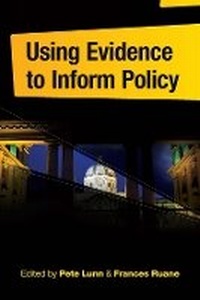
Using Evidence to Inform Policy
Published on 6. September 2013
Book
Paperback/Softback
288 pages
978-0-7171-5972-7 (ISBN)
Description
This unique new book systematically explores and demonstrates the potential breadth and value of the contribution that evidence can make to policy, while also highlighting its limitations.
* Provides a comprehensive insight into the complex relationship between evidence and policy, arguing that policy should be informed by evidence as far as resources and systems permit, but that policy can rarely be solely based on evidence.
* Aims to contribute to a more mutually constructive relationship between researchers and policymakers, by advancing the understanding of how and when evidence can inform policy.
* Using informative examples, it demonstrates how national and international research can be used to good effect, while clearly identifying the range of methodologies that are relevant to different areas of policy.
* Presenting eleven studies drawn from recent ESRI research projects, available on www.esri.ie/research, it illustrates different aspects of the relationship between evidence and policy, and how these vary by policy area.
Written for:
* Courses in economics, sociology, political science, governance and social policy, at postgraduate and undergraduate level
* Civil servants, politicians, policymakers, researchers and analysts in the public sector, who are looking to understand how to improve the use of evidence in the design of public policy.
* Provides a comprehensive insight into the complex relationship between evidence and policy, arguing that policy should be informed by evidence as far as resources and systems permit, but that policy can rarely be solely based on evidence.
* Aims to contribute to a more mutually constructive relationship between researchers and policymakers, by advancing the understanding of how and when evidence can inform policy.
* Using informative examples, it demonstrates how national and international research can be used to good effect, while clearly identifying the range of methodologies that are relevant to different areas of policy.
* Presenting eleven studies drawn from recent ESRI research projects, available on www.esri.ie/research, it illustrates different aspects of the relationship between evidence and policy, and how these vary by policy area.
Written for:
* Courses in economics, sociology, political science, governance and social policy, at postgraduate and undergraduate level
* Civil servants, politicians, policymakers, researchers and analysts in the public sector, who are looking to understand how to improve the use of evidence in the design of public policy.
More details
Language
English
Place of publication
Dublin
Ireland
Publishing group
Gill
Target group
College/higher education
Professional and scholarly
Dimensions
Height: 234 mm
Width: 156 mm
Thickness: 16 mm
Weight
459 gr
ISBN-13
978-0-7171-5972-7 (9780717159727)
Copyright in bibliographic data and cover images is held by Nielsen Book Services Limited or by the publishers or by their respective licensors: all rights reserved.
Schweitzer Classification
Other editions
Additional editions
Pete Lunn | Frances Ruane
Using Evidence to Inform Policy
E-Book
09/2013
Gill Books
€29.99
Available for download
Persons
Dr Pete Lunn is a behavioural economist, author and former BBC journalist, who joined the ESRI in 2006. He has produced over 30 peer-reviewed publications for policymakers in a range of government departments and state agencies, as well as contributing directly to the policymaking process in a number of areas. He has also written for numerous national newspapers and magazines, including The Irish Times, Irish Independent, New Scientist and Prospect.
Prof. Frances Ruane, Director of the ESRI, has previously lectured in the Department of Economics in Trinity College Dublin, where she also held the posts of Director of the Policy Institute and Director of the MSc programme in Economic Policy Studies. Her work in the IDA, the Central Bank of Ireland, on numerous boards and governmental advisory committees/groups contributes to her experience of the Irish policy process. She has written extensively on Irish policy issues, most recently on the issue of evidence for policy.
Prof. Frances Ruane, Director of the ESRI, has previously lectured in the Department of Economics in Trinity College Dublin, where she also held the posts of Director of the Policy Institute and Director of the MSc programme in Economic Policy Studies. Her work in the IDA, the Central Bank of Ireland, on numerous boards and governmental advisory committees/groups contributes to her experience of the Irish policy process. She has written extensively on Irish policy issues, most recently on the issue of evidence for policy.
Content
1: When and How Can Evidence Inform Policy?
2: Using Evidence to Improve Evaluation Methods for Public Infrastructure
3: Should Loan-to-Value Ratios be Limited? The International Evidence
4: The Potential Role of Pay-for-Performance in Irish Healthcare: Lessons From International Evidence
5: Learning From the Evidence: Using Educational Research
6: Boosting Innovation and Productivity in Enterprises: What Matters? What Works?
7. Do Active Labour Market Policies Activate?
8: Providing Economic Security Through Competition and Regulatory Policy: What Is the Evidence?
9: Protecting Consumers of Financial Services
10: Fiscal Consolidation Strategies: Evidence from the International Experience
11: Evidence on the Pattern of Earnings and Labour Costs Over the Recession
12: Quality of Public Services: Irish Public Perceptions and Implications for Public Service Reform
13: Increasing the Contribution of Evidence to Policy
2: Using Evidence to Improve Evaluation Methods for Public Infrastructure
3: Should Loan-to-Value Ratios be Limited? The International Evidence
4: The Potential Role of Pay-for-Performance in Irish Healthcare: Lessons From International Evidence
5: Learning From the Evidence: Using Educational Research
6: Boosting Innovation and Productivity in Enterprises: What Matters? What Works?
7. Do Active Labour Market Policies Activate?
8: Providing Economic Security Through Competition and Regulatory Policy: What Is the Evidence?
9: Protecting Consumers of Financial Services
10: Fiscal Consolidation Strategies: Evidence from the International Experience
11: Evidence on the Pattern of Earnings and Labour Costs Over the Recession
12: Quality of Public Services: Irish Public Perceptions and Implications for Public Service Reform
13: Increasing the Contribution of Evidence to Policy