

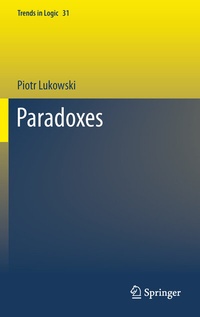
Paradoxes
Description

This book, provides a critical approach to all major logical paradoxes: from ancient to contemporary ones. There are four key aims of the book: 1. Providing systematic and historical survey of different approaches - solutions of the most prominent paradoxes discussed in the logical and philosophical literature. 2. Introducing original solutions of major paradoxes like: Liar paradox, Protagoras paradox, an unexpected examination paradox, stone paradox, crocodile, Newcomb paradox. 3. Explaining the far-reaching significance of paradoxes of vagueness and change for philosophy and ontology. 4. Proposing a novel, well justified and, as it seems, natural classification of paradoxes.
Reviews / Votes
From the reviews:
"Piotr Lukowski's Paradoxes is an abridged, revised and translated version of a book written in Polish . . As a source of paradoxes and arguments related to them, the book is highly valuable. . Lukowski often develops his analyses carefully. In his book he not only gathers the paradoxes . but also presents a rather unified and interesting view on them. It is definitely a good read." (Rafal Urbaniak, Studia Logica, Vol. 101, 2013)More details
Other editions
Additional editions
Persons
Piotr Lukowski is the Head of the Department of Cognitive Science at the Institute of Psychology, University of Lodz. He was visiting scholar in the Imperial College of London (1993), at the University of Warwick in Coventry (1993), Japan Advanced Institute of Science and Technology (JAIST) (1995-97, Japan), Université de Nantes (1998-1999, France). In 1993-94 and between 1998 and 2007, Piotr Lukowski was the editor of the journal ''Bulletin of the Section of Logic''.
Content
Preface.- Introduction.- 1. Sophisms and paralogisms (paradoxes of: horses, Newcomb, Fitch).- 2. Wrong intuition's paradoxes (paradoxes of: common birthday, approximation, Stevenson's bottle, Hempel, infinity).- 3. Paradoxes coming from ambiguity (paradoxes of Protagoras, Elektra, horn-headed man, the club without a name, God's omnipotence, stone) .- 4. Paradoxes of self-reference (Möbius ribbon (band), Klein's bottle, liar paradox, Buridan, barber, Richard, Berry, Grelling and Nelson, unexpected examination, crocodile).- 5. Ontological paradoxes.- 6. Epilogue.- Bibliography.- Subject index.- Name index.
