

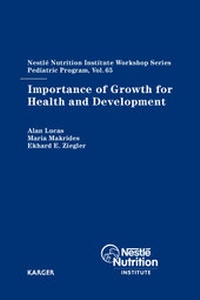
Importance of Growth for Health and Development
65th Nestlé Nutrition Institute Workshop, Pediatric Program, Kuala Lumpur, March 2009.
1st Edition
Published on 11. February 2010
252 pages
978-3-8055-9305-2 (ISBN)
Available for download
Description

Growth is universally used by health care professionals and caregivers to judge the physical condition of babies and children: poor growth in early life has a negative impact on cognitive development and morbidity, whereas rapid and excessive growth is associated with a higher prevalence of obesity and cardiovascular disease. This publication explores in some detail the relationship between early growth patterns and later neurodevelopment, obesity, cardiovascular outcomes and longevity in both industrialized and semi-industrialized societies. It consists of three parts that each deals with a specific topic: The first part focuses on the connection between early growth and obesity and cardiovascular outcomes. The next section concentrates on the interrelationship between growth and neurological development, and the last part is dedicated to the control and assessment of physical growth. Bringing together the expert opinions of outstanding clinicians and scientists, this book will be of particular value for pediatricians, public health scientists and epidemiologists.
More details
Other editions
Additional editions
A. Lucas | M. Makrides | E.E. Ziegler
Importance of Growth for Health and Development
65th Nestlé Nutrition Institute Workshop, Pediatric Program, Kuala Lumpur, March 2009.
Book
02/2010
1st Edition
S. Karger
€227.90
Article exhausted; check different version
Content
1 - Cover [Seite 1]
2 - Contents [Seite 5]
3 - Preface [Seite 7]
4 - Foreword [Seite 9]
5 - Contributors [Seite 11]
6 - Introduction [Seite 15]
6.1 - Growth and Later Health: A General Perspective [Seite 15]
6.1.1 - Abstract [Seite 15]
6.1.2 - Programming [Seite 16]
6.1.3 - Programming of Obesity and Risk of Cardiovascular Disease [Seite 16]
6.1.4 - Early Growth and the Brain [Seite 18]
6.1.5 - Windows for Programming by Early Growth [Seite 21]
6.1.6 - Mechanisms for Programming Effects [Seite 22]
6.1.7 - Future Perspectives [Seite 22]
6.1.8 - References [Seite 22]
6.1.9 - Discussion [Seite 23]
7 - 13Growth, Obesity and CV Outcomes [Seite 27]
7.1 - Early Infancy as a Critical Period for Development of Obesity and Related Conditions [Seite 27]
7.1.1 - Abstract [Seite 27]
7.1.2 - Acknowledgements [Seite 33]
7.1.3 - References [Seite 33]
7.1.4 - Discussion [Seite 34]
7.1.5 - References [Seite 37]
7.2 - Leptin, Nutrition, and the Programming of Hypothalamic Feeding Circuits [Seite 39]
7.2.1 - Abstract [Seite 39]
7.2.2 - Introduction [Seite 39]
7.2.3 - Importance of the Hypothalamus in Regulating Feeding and Energy Balance [Seite 40]
7.2.4 - Development of Hypothalamic Feeding Circuits [Seite 41]
7.2.5 - Factors Influencing Hypothalamic Development [Seite 42]
7.2.6 - Conclusions [Seite 47]
7.2.7 - Acknowledgments [Seite 47]
7.2.8 - References [Seite 48]
7.2.9 - Discussion [Seite 49]
7.2.10 - References [Seite 52]
7.3 - Early Growth and Ageing [Seite 55]
7.3.1 - Abstract [Seite 55]
7.3.2 - Introduction [Seite 55]
7.3.3 - Epidemiological Data [Seite 56]
7.3.4 - Thrifty Phenotype Hypothesis [Seite 56]
7.3.5 - Accelerated Early Postnatal Growth [Seite 56]
7.3.6 - Animal Models [Seite 57]
7.3.7 - Global Caloric Restriction [Seite 57]
7.3.8 - Intrauterine Artery Ligation [Seite 58]
7.3.9 - Hypoxic Model [Seite 58]
7.3.10 - Maternal Iron Restriction [Seite 58]
7.3.11 - Glucocorticoid Overexposure [Seite 58]
7.3.12 - Maternal Protein Restriction [Seite 59]
7.3.13 - Mechanisms Linking Early Growth and Ageing [Seite 60]
7.3.14 - Conclusion [Seite 62]
7.3.15 - References [Seite 63]
7.3.16 - Discussion [Seite 64]
7.3.17 - References [Seite 67]
7.4 - Does Early Growth Affect Long-Term Risk Factors for Cardiovascular Disease? [Seite 69]
7.4.1 - Abstract [Seite 69]
7.4.2 - Introduction [Seite 69]
7.4.3 - Evidence from Animal Models [Seite 70]
7.4.4 - Evidence from Humans [Seite 70]
7.4.5 - Mechanisms [Seite 75]
7.4.6 - Public Health Implications [Seite 76]
7.4.7 - Conclusions [Seite 76]
7.4.8 - References [Seite 77]
7.4.9 - Discussion [Seite 78]
7.4.10 - References [Seite 83]
7.5 - Developing World Perspective:The Importance of Growth for Short-Term Health [Seite 85]
7.5.1 - Abstract [Seite 85]
7.5.2 - Introduction [Seite 85]
7.5.3 - Why Is Poor Child Growth Related to Increased Morbidity and Mortality? [Seite 87]
7.5.4 - Extent of Malnutrition, Morbidity and Mortality in Developing Countries [Seite 88]
7.5.5 - Epidemiologic Evidence Relating Stunting and Wasting to Subsequent Morbidity and Mortality [Seite 88]
7.5.6 - Benefits of Catch-Up Growth [Seite 90]
7.5.7 - Conclusion: Future Research Needs for Evaluating the Tradeoffs [Seite 91]
7.5.8 - References [Seite 91]
7.5.9 - Discussion [Seite 93]
7.5.10 - References [Seite 97]
8 - Growth and Neurological Development [Seite 99]
8.1 - Postnatal Growth and Development in the Preterm and Small for Gestational Age Infant [Seite 99]
8.1.1 - Abstract [Seite 99]
8.1.2 - References [Seite 108]
8.1.3 - Discussion [Seite 110]
8.1.4 - References [Seite 112]
8.2 - Interrelationship between Growth and Development in Low and Middle Income Countries [Seite 113]
8.2.1 - Abstract [Seite 113]
8.2.2 - Introduction [Seite 113]
8.2.3 - Methods [Seite 114]
8.2.4 - LBW and Development [Seite 115]
8.2.5 - Postnatal Growth and Development [Seite 118]
8.2.6 - Control for Confounding in Studies of Growth and Development [Seite 126]
8.2.7 - Relative Importance of Prenatal vs. Postnatal Growth for Child Development Outcomes [Seite 127]
8.2.8 - Appropriate Analytic Approaches to Assess the Relative Importance of Growth across Periods [Seite 128]
8.2.9 - Review of Studies That Used Appropriate Methods for Assessingthe Relative Importance of Prenatal vs. Postnatal Growth onChild Development [Seite 128]
8.2.10 - Possible Mechanisms Liking Growth Retardation and Poor Development [Seite 129]
8.2.11 - Conclusions [Seite 130]
8.2.12 - References [Seite 130]
8.2.13 - Discussion [Seite 132]
8.2.14 - References [Seite 134]
8.3 - Role of Long-Chain Polyunsaturated Fatty Acids in Neurodevelopmentand Growth [Seite 137]
8.3.1 - Abstract [Seite 137]
8.3.2 - Type of LCPUFA Supplementation [Seite 138]
8.3.3 - When to Supplement with LCPUFA [Seite 142]
8.3.4 - Dose of LCPUFA [Seite 143]
8.3.5 - How Does DHA Work and Does This Relate to DHA Dose? [Seite 144]
8.3.6 - References [Seite 145]
8.3.7 - Discussion [Seite 147]
8.3.8 - References [Seite 150]
8.4 - Growth and Development of the Brainand Impact on Cognitive Outcomes [Seite 151]
8.4.1 - Abstract [Seite 151]
8.4.2 - Brain Development and Growth Visualized by Magnetic Resonance Imaging [Seite 152]
8.4.3 - Microstructural Brain Development by DTI [Seite 155]
8.4.4 - Developing WM Connectivity [Seite 156]
8.4.5 - Imaging and Neurodevelopmental Disorders [Seite 158]
8.4.6 - References [Seite 161]
8.4.7 - Discussion [Seite 163]
8.4.8 - Reference [Seite 165]
8.5 - Benefits and Harms of IronSupplementation in Iron-Deficientand Iron-Sufficient Children [Seite 167]
8.5.1 - Abstract [Seite 167]
8.5.2 - Introduction [Seite 167]
8.5.3 - Anemia [Seite 168]
8.5.4 - Brain Development [Seite 169]
8.5.5 - Growth [Seite 170]
8.5.6 - Infections [Seite 171]
8.5.7 - Interactions with Other Minerals [Seite 172]
8.5.8 - Mode of Administration [Seite 174]
8.5.9 - Conclusions [Seite 174]
8.5.10 - References [Seite 175]
8.5.11 - Discussion [Seite 176]
8.5.12 - References [Seite 179]
9 - Physical Growth and Body Composition [Seite 181]
9.1 - Effects of Selective Dropout on Infant Growth Standards [Seite 181]
9.1.1 - Abstract [Seite 181]
9.1.2 - Introduction [Seite 181]
9.1.3 - Data [Seite 183]
9.1.4 - Statistical Methods [Seite 183]
9.1.5 - Results [Seite 184]
9.1.6 - Discussion [Seite 185]
9.1.7 - Acknowledgements [Seite 188]
9.1.8 - References [Seite 188]
9.1.9 - Discussion [Seite 189]
9.1.10 - References [Seite 193]
9.2 - The 2000 Centers for Disease Controland Prevention Growth Charts: Several Insights after 8 Years [Seite 195]
9.2.1 - Abstract [Seite 195]
9.2.2 - Development of the 2000 CDC Growth Charts [Seite 196]
9.2.3 - Infant Charts and Data between Birth and 3 Months [Seite 198]
9.2.4 - BMI and Extreme Percentiles [Seite 204]
9.2.5 - Conclusion [Seite 205]
9.2.6 - References [Seite 206]
9.2.7 - Discussion [Seite 207]
9.2.8 - References [Seite 209]
9.3 - Growth Charts Compared [Seite 211]
9.3.1 - Abstract [Seite 211]
9.3.2 - Methods [Seite 212]
9.3.3 - Results [Seite 213]
9.3.4 - Discussion [Seite 220]
9.3.5 - References [Seite 223]
9.3.6 - Discussion [Seite 224]
9.3.7 - References [Seite 226]
9.4 - Body Composition in Infancy: Impacton Health Later in Life [Seite 227]
9.4.1 - Abstract [Seite 227]
9.4.2 - Introduction [Seite 227]
9.4.3 - Body Composition Methods and Models [Seite 228]
9.4.4 - Body Composition during Early Infancy [Seite 231]
9.4.5 - References [Seite 234]
9.4.6 - Discussion [Seite 235]
9.4.7 - References [Seite 238]
9.5 - Endocrinology of Growth [Seite 239]
9.5.1 - Abstract [Seite 239]
9.5.2 - Why Do Animals Grow? [Seite 239]
9.5.3 - What Causes Animals to Grow? [Seite 241]
9.5.4 - IGF Structure [Seite 241]
9.5.5 - Targeted Disruption of the IGF Genes [Seite 242]
9.5.6 - GH Receptor [Seite 244]
9.5.7 - IGF Deficiency [Seite 245]
9.5.8 - Therapeutic Implications [Seite 246]
9.5.9 - References [Seite 247]
9.5.10 - Discussion [Seite 248]
9.6 - Concluding Remarks [Seite 253]
10 - Subject Index [Seite 261]
2 - Contents [Seite 5]
3 - Preface [Seite 7]
4 - Foreword [Seite 9]
5 - Contributors [Seite 11]
6 - Introduction [Seite 15]
6.1 - Growth and Later Health: A General Perspective [Seite 15]
6.1.1 - Abstract [Seite 15]
6.1.2 - Programming [Seite 16]
6.1.3 - Programming of Obesity and Risk of Cardiovascular Disease [Seite 16]
6.1.4 - Early Growth and the Brain [Seite 18]
6.1.5 - Windows for Programming by Early Growth [Seite 21]
6.1.6 - Mechanisms for Programming Effects [Seite 22]
6.1.7 - Future Perspectives [Seite 22]
6.1.8 - References [Seite 22]
6.1.9 - Discussion [Seite 23]
7 - 13Growth, Obesity and CV Outcomes [Seite 27]
7.1 - Early Infancy as a Critical Period for Development of Obesity and Related Conditions [Seite 27]
7.1.1 - Abstract [Seite 27]
7.1.2 - Acknowledgements [Seite 33]
7.1.3 - References [Seite 33]
7.1.4 - Discussion [Seite 34]
7.1.5 - References [Seite 37]
7.2 - Leptin, Nutrition, and the Programming of Hypothalamic Feeding Circuits [Seite 39]
7.2.1 - Abstract [Seite 39]
7.2.2 - Introduction [Seite 39]
7.2.3 - Importance of the Hypothalamus in Regulating Feeding and Energy Balance [Seite 40]
7.2.4 - Development of Hypothalamic Feeding Circuits [Seite 41]
7.2.5 - Factors Influencing Hypothalamic Development [Seite 42]
7.2.6 - Conclusions [Seite 47]
7.2.7 - Acknowledgments [Seite 47]
7.2.8 - References [Seite 48]
7.2.9 - Discussion [Seite 49]
7.2.10 - References [Seite 52]
7.3 - Early Growth and Ageing [Seite 55]
7.3.1 - Abstract [Seite 55]
7.3.2 - Introduction [Seite 55]
7.3.3 - Epidemiological Data [Seite 56]
7.3.4 - Thrifty Phenotype Hypothesis [Seite 56]
7.3.5 - Accelerated Early Postnatal Growth [Seite 56]
7.3.6 - Animal Models [Seite 57]
7.3.7 - Global Caloric Restriction [Seite 57]
7.3.8 - Intrauterine Artery Ligation [Seite 58]
7.3.9 - Hypoxic Model [Seite 58]
7.3.10 - Maternal Iron Restriction [Seite 58]
7.3.11 - Glucocorticoid Overexposure [Seite 58]
7.3.12 - Maternal Protein Restriction [Seite 59]
7.3.13 - Mechanisms Linking Early Growth and Ageing [Seite 60]
7.3.14 - Conclusion [Seite 62]
7.3.15 - References [Seite 63]
7.3.16 - Discussion [Seite 64]
7.3.17 - References [Seite 67]
7.4 - Does Early Growth Affect Long-Term Risk Factors for Cardiovascular Disease? [Seite 69]
7.4.1 - Abstract [Seite 69]
7.4.2 - Introduction [Seite 69]
7.4.3 - Evidence from Animal Models [Seite 70]
7.4.4 - Evidence from Humans [Seite 70]
7.4.5 - Mechanisms [Seite 75]
7.4.6 - Public Health Implications [Seite 76]
7.4.7 - Conclusions [Seite 76]
7.4.8 - References [Seite 77]
7.4.9 - Discussion [Seite 78]
7.4.10 - References [Seite 83]
7.5 - Developing World Perspective:The Importance of Growth for Short-Term Health [Seite 85]
7.5.1 - Abstract [Seite 85]
7.5.2 - Introduction [Seite 85]
7.5.3 - Why Is Poor Child Growth Related to Increased Morbidity and Mortality? [Seite 87]
7.5.4 - Extent of Malnutrition, Morbidity and Mortality in Developing Countries [Seite 88]
7.5.5 - Epidemiologic Evidence Relating Stunting and Wasting to Subsequent Morbidity and Mortality [Seite 88]
7.5.6 - Benefits of Catch-Up Growth [Seite 90]
7.5.7 - Conclusion: Future Research Needs for Evaluating the Tradeoffs [Seite 91]
7.5.8 - References [Seite 91]
7.5.9 - Discussion [Seite 93]
7.5.10 - References [Seite 97]
8 - Growth and Neurological Development [Seite 99]
8.1 - Postnatal Growth and Development in the Preterm and Small for Gestational Age Infant [Seite 99]
8.1.1 - Abstract [Seite 99]
8.1.2 - References [Seite 108]
8.1.3 - Discussion [Seite 110]
8.1.4 - References [Seite 112]
8.2 - Interrelationship between Growth and Development in Low and Middle Income Countries [Seite 113]
8.2.1 - Abstract [Seite 113]
8.2.2 - Introduction [Seite 113]
8.2.3 - Methods [Seite 114]
8.2.4 - LBW and Development [Seite 115]
8.2.5 - Postnatal Growth and Development [Seite 118]
8.2.6 - Control for Confounding in Studies of Growth and Development [Seite 126]
8.2.7 - Relative Importance of Prenatal vs. Postnatal Growth for Child Development Outcomes [Seite 127]
8.2.8 - Appropriate Analytic Approaches to Assess the Relative Importance of Growth across Periods [Seite 128]
8.2.9 - Review of Studies That Used Appropriate Methods for Assessingthe Relative Importance of Prenatal vs. Postnatal Growth onChild Development [Seite 128]
8.2.10 - Possible Mechanisms Liking Growth Retardation and Poor Development [Seite 129]
8.2.11 - Conclusions [Seite 130]
8.2.12 - References [Seite 130]
8.2.13 - Discussion [Seite 132]
8.2.14 - References [Seite 134]
8.3 - Role of Long-Chain Polyunsaturated Fatty Acids in Neurodevelopmentand Growth [Seite 137]
8.3.1 - Abstract [Seite 137]
8.3.2 - Type of LCPUFA Supplementation [Seite 138]
8.3.3 - When to Supplement with LCPUFA [Seite 142]
8.3.4 - Dose of LCPUFA [Seite 143]
8.3.5 - How Does DHA Work and Does This Relate to DHA Dose? [Seite 144]
8.3.6 - References [Seite 145]
8.3.7 - Discussion [Seite 147]
8.3.8 - References [Seite 150]
8.4 - Growth and Development of the Brainand Impact on Cognitive Outcomes [Seite 151]
8.4.1 - Abstract [Seite 151]
8.4.2 - Brain Development and Growth Visualized by Magnetic Resonance Imaging [Seite 152]
8.4.3 - Microstructural Brain Development by DTI [Seite 155]
8.4.4 - Developing WM Connectivity [Seite 156]
8.4.5 - Imaging and Neurodevelopmental Disorders [Seite 158]
8.4.6 - References [Seite 161]
8.4.7 - Discussion [Seite 163]
8.4.8 - Reference [Seite 165]
8.5 - Benefits and Harms of IronSupplementation in Iron-Deficientand Iron-Sufficient Children [Seite 167]
8.5.1 - Abstract [Seite 167]
8.5.2 - Introduction [Seite 167]
8.5.3 - Anemia [Seite 168]
8.5.4 - Brain Development [Seite 169]
8.5.5 - Growth [Seite 170]
8.5.6 - Infections [Seite 171]
8.5.7 - Interactions with Other Minerals [Seite 172]
8.5.8 - Mode of Administration [Seite 174]
8.5.9 - Conclusions [Seite 174]
8.5.10 - References [Seite 175]
8.5.11 - Discussion [Seite 176]
8.5.12 - References [Seite 179]
9 - Physical Growth and Body Composition [Seite 181]
9.1 - Effects of Selective Dropout on Infant Growth Standards [Seite 181]
9.1.1 - Abstract [Seite 181]
9.1.2 - Introduction [Seite 181]
9.1.3 - Data [Seite 183]
9.1.4 - Statistical Methods [Seite 183]
9.1.5 - Results [Seite 184]
9.1.6 - Discussion [Seite 185]
9.1.7 - Acknowledgements [Seite 188]
9.1.8 - References [Seite 188]
9.1.9 - Discussion [Seite 189]
9.1.10 - References [Seite 193]
9.2 - The 2000 Centers for Disease Controland Prevention Growth Charts: Several Insights after 8 Years [Seite 195]
9.2.1 - Abstract [Seite 195]
9.2.2 - Development of the 2000 CDC Growth Charts [Seite 196]
9.2.3 - Infant Charts and Data between Birth and 3 Months [Seite 198]
9.2.4 - BMI and Extreme Percentiles [Seite 204]
9.2.5 - Conclusion [Seite 205]
9.2.6 - References [Seite 206]
9.2.7 - Discussion [Seite 207]
9.2.8 - References [Seite 209]
9.3 - Growth Charts Compared [Seite 211]
9.3.1 - Abstract [Seite 211]
9.3.2 - Methods [Seite 212]
9.3.3 - Results [Seite 213]
9.3.4 - Discussion [Seite 220]
9.3.5 - References [Seite 223]
9.3.6 - Discussion [Seite 224]
9.3.7 - References [Seite 226]
9.4 - Body Composition in Infancy: Impacton Health Later in Life [Seite 227]
9.4.1 - Abstract [Seite 227]
9.4.2 - Introduction [Seite 227]
9.4.3 - Body Composition Methods and Models [Seite 228]
9.4.4 - Body Composition during Early Infancy [Seite 231]
9.4.5 - References [Seite 234]
9.4.6 - Discussion [Seite 235]
9.4.7 - References [Seite 238]
9.5 - Endocrinology of Growth [Seite 239]
9.5.1 - Abstract [Seite 239]
9.5.2 - Why Do Animals Grow? [Seite 239]
9.5.3 - What Causes Animals to Grow? [Seite 241]
9.5.4 - IGF Structure [Seite 241]
9.5.5 - Targeted Disruption of the IGF Genes [Seite 242]
9.5.6 - GH Receptor [Seite 244]
9.5.7 - IGF Deficiency [Seite 245]
9.5.8 - Therapeutic Implications [Seite 246]
9.5.9 - References [Seite 247]
9.5.10 - Discussion [Seite 248]
9.6 - Concluding Remarks [Seite 253]
10 - Subject Index [Seite 261]

