

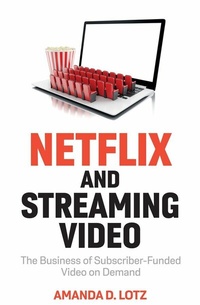
Netflix and Streaming Video
Description

Netflix and Streaming Video is the first book to provide a comprehensive foundation for understanding the business of subscriber-funded streaming video and its implications for the role of these services in culture. Drawing on Lotz’s two decades of research, it highlights the similarities and differences among streaming video services (Netflix; Amazon) and video distribution technologies (broadcast; satellite; internet).
Making a number of provocative and thought-provoking arguments, the book first reveals how the reliance on subscriber payment and video on demand produces different norms and strategies compared to previous video businesses. It then investigates Netflix and how its particular blend of characteristics distinguishes it from other subscriber-funded video on demand services. The author expertly shows that, by understanding the underlying economic and technological dynamics of these services (and their differences), it is possible to better assess the actions taken by the companies and what the future of video may encompass.
The book is a must-read for students and scholars of Media and Communications Studies, as well as those wishing to learn more about Netflix and streaming video services.
Amanda D. Lotz is a Professor in the Digital Media Research Centre at Queensland University of Technology.
More details
Other editions
Additional editions
Person
Content
Acknowledgements
List of Figures
Introduction
Section One: Subscriber-funded streaming services are different from linear services
1. Experience: On Schedules and Viewing Practices
2. Building Libraries: Conglomerating Niches and Beyond?
3. Subscriber Funding: On Success Metrics, Program Strategies, and Demographics
4. Licensing, Labour, Regulation, and Recommendation
5. Scale and Specialization
6. The Discrepant Field of Global Services
Section One Conclusion
Section Two: Netflix is not like other subscriber-funded streaming video services
7. Netflix Content Concepts and Vocabulary
8. Netflix Library Strategies
9. Netflix Content Strategies
10. Netflix's Approach to Being Global
Section Two Conclusion
Conclusion
Notes
Bibliography
Index
1
Experience: On Schedules and Viewing Practices
Almost all commentary about SVODs begins and ends with discussion of their content library and programmes. This focus misses a key way in which SVODs differ from linear services. I'm not suggesting that content is unimportant but, rather, asserting that experience strongly moderates the value proposition a service offers and distinguishes SVODs significantly from linear and AVOD alternatives. The role of experience in understanding the contemporary video ecosystem is something like: Content × Experience = Value Proposition.
It makes sense that experience has been overlooked. Experience has not been a factor in viewing practice in the past because it has been largely constant. Perhaps, with the exception of Raymond Williams's attention to 'flow' in Television: Technology and Cultural Form, we didn't think much about there being profoundly different experiences of television, because there weren't. In much of the world, for as long as most can remember, television shows were delivered according to a schedule. There were often regular commercial breaks, and new episodes of a show became available weekly - or daily - and so on. There is nothing natural about those norms; they are not inherent to 'television'. They simply emerged based on the opportunities and limitations of the first technologies capable of distributing video to the home and in response to the metrics of success that dictated their funding.
But experience matters now. We are increasingly familiar with talk of 'user experience' in relation to websites and apps, but SVOD experience is much more than interface ease of use.
First, there is the experiential gulf between linear and on demand. Neither is simply 'better' or 'worse'; rather, they are differently suited for different revenue models and programme features, and they encourage different cultural experiences. The variable amount of choice that linear and on-demand services offer leads to different decision-making processes and viewing behaviours: seeking particular content, perusing a particular library, or the more spontaneous simplicity of electing 'what's on'. We don't know much about how viewers regard any of these experiences. There is little research suggesting whether typical patterns exist among viewers, if there are particular typologies of behaviour, or whether there is considerable variation just at the individual level. There are complicated and intentional choices being made, even if they are made subconsciously.
Another aspect of experience that tends to align with the distinction of linear versus on demand is whether or not content is interrupted by commercials. Of course many publicly funded linear services don't have advertising, nor do purely subscriber-funded channels such as HBO (at least in the US), but most linear television has been dominated by ad-funding and the interruption of commercial messages. Hence another experiential difference involves whether the experience includes spending as much as a quarter of every hour occupied with advertisements or whether viewers are able to watch only the sought-after content - albeit at a monetary cost - using SVOD services.
In the case of video divided into segments - or what we have known as 'episodes' - another significant experiential dimension relates to the extent to which different types of services allow viewers access to those segments. There are notable experiential differences to being able to access only a recent episode, the current season, or all the episodes of a title. Notably, simply having full access to all the episodes does not require a viewer to watch them a particular way; it simply supplies the choice.
Next is a question of library stability. To what extent can a subscriber rely on favourite titles or those of interest to remain available? Library stability allows viewers to follow the whim of impulse with no need to worry about watching something before it is 'gone'. After these considerations, experience might be evaluated in terms of the ease of interface negotiation, recommendation, and search capabilities. And, finally, attributes such as the ease of starting the next episode, of easily restarting wherever viewing stopped, and perhaps of the service remembering the last point of viewing across multiple devices all enhance viewer experience.
Despite the attention given to different shows or intellectual property controlled by different companies, or to buzzy announcements of certain stars or creators aligning with particular services, it is possible to imagine that a high-quality experience trumps content. Or at least that experience contributes strongly to driving viewers between linear, AVOD, and SVOD contexts. Personally, I cannot tolerate commercials. I would rather not watch television or film than sit through content with commercials. I know such an extreme example is not normal, but it illustrates how experience can structure the universe of viewing choices. I will choose content I'd rate as B or B+ over A or A- if there are experience hurdles to the A content. (Though A+ content is worth the hurdles; to be clear, these 'grades' are based on my personal taste profile and not universal content ratings).
Experience can become a factor at many moments in the viewing process; this is often called 'friction' when people write about technology use. A telling illustration was how little Amazon Prime Video I watched until it became available on the Apple TV (the device I used to connect my television to the internet). I knew how to use Airplay to throw the content from my phone to the living room screen, but I rarely did it. The hassle of its burning through battery or that I wasn't able to be simultaneously on my phone made it too 'inconvenient' relative to my desire to watch the content available on Amazon. Then, one day, there was an Amazon Prime Video app at the top of the Apple TV menu, and we watched nothing but Amazon Prime Video for a few weeks.
Moving across the world from the US to Australia a few years ago required buying all new electronics and encountering a mostly new video ecosystem (except for Netflix and Amazon, though the libraries aren't precisely the same) and a whole new universe of shows. Everything was made strange, and this made differences in experience particularly clear. Sometimes I wanted to watch a series on ABC iView (Australia's publicly funded broadcaster's ad-free catch-up service), but the thought of negotiating its interface was 'too hard' (because I found it counter-intuitive, and I often struggled to find content I knew was available) when I could watch the next episode of Money Heist on Netflix with one click. Also, I knew that, once one episode was over, I'd be returned to the home screen to repeat the byzantine process of finding the show rather than be easily ushered to the next episode. Or I generally avoided the AVODs because I repeatedly had the experience of content freezing during commercials (so nothing happened for the first minute of a three-minute commercial block, making the disruption four minutes or longer), or of the freeze never ending, kicking me back to a home screen and forcing me to start the episode from the beginning (or fast forward to where I left off, but replaying every commercial break); in short, a horrible experience. I may be uncommonly impatient, but these anecdotes illustrate how experience factors into the current video ecosystem and the kinds of choices viewers make, mostly without recognizing they make them at all.
My viewing behaviour may not fit the norm, but it is difficult to know what is normal these days. For some viewers - in particular those who study and work in video industries - content might deserve the unbridled supremacy indicated by endless talk of shows and libraries as key to streaming service success. But the psychographic that writes about video industries isn't representative of the general population of viewers. Also difference in experience is difficult to quantify, and we lack necessary concepts and terminology - remember, we are still using 'binge viewing' to talk about everything that isn't watched on a linear schedule.1 There is much to say about SVOD content, but this discussion intentionally begins by putting experience on the table.
Too many discussions - especially those that compare SVODs with linear ad-supported channels - speak only of content and ignore the difference in experience. Such a frame neglects the variation in value proposition that derives from the distinctive revenue model, technological affordances, and business strategies of SVODs. People pay for SVODs because of the content, but also to access the experience. Not all SVODs offer an equivalent experience, and there is a universe of difference between AVOD catch-up services and SVODs, even though both are internet distributed. Experience might not be relevant to all questions and analysis, but it is crucial to many and far too rarely acknowledged.
Hegemony of linear norms
A key differentiation of SVODs from linear services is the availability of content on demand instead of on a schedule. This enables the experience of video content in a manner more akin to other...
