

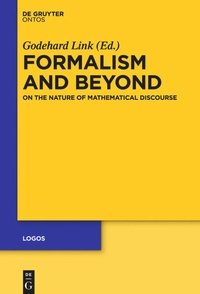
Formalism and Beyond
On the Nature of Mathematical Discourse
1st Edition
Published on 9. October 2014
X, 420 pages
978-1-61451-847-1 (ISBN)
Available for download
Description

The essays collected in this volume focus on the role of formalist aspects in mathematical theorizing and practice, examining issues such as infinity, finiteness, and proof procedures, as well as central historical figures in the field, including Frege, Russell, Hilbert and Wittgenstein. Using modern logico-philosophical tools and systematic conceptual and logical analyses, the volume provides a thorough, up-to-date account of the subject.
More details
Other editions
Additional editions
E-Book
10/2014
1st Edition
De Gruyter
€179.95
Available for download
Book
09/2014
1st Edition
De Gruyter
€179.95
Shipment within 3-4 weeks
Person
Godehard Link, Ludwig Maximilian University of Munich, Germany.
Content
- Intro
- Contents
- Preface
- Duality, Epistemic Efficiency & Consistency
- 1 Introduction
- 2 Abstract Duality or Dualization?
- 3 The Contentual Addition Model of Dualization
- 4 Proofs & Proof Developments
- 5 The Contentual Addition Model & The Traditional Contentualist View of Proof
- 6 Contentual Addition in an Abstract Setting
- 7 Non-Trivial Axiom Systems
- 8 Conclusion
- Frege on Quantities and Real Numbers in Consideration of the Theories of Cantor, Russell and Others
- 1 Introduction
- 2 The concept of quantity in Frege's writings between 1874 and 1884
- 3 Cantor's theory of irrational numbers and Frege's critique
- 4 Russell on quantities and real numbers in Principles of Mathematics and Principia Mathematica
- 5 Quantities and real numbers in Grundgesetze
- 6 Frege's plan carried out: von Kutschera's account
- Frege on Formality and the 1906 Independence-Test
- 1 Introduction
- 2 The Proposal
- 3 The Import of the 1910 Notes
- 4 The Anti-Metatheory Explanation
- 5 The Similarity with Hilbert
- 6 Conclusion
- Formal Discourse in Russell: From Metaphysics to Philosophical Logic
- 1 Introduction
- 2 Setting the Stage: Russell's Early Ontology
- 3 On the Nature of Functions
- 4 The Substitutional Theory
- 5 Principia Mathematica
- 6 Ramification: Gödel's Gestalt Switch
- 7 Lessons for Ontology
- 8 Conclusion
- On Live and Dead Signs in Mathematics
- 1 A Mess Concerning the Reference, Interpretation and Application
- 2 How can Intended Models be Singled Out?
- 3 Strings of Strokes in Hilbertian Finitism
- Generalization and the Impossible
- 1 "Contradictions are emotions": The example of the complex numbers
- 2 Russell on symbolism: Making the simple complicated
- 3 Ways into logic: Generalization and abstraction
- 4 Pure logic and meta-scientific induction
- 5 Scientistic liberalism and interesting generalizations
- Assumptions of Infinity
- 1 Introduction
- 2 "T makes an assumption of infinity", "T assumes merely the finite"
- 3 Expressing infinity: a preliminary suggestion
- 4 Axioms for and definitions of "finite"
- 5 Elaboration of (DIiii)
- 6 The potentially infinite
- 7 Conclusion
- 8 Appendix
- The Interpretation of Classes in Axiomatic Set Theory
- 1 Introduction
- 2 Set Theories
- 3 Interpreting Classes
- 4 Concluding Remarks
- Purity in Arithmetic: some Formal and Informal Issues
- 1 Introduction
- 2 Topical purity
- 3 The infinitude of primes
- 4 Incompleteness and the possibility of purity
- 5 Closing thoughts
- Domain Extensions and Higher-Order Syntactical Interpretations
- 1 Introductory remarks
- 2 Domain extensions: some paradigmatic examples
- 3 L-operations and L-constructions
- 4 Higher-order syntactical interpretations and their constructions
- 5 Concluding remarks
- Finite Methods in Mathematical Practice
- 1 Introduction
- 2 Hilbert's programme now and then
- 3 Finite methods for constructive algebra
- 4 Geometric formulas and dynamical proofs
- 5 Realising Hilbert's programme in commutative algebra
- 6 Appendix
- List of Contributors
- Name Index

