

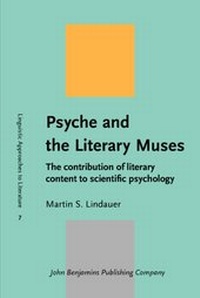
Psyche and the Literary Muses
The contribution of literary content to scientific psychology
1st Edition
Published on 11. June 2009
XIII, 209 pages
978-90-272-8945-2 (ISBN)
Description

Psyche and the Literary Muses focuses on the psychology of literature from an empirical point of view, rather than the more typical psychoanalytic position, and concentrates on literary content rather than readers or writers. The book centers on the author's quantitative studies of brief literary and quasi-literary forms, ranging from titles of short stories and names of literary characters to clichés and quotations from literary sources, in demonstrating their contribution to the topics of learning, perception, thinking, emotions, creativity, and especially person perception and aging. More broadly, Psyche bears on literary studies, art, and psychology in general, as well as interdisciplinarity. This book deepens the understanding and appreciation of literature for scholars, academics and the general reader.
More details
Other editions
Additional editions
Martin S. Lindauer
Psyche and the Literary Muses
The contribution of literary content to scientific psychology
Book
06/2009
John Benjamins Publishing Co
€104.94
Shipment within 10-15 days
Person
Content
- Psyche and the Literary Muses
- Editorial page
- Title page
- LCC data
- Dedication
- Table of contents
- Preface
- Part 1. Introduction
- 1. An orientation
- 2. Similarities and differences across the psychology of art
- Unique aspects of the psychology of art
- The role of the arts in psychology
- 3. Competing psychological approaches to the arts: Clinical and scientific
- An overview
- The clinical psychological approach to the arts
- Scientific psychology and the arts
- 4. The status of the scientific psychology of art
- Part 2. The psychology of literature: An overview
- 5. The psychology of literature: Comparisons with other psychologies of art
- Similarities between literature and the other arts
- The distinctive features of the psychology of literature
- Literary content is psychological
- The neglect of the psychological content of literature
- 6. A scientific psychology of literary content: Obstacles and steps towards a solution
- The many-sided objections to a scientific psychology of literary content
- Towards a solution: overcoming the obstacles to a scientific psychology of literary content
- The importance of the literary stimulus
- The virtues of brief literary materials
- Part 3. The psychological relevance of brief literary forms
- 7. Poetry, autobiographies, and titles: Their contribution to cognition, creativity, and physiognomic perception
- Poetry, the recognition of style, and concept learning
- Artists on creativity
- Titles of abstract paintings and short stories: Their expressive properties
- The titles of abstract art
- The titles of short stories
- 8. Literary names, indices, and clichés: Their contribution to physiognomic perception, emotions, and thinking
- Names in literature: Their physiognomic properties
- Studies of the positive and negative qualities of names
- Indices of literary content: Positive and negative emotions in literature
- Clichés: Cognitive and personal factors in their use
- The lessons learned
- 9. Quotations: Their psychological usefulness
- Quotations on quotations
- Quotations on literature
- A study of quotations: attitudes towards numbers
- Part 4. The psychological content of quotations: Person perception and attitudes to aging
- 10. Person perception and the psychological attributes of the body
- 11. A study of quotations on the psychological implications of the body
- 12. Prologue: Aging and the arts
- Paintings
- Literature
- Paintings and literature compared
- The next step
- 13. Aging's memorable lines: A study of quotations about growing old
- 14. The preoccupations of aging: The subject matter of quotations
- 15. Evaluations of aging in quotations
- The old compared to the young
- Old age as good or bad
- The physical-sensory aspects of aging
- The aged's mental abilities
- The aged's enjoyment of life
- Old women
- The aged's relationships with others
- Quotations with modest frequencies
- Evaluations of old age over time
- Old age: good or bad?
- The contribution of quotations to the study of aging
- Part 5. Conclusion
- 16. Implications of a content-oriented psychology of literature
- The focus on literary content
- Towards a perceptual emphasis
- A revitalized experimental aesthetics of literature
- Furthering interdisciplinary and other connections
- Evaluating the approach
- A personal word
- A final word
- Notes
- References cited
- Index
- The series Linguistic Approaches to Literature
