

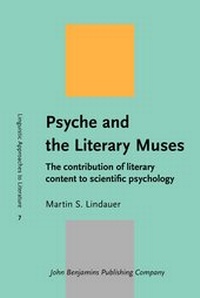
Psyche and the Literary Muses
The contribution of literary content to scientific psychology
Published on 11. June 2009
Book
Hardback
209 pages
978-90-272-3339-4 (ISBN)
Description
Psyche and the Literary Muses focuses on the psychology of literature from an empirical point of view, rather than the more typical psychoanalytic position, and concentrates on literary content rather than readers or writers. The book centers on the author's quantitative studies of brief literary and quasi-literary forms, ranging from titles of short stories and names of literary characters to cliches and quotations from literary sources, in demonstrating their contribution to the topics of learning, perception, thinking, emotions, creativity, and especially person perception and aging. More broadly, Psyche bears on literary studies, art, and psychology in general, as well as interdisciplinarity. This book deepens the understanding and appreciation of literature for scholars, academics and the general reader.
More details
Series
Language
English
Place of publication
Amsterdam
Netherlands
Target group
Professional and scholarly
Illustrations
+ index
Dimensions
Height: 245 mm
Width: 164 mm
Weight
555 gr
ISBN-13
978-90-272-3339-4 (9789027233394)
Copyright in bibliographic data and cover images is held by Nielsen Book Services Limited or by the publishers or by their respective licensors: all rights reserved.
Schweitzer Classification
Other editions
Additional editions
Martin S. Lindauer
Psyche and the Literary Muses
The contribution of literary content to scientific psychology
E-Book
06/2009
1st Edition
John Benjamins Publishing Company
€123.99
Available for download
Person
Content
1. List of tables; 2. Preface; 3. Part 1. Introduction; 4. 1. An orientation; 5. 2. Similarities and differences across the psychology of art; 6. 3. Competing psychological approaches to the arts: Clinical and scientific; 7. 4. The status of the scientific psychology of art; 8. Part 2. The psychology of literature: An overview; 9. 5. The psychology of literature: Comparisons with other psychologies of art; 10. 6. A scientific psychology of literary content: Obstacles and steps towards a solution; 11. Part 3. The psychological relevance of brief literary forms; 12. 7. Poetry, autobiographies, and titles: Their contribution to cognition, creativity, and physiognomic perception; 13. 8. Literary names, indices, and cliches: Their contribution to physiognomic perception, -emotions, and thinking; 14. 9. Quotations: Their psychological usefulness; 15. Part 4. The psychological content of quotations: Person perception and attitudes to aging; 16. 10. Person perception and the psychological -attributes of the body; 17. 11. A study of quotations on the psychological -implications of the body; 18. 12. Prologue: Aging and the arts; 19. 13. Aging's memorable lines: A study of quotations about growing old; 20. 14. The preoccupations of aging: The subject matter of quotations; 21. 15. Evaluations of aging in quotations; 22. Part 5. Conclusion; 23. 16. Implications of a content-oriented psychology of literature; 24. Notes; 25. References cited; 26. Index