

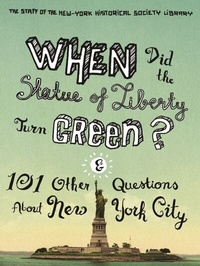
When Did the Statue of Liberty Turn Green?
And 101 Other Questions About New York City
1st Edition
Published on 19. October 2010
192 pages
978-0-231-51939-7 (ISBN)
Description

No detailed description available for "When Did the Statue of Liberty Turn Green?".
All prices
More details
Other editions
Additional editions
The Staff of the New-York Historical Society Library | Nina Nazionale | Jean Ashton
When Did the Statue of Liberty Turn Green?
And 101 Other Questions About New York City
Book
10/2010
Columbia University Press
€52.00
Shipment within 10-20 days
The Staff of the New-York Historical Society Library | Nina Nazionale | Jean Ashton
When Did the Statue of Liberty Turn Green?
And 101 Other Questions About New York City
Book
10/2010
Columbia University Press
€18.56
Shipment within 10-20 days
Persons
The New-York Historical Society, a preeminent educational and research institution, is home to both New York City's oldest museum and one of the nation's most distinguished independent research libraries. Each year, the library staff assists more than 5000 researchers on-site and another 5000 remotely.
Jean W. Ashton is executive vice president and director of the New-York Historical Society Library.
Nina Nazionale is director of library operations at the New-York Historical Society.
Jean W. Ashton is executive vice president and director of the New-York Historical Society Library.
Nina Nazionale is director of library operations at the New-York Historical Society.
Content
Foreword, by Ric Burns
Acknowledgments
Firsts and Origins
History and Politics
Curiosities and Wonders
Buildings, Streets, and Neighborhoods
Arts, Leisure, and Diversions
Acknowledgments
Firsts and Origins
History and Politics
Curiosities and Wonders
Buildings, Streets, and Neighborhoods
Arts, Leisure, and Diversions
When did the Statue of Liberty turn green?
For more than twenty years, the Statue of Liberty, originally known as "Liberty Enlightening the World," was dark brown, only changing to its familiar verdant hue close to the time of America's entry into the First World War. By the early 1920s, the entire monument turned green. The dark color of the statue in the early years gives quite accidental plausibility to proponents of a theory that the model for the work was black and that she was donated to the United States to celebrate the end of American slavery. August Bartholdi, however, claimed he gave the sculpture the stern features of his mother.
For more than twenty years, the Statue of Liberty, originally known as "Liberty Enlightening the World," was dark brown, only changing to its familiar verdant hue close to the time of America's entry into the First World War. By the early 1920s, the entire monument turned green. The dark color of the statue in the early years gives quite accidental plausibility to proponents of a theory that the model for the work was black and that she was donated to the United States to celebrate the end of American slavery. August Bartholdi, however, claimed he gave the sculpture the stern features of his mother.

