
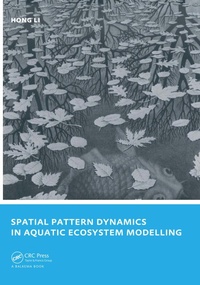
Spatial Pattern Dynamics in Aquatic Ecosystem Modelling
Description
Alles über E-Books | Antworten auf Fragen rund um E-Books, Kopierschutz und Dateiformate finden Sie in unserem Info- & Hilfebereich.
In this work, several modelling approaches are explored to represent spatial pattern dynamics of aquatic populations in aquatic ecosystems by the combination of models, knowledge and data in different scales.
It is shown that including spatially distributed inputs retrieved from Remote Sensing images, a conventional physically-based Harmful Algal Bloom model can be enhanced. Also, Cellular Automata based models using high resolution photographs prove to be good in representing aquatic plant growth. Multi-Agent Systems can capture well the spatial patterns exhibited in GIS density maps. A synthesis modelling framework was developed to include biological/ecological growth and diffusive processes, and local effects in conventional modelling framework. The results of the complementary modelling paradigms investigated in this research can be of help in achieving a sustainable environmental management strategy.
More details
Other editions
Additional editions

Person
Content
System requirements
File format: PDF
Copy protection: without DRM (Digital Rights Management)
System requirements:
- Computer (Windows; MacOS X; Linux): Use the free software Adobe Reader, Adobe Digital Editions, or any other PDF viewer of your choice (see eBook Help).
- Tablet/Smartphone (Android; iOS): Install the free app Adobe Digital Editions or another reading app for eBooks, e.g., PocketBook (see eBook Help).
- E-reader: Bookeen, Kobo, Pocketbook, Sony, Tolino and many more (only limited: Kindle).
The file format PDF always displays a book page identically on any hardware. This makes PDF suitable for complex layouts such as those used in textbooks and reference books (images, tables, columns, footnotes). Unfortunately, on the small screens of e-readers or smartphones, PDFs are rather annoying, requiring too much scrolling.
This eBook does not use copy protection or Digital Rights Management.
For more information, see our eBook Help page.