

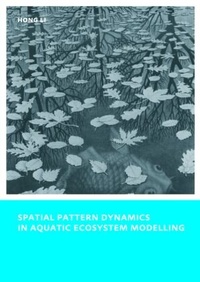
Spatial Pattern Dynamics in Aquatic Ecosystem Modelling
UNESCO-IHE PhD Thesis
1st Edition
Published on 22. December 2009
Book
Paperback/Softback
202 pages
978-0-415-55897-6 (ISBN)
Description
In this work, several modelling approaches are explored to represent spatial pattern dynamics of aquatic populations in aquatic ecosystems by the combination of models, knowledge and data in different scales.
It is shown that including spatially distributed inputs retrieved from Remote Sensing images, a conventional physically-based Harmful Algal Bloom model can be enhanced. Also, Cellular Automata based models using high resolution photographs prove to be good in representing aquatic plant growth. Multi-Agent Systems can capture well the spatial patterns exhibited in GIS density maps. A synthesis modelling framework was developed to include biological/ecological growth and diffusive processes, and local effects in conventional modelling framework. The results of the complementary modelling paradigms investigated in this research can be of help in achieving a sustainable environmental management strategy.
It is shown that including spatially distributed inputs retrieved from Remote Sensing images, a conventional physically-based Harmful Algal Bloom model can be enhanced. Also, Cellular Automata based models using high resolution photographs prove to be good in representing aquatic plant growth. Multi-Agent Systems can capture well the spatial patterns exhibited in GIS density maps. A synthesis modelling framework was developed to include biological/ecological growth and diffusive processes, and local effects in conventional modelling framework. The results of the complementary modelling paradigms investigated in this research can be of help in achieving a sustainable environmental management strategy.
More details
Language
English
Place of publication
London
United Kingdom
Publishing group
Taylor & Francis Ltd
Target group
College/higher education
Academics, researchers and graduate students in water science, in particular aquatic ecological modelling
Product notice
Paperback (UK-B)
Illustrations
20 s/w Abbildungen, 60 farbige Abbildungen
60 Illustrations, color; 20 Illustrations, black and white
Dimensions
Height: 254 mm
Width: 178 mm
Weight
521 gr
ISBN-13
978-0-415-55897-6 (9780415558976)
Copyright in bibliographic data and cover images is held by Nielsen Book Services Limited or by the publishers or by their respective licensors: all rights reserved.
Schweitzer Classification
Other editions
Additional editions
E-Book
02/2026
Taylor & Francis
€116.99
Available for download
E-Book
02/2026
Taylor & Francis
€116.99
Available for download
Book
10/2017
1st Edition
CRC Press
€282.26
Shipment within 10-20 days
Person
Hong Li carried out her PhD research in collaboration with Deltares | Delft Hydraulics, UNESCO-IHE and Delft University of Technology. Her current interests are in spatial temporal dynamics in aquatic ecosystems. She has experience in several areas including, hydroinformatics and ecohydraulics modelling, aquatic population dynamics, and modelling spatial patterns of aquatic populations with various data sources and advanced computational technologies. She holds a M.Sc. degree in Hydrology from Hohai University, China and one in Hydroinformatics from UNESCO-IHE Institute for Water Education, the Netherlands.
Content
Abstract, Samenvatting, Acknowledgement, Chapter 1 Introduction, Chapter 2 Theoretical background , Chapter 3 Developments in modelling paradigms, Chapter 4 Harmful algal bloom prediction using data-driven techniques, Chapter 5 Enhancing physically-based algal dynamics modelling using remote sensing images, Chapter 6 Spatial pattern dynamics in cellular automata based aquatic ecosystem modelling, Chapter 7 Revealing spatial pattern dynamics in aquatic ecosystem modelling with multi-agent systems, Chapter 8 A synthesis of physically-based water quality modelling and multi-agent-based population dynamics modelling, Chapter 9 Conclusions and recommendations, References, List of figures, List of tables, List of symbols and abbreviations, Appendix, Curriculum Vitae.