

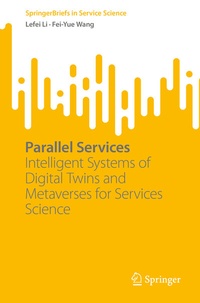
Parallel Services
Description

By incorporating the latest advancement in complex system modeling and simulation into the service system research, this book makes a valuable contribution to this field that will lead service innovation and service management toward the digital twin and metaverse. It covers important topics such as computational experiments and parallel execution of a parallel service system, the modeling of artificial service systems, semi-parallel service systems, parallel service, and digital twin/metaverse. It also provides a unified framework for realizing a parallel service system that demonstrates the capabilities or potentials of adopting digital twin and metaverse.
In addition, the book contains numerous solutions to real-world problems, through which both academic readers and practitioners will gain new perspectives on service systems, and learn how to model a parallel service system or how to use the model to analyze and understand the behaviors of the system. For academic readers, it sheds light on a new research direction within the service science/engineering domain made possible by the latest technologies. For practitioners, with the help of methods such as Agent-based Modeling and Simulation, the book will enable them to enhance their skills in designing or analyzing a service system.More details
Other editions
Additional editions
Persons
Dr. Lefei Li is an Associate Professor at the Department of Industrial Engineering, Tsinghua University (China). His research focuses on artificial transportation systems, Systems Engineering, and service management problems. He is the Assistant Director of the International Council on Systems Engineering (INCOSE) and an associate editor for several international journals.
Dr. Feiyue Wang is the Director of the key laboratory of Complex Systems and Intelligence Science, Chinese Academy of Sciences (CAS), China. His current research focuses on methods and applications for parallel intelligence, social computing, and knowledge automation. He is a Fellow of INCOSE, IFAC, ASME, and AAAS.Content
- Intro
- Preface
- Acknowledgments
- Contents
- 1 Introduction
- References
- 2 Motivation: Complexity of Service in the Digital Age
- 2.1 Trends of Services in the Digital Age
- 2.1.1 Smart Services with Smart Sensors
- 2.1.2 Retailing, Logistics, and Financial Services Based on Artificial Intelligence Technology
- 2.1.3 Technology Applications in Services for Emergencies
- 2.2 Complexity of Services System
- 2.3 Challenges in the Digital Age
- References
- 3 Opportunity: The Actual-Artificial Duality of Services
- 3.1 Three Worlds and Three Axial Ages
- 3.2 The ``Cognitive Gap'' Between Two Worlds
- 3.3 Parallel Services as a Bridge
- 3.4 From CPS to CPSS
- 3.5 The Future of Parallel Services Based on True DAO
- References
- 4 Framework of Parallel Services
- 4.1 Definition and Vision of Parallel Services
- 4.2 Framework of Parallel Services
- Reference
- 5 Enabling Methodology
- 5.1 ACP Method
- 5.2 Artificial Services System Design
- 5.2.1 The Services Need-Demand Model
- 5.2.2 The Services Network
- 5.2.3 Parallel Learning and Optimization
- 5.3 Design Thinking
- 5.4 Systems Engineering
- References
- 6 Enabling Technology
- 6.1 Decentralized Technology
- 6.2 Multi-Agent Simulation
- 6.3 Data Fusion Techniques
- References
- 7 Research on Parallel Services
- 7.1 Parallel Transportation Management Systems
- 7.1.1 Background
- 7.1.2 Parallel Transportation Management Systems
- 7.1.3 Applications
- 7.2 Parallel Healthcare Services
- 7.2.1 Background
- 7.2.2 Design of Hybrid Services System
- 7.2.3 Computational Experiments
- 7.2.4 Parallel Execution of the Internet Hospitals
- 7.3 Parallel Retailing Services
- 7.3.1 Background
- 7.3.2 Design of the Artificial Services Systems
- 7.3.3 Computational Experiments
- 7.3.4 Extensions
- 7.4 Parallel Logistics Services
- 7.4.1 Background
- 7.4.2 Parallel Logistics Systems
- References
- 8 Parallel Services and Digital Twins
- 8.1 Introduction of Digital Twins
- 8.2 Parallel Services and Digital Twins
- References
- 9 Parallel Services Metaverses
- 9.1 Introduction of Metaverses
- 9.1.1 The Basic Concept of Metaverses
- 9.1.2 The Value Proposition Behind Metaverses
- 9.2 CPSS for Metaverses
- 9.2.1 Parallel Intelligence for Metaverses
- 9.2.2 The Essence of Parallel Services Metaverses
- 9.3 DAOs for Parallel Services Metaverses
- 9.3.1 ``TRUE DAO'' Toward Deep Intelligence
- 9.3.2 Enabling Technologies for DAOs
- References
