

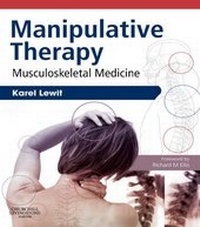
Manipulative Therapy
Description

Manipulative Therapy provides a systematic overview of chain reactions which are the basis of a rational holistic approach. These reactions are closely related to the upright human posture and to the 'deep stabilisation system' as shown in the work of Richardson et al in Therapeutic Exercise for Spinal Stabilisation in Low Back Pain. This approach has meant a considerable advance in the therapy and rehabilitation of patients.
It gives a balanced picture of the importance of musles, joints and soft tissues, under the control of the nervous system, the textbook aims to treat disturbance of function, the most common cause of pain in the motor system, in the most effective way.
Locomotor system dysfunctions are shown to be treated very effectively using manual medicine techniques. Spinal column and joint mobility can be restored, and pain triggered by the autonomic nervous system can be positively influenced.
This is a comprehensive source of information relating to pathogenesis, diagnosis, indications and treatment methods, incorporating the latest research findings. Radiological diagnosis is is shown as laying the foundation for successful diagnosis and treatment with manual medicine techniques. Typical conditions associated with pain in the locomotor system is presented and described in functional terms for the first time. The book concludes with chapters covering preventative aspects and expert assessment.
Manipulative Therapy: Musculoskeletal Medicine is the follow on from: Manipulative Therapy in Rehabilitation of the Locomotor System, published by Butterworth Heinemann, 1985.
More details
Other editions
Additional editions
Content
- Intro
- Cover Image
- Table of Contents
- Dedication
- Copyright
- Foreword
- Preface
- Acknowledgments
- Abbreviations
- Chapter 1. History and fundamental principles
- 1.1. The history of manipulative therapy
- 1.2. Fundamental principles of reflex therapy
- 1.3. Reflex therapy
- Chapter 2. Etiology and pathogenesis
- 2.1. The significance of morphological changes
- 2.2. Theoretical aspects of manipulation therapy
- 2.3. The significance of functional disturbances
- 2.4. Motion segment and joint dysfunctions
- 2.5. The spinal column as a functional unit
- 2.6. Dysfunctions of the spinal column in childhood
- 2.7. Restrictions and their sequelae
- 2.8. The significance of disturbed motor patterns (stereotypes)
- 2.9. Sequelae of disturbed movement patterns
- 2.10. The significance of constitutional hypermobility
- 2.11. Reflex processes in vertebrogenic dysfunctions
- 2.12. Radicular pain
- 2.13. The term 'vertebrogenic'
- 2.14. Conclusions
- Chapter 3. Functional anatomy and radiology of the spinal column
- 3.1. General principles
- 3.2. Technique in functional diagnosis
- 3.3. The lumbar spine and pelvis
- 3.4. The thoracic spine
- 3.5. The cervical spine
- Chapter 4. Diagnosis of dysfunctions of the locomotor system
- 4.1. Patient history
- 4.2. The inspection: posture
- 4.3. Palpation (soft-tissue examination)
- 4.4. Mobility testing
- 4.5. Examination of the pelvis
- 4.6. Examination of the lumbar spine
- 4.7. Examination of the thoracic spine
- 4.8. Examination of the ribs
- 4.9. Examination of the cervical spine
- 4.10. Examination of the limb joints
- 4.11. Examination of the temporomandibular joint
- 4.12. Examination of disturbances of balance
- 4.13. Examination of muscle function
- 4.14. Examination of hypermobility
- 4.15. Examination of coordinated movements (motor stereotypes)
- 4.16. Syndromes
- 4.17. Retesting
- 4.18. Dysfunctions and the course of examination
- 4.19. Adjusting our thinking to the functional approach
- 4.20. Chain reactions of dysfunctions and motor programs
- 4.21. Differential diagnosis
- Chapter 5. Indications for and principles underlying individual treatment methods
- 5.1. Manipulation
- 5.2. Soft-tissue manipulation
- 5.3. Reflex therapy
- 5.4. Remedial exercise
- 5.5. Treatment of faulty statics
- 5.6. Immobilization and supports
- 5.7. Pharmacotherapy
- 5.8. Surgery
- 5.9. Lifestyle
- 5.10. The course of manipulative treatment
- 5.11. Conclusions
- Chapter 6. Therapeutic techniques
- 6.1. Manipulation
- 6.2. Indirect techniques
- 6.3. Exteroceptive stimulation
- 6.4. Soft-tissue manipulation
- 6.5. Self-mobilization
- 6.6. Post-isometric relaxation and reciprocal inhibition
- 6.7. Training weak muscles (facilitation)
- 6.8. Re-training to correct faulty movement patterns
- 6.9. Supports
- 6.10. Local anesthesia
- Chapter 7. Clinical aspects of locomotor system dysfunction (vertebrogenic disorders)
- 7.1. Pain in the lumbar spine and pelvic region
- 7.2. Pain in the thoracic spine and thorax
- 7.3. Pain in the cervical spine
- 7.4. Referred pain and other pain types
- 7.5. Entrapment syndromes
- 7.6. The cervicocranial syndrome
- 7.7. Active scars
- 7.8. Structural diseases associated with locomotor system dysfunction
- 7.9. Vertebrovisceral inter-relationships
- 7.10. Post-traumatic states
- 7.11. The clinical picture of dysfunctions in individual motion segments
- Chapter 8. Prevention of locomotor system dysfunctions
- 8.1. Importance and incidence of locomotor system dysfunctions
- 8.2. Principles and goals of prevention
- 8.3. Lifestyle factors
- 8.4. Manipulation as a prophylactic measure
- Chapter 9. Expert assessment of locomotor system dysfunctions
- 9.1. Assessment of (un)fitness for work
- 9.2. Assessment of trauma and its consequences
- Chapter 10. The place of manipulative therapy and its future
- Glossary
- Bibliography
- Further reading
- Index

