

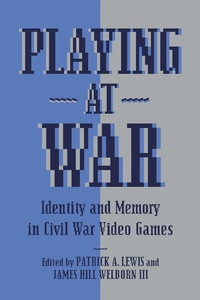
Playing at War
Description

Playing at War offers an innovative focus on Civil War video games as significant sites of memory creation, distortion, and evolution in popular culture. With fifteen essays by historians, the collection analyzes the emergence and popularity of video games that topically engage the period surrounding the American Civil War, from the earliest console games developed in the 1980s through the web-based games of the twenty-first century, including popular titles such as Red Dead Redemption 2 and War of Rights. Alongside discussions of technological capabilities and advances, as well as their impact on gameplay and content, the essays consider how these games engage with historical scholarship on the Civil War era, the degree to which video games reflect and contribute to popular understandings of the period, and how those dynamics reveal shifting conceptions of martial identity and historical memory within U.S. popular culture. Video games offer productive sites for extending the analysis of Civil War memory into the post-Confederates in the Attic era, including the political and cultural moments of Obama and Trump, where overt expressions of Lost Cause memory were challenged and removed from schools and public spaces, then embraced by new manifestations of white supremacist organizations.
Edited by Patrick A. Lewis and James Hill Welborn III, Playing at War traces the drift of Civil War memory into digital spaces and gaming cultures, encouraging historians to engage more extensively with video games as important cultural media for examining how contemporary Americans interact with the nation's past.
More details
Other editions
Additional editions
Persons
Patrick A. Lewis is the director of collections and research at the Filson Historical Society in Louisville, Kentucky, and the author of For Slavery and Union: Benjamin Buckner and Kentucky Loyalties in the Civil War.
James Hill Welborn III, associate professor of history at Georgia College and State University, is the author of Dueling Cultures, Damnable Legacies: Southern Violence and White Supremacy in the Civil War Era.
Content
- Cover
- Contents
- Acknowledgments
- Introduction
- PART I. SCOUTING THE LANDSCAPE OF CIVIL WAR GAME STUDIES
- Playing with Accuracy: Research Methodology and Historical Accuracy in Civil War Video Games
- "Itching to Fight": Civil War Video Game Manuals and the Emotions of Playing at War
- Modeling "Clean Wars": The Civil War and Second World War in Grand Strategy Games
- Civil War-Based Game Modifications and Crowdsourced Historical Memory
- PART II. BRIEFING ON CIVIL WAR CAUSATION AND GAMEPLAY LIMITATIONS, 1970s-1990s
- Searching for Indigeneity in The Oregon Trail
- Interpreting Slavery through Video Games: The Story of Freedom!
- Two-Bit History at 8-Bit Speed: Civil War Memory in North & South during the Resurgence of Console Gaming
- PART III. DEPLOYMENT TO THE STRATEGIC HEX GRID AND FIRST-PERSON SHOOTERS, 1990s-2000s
- Sid Meier's Gettysburg! and Civil War Culture
- Party on the Hex Grid: Balancing Authenticity and Fun in Civil War Generals 2
- The End Boss of the Union: Examining Virtual Fights for Washington, DC, in Civil War Video Games
- Combating Flawed Authenticity: The History Channel, A Nation Divided, and Civil War Memory
- PART IV. NEXT-GEN AND ONLINE REDEPLOYMENT IN THE 2010s
- Race, Slavery, and the United States Colored Troops in Ultimate General: Civil War
- What "Rights" Exactly? War of Rights, Education, and Civil War Memory in the Twenty-First Century
- Myth, Memory, and the Civil War's Looming Presence in Call of Juarez: Bound in Blood
- Slavery, the Civil War, and Memory in Red Dead Redemption 2
- Contributors
- Index
