

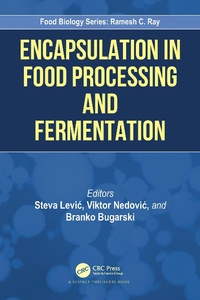
Encapsulation in Food Processing and Fermentation
1st Edition
Published on 18. August 2022
378 pages
978-1-000-65593-3 (ISBN)
Description

Food technology has adopted new principles and practices that are rapidly changing the food sector. New foods are now available under more uniform standards and better quality control. Globalised food market offers opportunities for manufacturers to increase production and profit, and at the same time, consumers benefit from the choice of food products like never before. All this is possible only because of the innovations in the food sector. One of such innovations is encapsulation technology, which aims to preserve food quality, enhance the sensorial properties of food and increase the efficiency in food processing.
This book discusses the uses of encapsulation technology in food practices and conventional processes and also highlights new directions in food processing. In the introductory chapters' review of encapsulation technologies, carrier materials and criteria for their selection, analytical methods for characterisation of encapsulated products and some aspects of product design and process optimisation. The most important achievements of encapsulation technology in the food sector are reviewed in the later chapters related to encapsulation of food ingredients, food biocatalysts and examples of usage of encapsulated active ingredients in the dairy and meat industry, beverage production, etc. In addition, the implementation of nanotechnology in the food sector is reviewed, emphasizing the most important materials and technologies for the production of nanoencapsulates. The book is a valuable source of information on encapsulation technology, for academia and industry, especially the food sector, with the aim of enhancing knowledge transfer.
This book discusses the uses of encapsulation technology in food practices and conventional processes and also highlights new directions in food processing. In the introductory chapters' review of encapsulation technologies, carrier materials and criteria for their selection, analytical methods for characterisation of encapsulated products and some aspects of product design and process optimisation. The most important achievements of encapsulation technology in the food sector are reviewed in the later chapters related to encapsulation of food ingredients, food biocatalysts and examples of usage of encapsulated active ingredients in the dairy and meat industry, beverage production, etc. In addition, the implementation of nanotechnology in the food sector is reviewed, emphasizing the most important materials and technologies for the production of nanoencapsulates. The book is a valuable source of information on encapsulation technology, for academia and industry, especially the food sector, with the aim of enhancing knowledge transfer.
More details
Series
Edition
1. Auflage
Language
English
Place of publication
London
United Kingdom
Publishing group
Taylor & Francis Ltd
Target group
Professional and scholarly
Illustrations
33 Tables, black and white; 5 Line drawings, color; 12 Line drawings, black and white; 2 Halftones, color; 2 Halftones, black and white; 7 Illustrations, color; 14 Illustrations, black and white
ISBN-13
978-1-000-65593-3 (9781000655933)
Copyright in bibliographic data and cover images is held by Nielsen Book Services Limited or by the publishers or by their respective licensors: all rights reserved.
Schweitzer Classification
Other editions
Additional editions
Steva Levic | Viktor Nedovic | Branko Bugarski
Encapsulation in Food Processing and Fermentation
Book
10/2024
1st Edition
CRC Press
€114.60
Shipment within 10-20 days
Steva Levic | Viktor Nedovic | Branko Bugarski
Encapsulation in Food Processing and Fermentation
Book
08/2022
1st Edition
CRC Press
€260.80
Shipment within 15-20 days
Persons
Steva Levic is an assistant professor at University of Belgrade-Faculty of Agriculture, Belgrade, Serbia. His primarily scientific expertise is in the area of immobilization of biocatalysts and food ingredients. Also, his expertise includes the usage of various analytical methods and techniques such as Raman and IR spectroscopy for characterization of encapsulates and optimization of encapsulation procedures.
Dr. Steva Levic has published more than 20 papers in journals, several book chapters and more than 30 conferences' papers on different aspect of encapsulation techniques and procedures, brewing yeast encapsulation, beer fermentation, ethanol production and encapsulation of food ingredients. He is a member of Serbian Association of Food Technologist.
Viktor Nedovic is a professor of Biochemical Engineering, Bioreactor Engineering and Beer and Malt Technology at the University of Belgrade, Faculty of Agriculture. For over twenty years, Prof Viktor Nedovic has been involved in development of the new brewing and reactor processes. One of the most important parts of Prof. Nedovic's research is developing and application of new immobilization/encapsulation processes in food sector, with special interest in cells encapsulation and application in fermentation processes. He is a well-known expert in area of nanotechnology and application of special dispersion techniques for fabrication of nano- and microencapsulates.
Prof. Viktor Nedovic has published over 70 scientific papers and chapters in text books. He has been participant in 18 national projects and 25 international projects.
Branko Bugarski is a professor of Process Design in Bioprocess and Pharmaceutical Engineering, Bioreactor Engineering, Pharmaceutical Engineering and Separation Processes at University of Belgrade, Faculty of Technology and Metallurgy. He is the head of laboratory that works with microorganisms and their products, new encapsulation procedures, production of active ingredients, material testing, etc. During more than twenty years, Dr Branko Bugarski has worked on numerous researches in broad area of biotechnology. Primarily his research interests are in the areas of biomedical science and biotechnology - immobilized biocatalysts, encapsulation of cells, bioreactor design, biomass production and controolled delivery.
Dr. Branko Bugarski published over 100 scientific papers and chapters in text books. He is a co-author of three patents. He has been participant in numerous national and international projects.
Dr. Steva Levic has published more than 20 papers in journals, several book chapters and more than 30 conferences' papers on different aspect of encapsulation techniques and procedures, brewing yeast encapsulation, beer fermentation, ethanol production and encapsulation of food ingredients. He is a member of Serbian Association of Food Technologist.
Viktor Nedovic is a professor of Biochemical Engineering, Bioreactor Engineering and Beer and Malt Technology at the University of Belgrade, Faculty of Agriculture. For over twenty years, Prof Viktor Nedovic has been involved in development of the new brewing and reactor processes. One of the most important parts of Prof. Nedovic's research is developing and application of new immobilization/encapsulation processes in food sector, with special interest in cells encapsulation and application in fermentation processes. He is a well-known expert in area of nanotechnology and application of special dispersion techniques for fabrication of nano- and microencapsulates.
Prof. Viktor Nedovic has published over 70 scientific papers and chapters in text books. He has been participant in 18 national projects and 25 international projects.
Branko Bugarski is a professor of Process Design in Bioprocess and Pharmaceutical Engineering, Bioreactor Engineering, Pharmaceutical Engineering and Separation Processes at University of Belgrade, Faculty of Technology and Metallurgy. He is the head of laboratory that works with microorganisms and their products, new encapsulation procedures, production of active ingredients, material testing, etc. During more than twenty years, Dr Branko Bugarski has worked on numerous researches in broad area of biotechnology. Primarily his research interests are in the areas of biomedical science and biotechnology - immobilized biocatalysts, encapsulation of cells, bioreactor design, biomass production and controolled delivery.
Dr. Branko Bugarski published over 100 scientific papers and chapters in text books. He is a co-author of three patents. He has been participant in numerous national and international projects.
Content
1. Introduction to Encapsulation Processes 2. Carrier Materials for Encapsulation 3. Encapsulation Techniques for Food Purposes 4. Industrial-scale Encapsulation Processes and Products 5. Methods for Analysis of Encapsulates 6. Controlled Release Systems for Food Application 7. Encapsulation of Plant Extracts 8. Alcoholic Beverages Produced by Immobilised Microorganisms 9. Encapsulated/Immobilized Biocatalysts for Production of Dairy Products 10. Encapsulation of Meat Product Ingredients and Influence on Product Quality 11. Encapsulation of Food Supplements 12. Nanoencapsulation in Food Technology 13. Safety, Standards and Regulations of Nanotechnology in Food
