

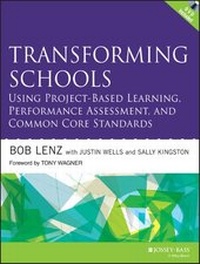
Transforming Schools Using Project-Based Learning, Performance Assessment, and Common Core Standards
Description

Schools are changing in response to this reality, and in Transforming Schools Using Project-Based Learning, Performance Assessment, and Common Core Standards, Bob Lenz, Justin Wells, and Sally Kingston draw on the example of the Envision Education schools, as well as other leading schools around the country, to show how the concept of deeper learning can meet the need for students who are both college and career ready and engaged in their own education.
In this book, the authors explain how project-based learning can blend with Common Core-aligned performance assessment for deeper learning. You'll discover how many schools have successfully made the transition from traditional, teacher-centered learning to project-based, deeper learning and find many practical ideas for implementation.
* Companion DVD and website include videos showing how to implement deeper learning strategies in the classroom
* Evidence-based descriptions show why deeper learning is right for students
* Performance assessment experts explain how to align assessments with Common Core by shifting the emphasis from knowing to doing
* Extensive game plan section provides step-by-step guidance for change
Schools are complex organizations, and transformation involves all of the stakeholders, from students to superintendents. But as this book shows, there are amazing benefits to be realized when everyone commits to diving deeper into learning.
All prices
More details
Other editions
Additional editions
Persons
Justin Wells is a founding English teacher of EnvisionSchools.
Sally Kingston, PhD, is the Senior Education Analyst atApplied Engineering Management Corporation.
Content
Acknowledgments xiii
About the Authors xv
Foreword by TonyWagner xvii
Introduction: Why Learning Must Go Deeper 1
Breadth versus depth--it's an old struggle. Stop struggling. Go with depth. It's the only way to engage students in the present and to prepare them for their futures.
1 Transforming the Graduate 19
Everything maps backward from a redefinition of what it means to graduate from high school. Know, do, reflect: our unified theory.
2 Designing a Standards-Aligned Performance Assessment System 41
A school that is dedicated to deeper learning is a school that has established a coherent, schoolwide, standards-aligned performance assessment system. We explain what this means, why it's vital, and how to work toward this challenging but transformative goal.
3 Project-Based Learning--It's the How (and the Why) 65
Learning is deepest when it culminates in an act of creation. As we walk through an example project, we show how PBL is the most effective and efficient means to our ends: preparing students for rigorous performance assessments, meeting state standards, and, most important, making learning matter to students.
4 Transforming School Culture 101
Transforming the lives of students requires a culture that believes it's possible. We describe how to nurture a culture for deeper learning.
5 Transforming School Systems 123
Without supporting structures, a school's mission is talk without action. We outline the school structures that sustain deeper learning, including advisory, project-based scheduling, common planning time, community meetings, student internships, and grading.
6 Leadership for Deeper Learning 147
As stewards of the school's mission, leaders must ensure integrity and consistency through all the layers of the organization. Here we offer philosophical and practical advice on how to lead a school through
transformative change.
7 A Call to Action 161
A movement is a small step taken by many people. Here are three ways to take a first step toward deeper learning.
Appendix: SupplementaryMaterial 173
Index 267
Introduction
My first year in college was amazing. Everything that you guys taught us here, I use. Every, single, thing.
-Envision Schools graduate (2011)
You've either heard the claim or reached the conclusion on your own: the world is changing, and our schools are not keeping up.
If you still need some convincing, there are entire books that lay out the argument persuasively. There may be some disagreement around how we got to this point and which facet of the complex problem is most pressing, but those who worry about our schools point to the same facts. America's public education system once led the world; now it wheezes in the middle of the pack. A system meant to break down walls of class and race is now implicated in building them up. Because of globalization and advances in technology, the kinds of jobs that created and defined the American middle class are vanishing before our eyes. A troubling number of kids don't like school; a tragic number are dropping out. And despite generations of rhetoric around reform, the typical student's day-to-day classroom experience has hardly changed in a hundred years.
Great Books on the Need for Educational Change
- Ted Sizer (1985), Horace's Compromise
- Deborah Meier (1995), The Power of Their Ideas
- Linda Darling-Hammond (1997), The Right to Learn
- David Conley (2005), College Knowledge
- Tony Wagner (2008), The Global Achievement Gap
It's this last fact that most concerns this book, not because it is more important but because it is the one that educators can act on most concretely. It is also a fact easily overlooked. In recent years, education has enflamed intense debate. You would think it was the direction of change, rather than the absence of change, that could provoke such anger. But examine the labels on all our hot buttons: testing, tenure, teacher evaluation, charter schools, vouchers, trigger laws, unions, rubber rooms, No Child Left Behind. . . . While these controversies crash into adult sensibilities, they barely ripple into the typical day of the typical student at the typical school in America. Harvard education professor Jal Mehta (2013) sums up the last hundred years: "On the whole, we still have the same teachers, in the same roles, with the same level of knowledge, in the same schools, with the same materials, and much the same level of parental support."
This book is for those who agree that school should be different and are wondering how to go about making it better. It is a book about school design. It's not the only thing that must change to fix the problems of American education, but it's an essential one and the one our experience speaks to.
About Envision Education and the Authors
Over ten years ago, after earning acclaim for his leadership of an innovative academy within a comprehensive high school, Bob founded the first Envision school, dedicated to the ideas of performance assessment and project-based learning. He recruited a team of teachers before he had a school building secured. Justin was the second teacher hired.
The summer before we opened our doors, there was a building but still no furniture. For two months, we sat on the floor of an empty room and designed our school. That initial design grew into three schools, a small charter management organization, an educational consulting division, and now the book in your hands.
Along the way, Envision Schools garnered national recognition for its innovations in performance assessment, its graduation portfolio system, its rigorous and integrated approach to project-based learning, its workplace learning internships, and its personalized learning environment that have been so successful in getting students into college who were statistically not likely to go. We serve students who come from low-income families (almost 70 percent qualify for free and reduced lunch) and whose parents did not go to college (almost 80 percent of our students will be the first in their families to graduate from college). (Figure I.1 details the demographics of Envision Schools.)
Figure I.1 Envision Schools' Demographics, 2013-2014
Because college success is the goal we have for our students, college success is how we measure our performance. Case studies on our schools, published by Stanford University researchers (Cook-Harvey, 2014; Lewis-Charp & Law, 2014), found that Envision Schools graduates are entering and persisting in college at rates far ahead of their demographically comparable peers. One hundred percent of African American and Latino 2012 graduates completed the courses required for University of California/California State University eligibility at Impact Academy, an Envision school. Statewide, the rates are 34 percent and 39 percent, respectively. Whereas only 8 percent of all low-income students nationwide earn a bachelor's degree by their mid-twenties (Mortenson, 2010), at our City Arts and Tech High School (CAT), 72 percent of 2008 graduates and 85 percent of 2009 graduates are persisting into their fourth and fifth years of college or have already graduated. Figure I.2 provides more detail on how Envision's college persistence rates compare to relevant national averages.
Figure I.2 College Persistence Rates
Note: Nationwide numbers indicate the percentage of students who attained a bachelor's degree within six years of matriculating at a four-year college (2004-2009). Adapted from Persistence and Attainment of 2003-4 Beginning Postsecondary Students: After 6 Years. by A. W. Radford, L. Berkner, S. C. Wheeless, and B. Shepherd, 2010, Washington, DC: National Center for Education Statistics. Retrieved from http://nces.ed.gov/pubs2011/2011151.pdf. The Envision Schools number indicates the percentage of all Envision alums who are enrolled in college and working toward a bachelor's degree or have already earned one. Based on data from the National Student Clearinghouse.
From this success was born Envision Learning Partners (ELP), a division of Envision Education that partners with schools and districts nationwide that are inspired by our school design and the results it has generated. (Sally served as the executive director of ELP from 2013 to 2014.) Currently ELP is working directly with teachers and schools in seven states (New York, Delaware, Washington, Massachusetts, Michigan, California, and Hawaii), impacting more than ten thousand students; in addition, we are supporting the efforts of several large school systems, including Los Angeles Unified, the Educational Achievement Authority in Detroit, Sacramento City Unified, Oakland Unified, and awardees of the US Department of Education's Race to the Top - District competition.
The Common Core Is Not a Hurdle; It's an Opportunity
Envision accomplished all of this during a time of enormous pressure not to. The organization was founded in 2001, at the same tine as the No Child Left Behind (NCLB) legislation was passed. That law, while broadening awareness of the achievement gap, simultaneously narrowed the purpose of our nation's schools, boiling the whole endeavor down to the incremental movement of some numbers attempting to say something about student literacy and numeracy. Like many others (we've never been alone in our thinking), Envision defined success for its students as something bigger, more aspirational, and with a longer time horizon. For us, it has always been about preparing students for college and life success, and we never believed that standardized testing alone would get us there. We did what NCLB told us to do, but stayed true to our philosophy of building schools predicated on deeper learning (more on that in a moment).
Fast-forward to today, where we seem to have entered the era of Accountability 2.0. Performance assessment is "trending," and fast. A concept that for decades-and especially the last decade-has been fervently tended to by a small and forward-thinking group of educators is now on the tipping point of becoming mainstream practice in schools across the nation.
That's because of the new Common Core State Standards (CCSS). Improbably, over just a few years, the Common Core was adopted by forty-three states and territories and became a de facto set of national standards for math, reading, and writing across the curriculum.
Many factors were at work in the Common Core's swift adoption by so many states, but significant among them is the increasingly shared verdict that NCLB, for all its good intentions, demanded accountability without offering any educational vision. All value was placed on the act of counting, with scant attention paid to what it was that was being counted. A few states held themselves to a high standard, invariably one that was established before NCLB was passed. Most states, however, opted to test themselves on what could be bubbled in. We now have a decade of evidence to support the aphorism that "what gets tested is what gets taught." And when bubble tests define what gets taught, we end up with narrow and shallow curriculum.
Federal pressure certainly played a big role in its spread, but the Common Core would never have caught on if it wasn't riding a groundswell of recognition that in order to succeed in the 21st century, our kids need to not only learn content and basic test-taking...
