

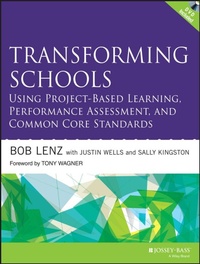
Transforming Schools Using Project-Based Learning, Performance Assessment, and Common Core Standards
1st Edition
Published on 17. March 2015
Book
Paperback/Softback
304 pages
978-1-118-73974-7 (ISBN)
Description
It's not what students know, but what they do with what they know that is important Schools are changing in response to this reality, and in Transforming Schools Using Project-Based Learning, Performance Assessment, and Common Core Standards, Bob Lenz, Justin Wells, and Sally Kingston draw on the example of the Envision Education schools, as well as other leading schools around the country, to show how the concept of deeper learning can meet the need for students who are both college and career ready and engaged in their own education.
In this book, the authors explain how project-based learning can blend with Common Core-aligned performance assessment for deeper learning. You'll discover how many schools have successfully made the transition from traditional, teacher-centered learning to project-based, deeper learning and find many practical ideas for implementation.
Companion DVD and website include videos showing how to implement deeper learning strategies in the classroom
Evidence-based descriptions show why deeper learning is right for students
Performance assessment experts explain how to align assessments with Common Core by shifting the emphasis from knowing to doing
Extensive game plan section provides step-by-step guidance for change
Schools are complex organizations, and transformation involves all of the stakeholders, from students to superintendents. But as this book shows, there are amazing benefits to be realized when everyone commits to diving deeper into learning.
In this book, the authors explain how project-based learning can blend with Common Core-aligned performance assessment for deeper learning. You'll discover how many schools have successfully made the transition from traditional, teacher-centered learning to project-based, deeper learning and find many practical ideas for implementation.
Companion DVD and website include videos showing how to implement deeper learning strategies in the classroom
Evidence-based descriptions show why deeper learning is right for students
Performance assessment experts explain how to align assessments with Common Core by shifting the emphasis from knowing to doing
Extensive game plan section provides step-by-step guidance for change
Schools are complex organizations, and transformation involves all of the stakeholders, from students to superintendents. But as this book shows, there are amazing benefits to be realized when everyone commits to diving deeper into learning.
More details
Language
English
Place of publication
New York
United States
Publishing group
John Wiley & Sons Inc
Target group
Professional and scholarly
Product notice
Paperback (trade)
Unsewn / adhesive bound
Dimensions
Height: 236 mm
Width: 180 mm
Thickness: 20 mm
Weight
543 gr
ISBN-13
978-1-118-73974-7 (9781118739747)
Copyright in bibliographic data and cover images is held by Nielsen Book Services Limited or by the publishers or by their respective licensors: all rights reserved.
Schweitzer Classification
Other editions
Additional editions
Bob Lenz | Justin Wells | Sally Kingston
Transforming Schools Using Project-Based Learning, Performance Assessment, and Common Core Standards
E-Book
01/2015
Jossey-Bass
from
€19.99
Available for download
Bob Lenz | Justin Wells | Sally Kingston
Transforming Schools Using Project-Based Learning, Performance Assessment, and Common Core Standards
E-Book
01/2015
Jossey-Bass
€19.99
Available for download
Persons
Bob Lenz is cofounder and Chief of Innovation of Envision Education, which includes Envision Schools, and Envision Learning Partners.
Justin Wells is a founding English teacher of Envision Schools.
Sally Kingston, PhD, is the Senior Education Analyst at Applied Engineering Management Corporation.
Justin Wells is a founding English teacher of Envision Schools.
Sally Kingston, PhD, is the Senior Education Analyst at Applied Engineering Management Corporation.
Content
Video Contents vii Acknowledgments xiii
About the Authors xv
Foreword by TonyWagner xvii
Introduction: Why Learning Must Go Deeper 1
Breadth versus depth-it's an old struggle. Stop struggling. Go with depth. It's the only way to engage students in the present and to prepare them for their futures.
1 Transforming the Graduate 19
Everything maps backward from a redefinition of what it means to graduate from high school. Know, do, reflect: our unified theory.
2 Designing a Standards-Aligned Performance Assessment System 41
A school that is dedicated to deeper learning is a school that has established a coherent, schoolwide, standards-aligned performance assessment system. We explain what this means, why it's vital, and how to work toward this challenging but transformative goal.
3 Project-Based Learning-It's the How (and the Why) 65
Learning is deepest when it culminates in an act of creation. As we walk through an example project, we show how PBL is the most effective and efficient means to our ends: preparing students for rigorous performance assessments, meeting state standards, and, most important, making learning matter to students.
4 Transforming School Culture 101
Transforming the lives of students requires a culture that believes it's possible. We describe how to nurture a culture for deeper learning.
5 Transforming School Systems 123
Without supporting structures, a school's mission is talk without action. We outline the school structures that sustain deeper learning, including advisory, project-based scheduling, common planning time, community meetings, student internships, and grading.
6 Leadership for Deeper Learning 147
As stewards of the school's mission, leaders must ensure integrity and consistency through all the layers of the organization. Here we offer philosophical and practical advice on how to lead a school through
transformative change.
7 A Call to Action 161
A movement is a small step taken by many people. Here are three ways to take a first step toward deeper learning.
Appendix: SupplementaryMaterial 173
Index 267
About the Authors xv
Foreword by TonyWagner xvii
Introduction: Why Learning Must Go Deeper 1
Breadth versus depth-it's an old struggle. Stop struggling. Go with depth. It's the only way to engage students in the present and to prepare them for their futures.
1 Transforming the Graduate 19
Everything maps backward from a redefinition of what it means to graduate from high school. Know, do, reflect: our unified theory.
2 Designing a Standards-Aligned Performance Assessment System 41
A school that is dedicated to deeper learning is a school that has established a coherent, schoolwide, standards-aligned performance assessment system. We explain what this means, why it's vital, and how to work toward this challenging but transformative goal.
3 Project-Based Learning-It's the How (and the Why) 65
Learning is deepest when it culminates in an act of creation. As we walk through an example project, we show how PBL is the most effective and efficient means to our ends: preparing students for rigorous performance assessments, meeting state standards, and, most important, making learning matter to students.
4 Transforming School Culture 101
Transforming the lives of students requires a culture that believes it's possible. We describe how to nurture a culture for deeper learning.
5 Transforming School Systems 123
Without supporting structures, a school's mission is talk without action. We outline the school structures that sustain deeper learning, including advisory, project-based scheduling, common planning time, community meetings, student internships, and grading.
6 Leadership for Deeper Learning 147
As stewards of the school's mission, leaders must ensure integrity and consistency through all the layers of the organization. Here we offer philosophical and practical advice on how to lead a school through
transformative change.
7 A Call to Action 161
A movement is a small step taken by many people. Here are three ways to take a first step toward deeper learning.
Appendix: SupplementaryMaterial 173
Index 267