

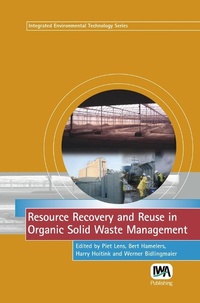
Resource Recovery and Reuse in Organic Solid Waste Management
Published on 1. March 2004
538 pages
978-1-78040-276-5 (ISBN)
Description

Uncontrolled spreading of waste materials leads to health problems and environmental damage. To prevent these problems a waste management infrastructure has been set to collect and dispose of the waste, based on a hierarchy of three principles: waste prevention, recycling/reuse, and final disposal. Final disposal is the least desirable as it causes massive emissions, to the atmosphere, water bodies and the subsoil. The emission of methane to the atmosphere is an important source of greenhouse gasses. Organic waste therefore gets a lot of attention in waste management, which for Europe can be illustrated by the issue of the Landfill Directive (99/31/EC) and the Sewage Sludge Directive (86/278/EEC). Proper treatment of organic waste may however turn this burden into an asset. In particular, biological treatment may help in developing more effective resource management and sustainable development. The following advantages may be listed: The greenhouse effect is tackled as methane emissions from landfilling are prevented Soil quality can be restored or enhanced by the use of compost in agriculture Compost may replace peat in horticulture and home gardening, reducing greenhouse emissions and wetland exploitation Anaerobic digestion has the additional benefit of producing biogas that may be used as a fuel Pesticide use can be reduced by proper use of the disease suppressive properties of compost Resource Recovery and Reuse in Organic Solid Waste Management disseminates at advanced scientific level the potential of environmental biotechnology for the recovery and reuse of products from solid waste. Several options to recover energy out of organic solid waste from domestic, agricultural and industrial origin are presented and discussed and existing economically feasible treatment systems that produce energy out of solid waste and recover useful by-products in the form of fertiliser or soil conditioner are demonstrated. The potential of environmental biotechnology is highlighted from different perspectives: societal, technological and practical.
More details
Series
Edition
Revised edition
Language
English
Place of publication
London
United Kingdom
Target group
College/higher education
Professional and scholarly
Edition type
Revised edition
File size
4,20 MB
ISBN-13
978-1-78040-276-5 (9781780402765)
Copyright in bibliographic data and cover images is held by Nielsen Book Services Limited or by the publishers or by their respective licensors: all rights reserved.
Schweitzer Classification
Other editions
Additional editions
Piet Lens | B. Hamelers | H. Hoitink
Resource Recovery and Reuse in Organic Solid Waste Management
Book
03/2004
IWA Publishing
€226.19
Shipment within 3-4 weeks
Content
- Cover
- Copyright
- Contents
- Preface
- Contributors
- Part one: Integral aspects of solid waste management
- 1. Material metabolism through society and environment: a new view on waste management
- 1.1 Introduction
- 1.2 A brief history of waste management
- 1.3 Present-day technologies for waste management
- 1.4 Economic and environmental evaluations of waste management
- 1.5 Sustainable approaches for material and waste management
- 1.6 Cases of improvement of material quality management
- 1.7 Towards sustainable waste management
- 1.8 Conclusions
- References
- 2. Eco-industrial design of biomass cycles: flows, technologies, and actors
- 2.1 Introduction
- 2.2 IE, a bird's eye view
- 2.3 Angles of IE design
- 2.4 Assessing flows, technologies, and actors
- 2.5 Finding factor-technology-actor combinations
- 2.6 Conclusions
- References
- 3. System analysis of organic waste management schemes - experiences of the ORWARE model
- 3.1 Introduction
- 3.2 Life cycle asssessments
- 3.3 The ORWARE model
- 3.4 Earlier ORWARE studies
- 3.5 Further analysis of ORWARE data - objectives and system boundaries
- 3.6 Further analysis of ORWARE data - results
- 3.7 The relevance for other countries
- 3.8 Conclusions
- References
- 4. Biowaste management from an ecological perspective
- 4.1 Introduction
- 4.2 Materials and methods
- 4.3 Results
- 4.4 Discussion
- 4.5 Conclusion
- References
- Part two: Socio-economic aspects of solid waste management
- 5. Cost and benefits of bioprocesses in waste management
- 5.1 System analysis of solid waste management
- 5.2 Emissions from the composting process
- 5.3 Benefits from compost utilisation
- 5.4 Concluding observations
- 5.5 Conclusions
- References
- 6. Modelling the municipal solid waste management problem in an applied spatial general equilibrium framework
- 6.1 Introduction
- 6.2 Modelling the municipal solid waste problem taking into account the spatial aspects
- 6.3 Model application and numerical analysis
- 6.4 Discussion and conclusions
- References
- 7. Impacts of European legislation on biotreatment and recovery of organic solid waste
- 7.1 Introduction
- 7.2 Implication of Euopean legislation on collection, treatment and recovery of wastes - an overview
- 7.3 Biological treatment of biowaste, working document
- 7.4 ABP regulation (EC) NO. 1774/2002
- 7.5 Conclusions
- References
- 8. Products from waste: quality assurance systems
- 8.1 Introduction
- 8.2 Standardisation as a precondition for the product property
- 8.3 Legal point of view of a product status
- 8.4 Conclusion
- References
- Part three: Bioprocesses in organic solid waste management
- 9. Solid-state NMR investigations of organic matter conversions during solid-waste processing
- 9.1 Introduction
- 9.2 Basic NMR theory
- 9.3 Application of solid-state 13C and 15N NMR to solid waste
- 9.4 Conclusions and future prospectives
- References
- 10. Microbial ecology of compost
- 10.1 Introduction
- 10.2 Monitoring microbial communities in compost
- 10.3 Microbial community dynamics during composting
- 10.4 Influence of process management on microbial communities
- 10.5 Conclusions
- References
- 11. Overview of resource recovery technologies for biowastes
- 11.1 Introduction
- 11.2 Environmental technology
- 11.3 Treatment of MSW
- 11.4 Treatment of sewage sludge
- 11.5 Treatment of pig manure
- 11.6 General discussion
- References
- 12. Fundamental parameters of aerobic solid-state bioconversion processes
- 12.1 Introduction
- 12.2 Composting parameters
- 12.3 Conclusions
- References
- 13. Trends in solid-waste management through composting in the US
- 13.1 Introduction
- 13.2 Trends in municipal and industrial solid wastes
- 13.3 Trends in composting of manures
- 13.4 Trends in utilization of composts
- References
- 14. Anaerobic bioprocess concepts
- 14.1 Introduction
- 14.2 Main steps in ad processes
- 14.3 Environmental factors controlling the AD process
- 14.4 Important parameters in anaerobic digesters
- 14.5 Biodegradability and degree of biodegradation
- 14.6 Types of digesters
- 14.7 Final remarks
- 14.8 Conclusions
- References
- Part four: Resources from inorganic solid waste
- 15. Use of compost as suppressor of plant diseases
- 15.1 Introduction
- 15.2 Soilborne plant diseases suppressed by compost
- 15.3 Factors in disease suppression
- 15.4 Biocontrol agents and compost maturity
- 15.5 Controlled fortification
- 15.6 Restrictions
- 15.7 Prediction of suppressiveness
- 15.8 Conclusions
- Acknowledgments
- References
- 16. Indicators for determination of stability of composts and recycled organic wastes
- 16.1 Introduction
- 16.2 Process stability indicators
- 16.3 Most common physical and chemical stability indicators
- 16.4 Microbiological indicators
- 16.5 Biochemical indicators
- 16.6 Spectroscopic indicators
- 16.7 Thermal fractionation methods
- 16.8 Phytotoxic indicators
- 16.9 Conclusion
- References
- 17. Manure-based biogas systems
- 17.1 The place of biogas in the Danish energy strategy
- 17.2 Biogas technologies
- 17.3 Technical experience with centralised biogas production in Denmark
- 17.4 Organisation and financing
- 17.5 Driving forces for further anaerobic digestion development
- 17.6 Conclusion
- References
- 18. Electricity production from agricultural wastes through valorisation of biogas
- 18.1 Introduction
- 18.2 The biogas process
- 18.3 Energy converting aspects
- 18.4 PEM-FC pilot plant
- 18.5 Conclusion
- References
- 19. Trendsetter: biogas in European vehicles
- 19.1 Introduction
- 19.2 Biogas production and use in Europe
- 19.3 Biogas as fuel for vehicles
- 19.4 Trendsetter biogas projects in Stockholm and Lille
- 19.5 Conclusion
- 20. Bioplastics from waste materials
- 20.1 Introduction
- 20.2 PHA
- 20.3 PHA production
- 20.4 PHA utilization
- 20.5 Biodegradability of PHA
- 20.6 Conclusions
- Reference
- 21. Biological production of hydrogen from waste and biomass
- 21.1 Introduction
- 21.2 Fermentation
- 21.3 Example applications of biohydrogen production
- 21.4 Conclusions
- References
- 22. Hygienic safety in organic waste management
- 22.1 Introduction
- 22.2 Occupational health aspects
- 22.3 Risks due to processing and utilization of organic wastes
- 22.4 Prevention of occupational risks
- 22.5 Hygienic safety of products
- 22.6 Strategies for validation of the organic solid waste treatment process
- 22.7 Supervision of the final product
- 22.8 Restrictions in the use of the final product
- 22.9 Conclusive summary
- References
- 23. Remediation technologies for conversion of heavy metal polluted organic wastes into compost
- 23.1 Introduction
- 23.2 Remediation technologies
- 23.3 Case studies
- 23.4 Conclusions
- References
- 24. Odour monitoring within solid waste management
- 24.1 Introduction
- 24.2 Odour sources and physical factors
- 24.3 Factors affecting emission rates
- 24.4 Odour measurement
- 24.5 Case study - better quality compost
- 24.6 Conclusion
- References
- Index
