

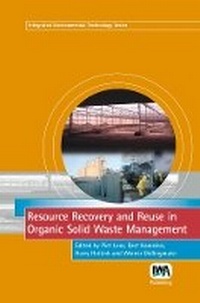
Resource Recovery and Reuse in Organic Solid Waste Management
Published on 1. March 2004
Book
Hardback
538 pages
978-1-84339-054-1 (ISBN)
Description
Uncontrolled spreading of waste materials leads to health problems and environmental damage. To prevent these problems a waste management infrastructure has been set to collect and dispose of the waste, based on a hierarchy of three principles: waste prevention, recycling/reuse, and final disposal. Final disposal is the least desirable as it causes massive emissions, to the atmosphere, water bodies and the subsoil. The emission of methane to the atmosphere is an important source of greenhouse gasses. Organic waste therefore gets a lot of attention in waste management, which for Europe can be illustrated by the issue of the Landfill Directive (99/31/EC) and the Sewage Sludge Directive (86/278/EEC). Proper treatment of organic waste may however turn this burden into an asset. In particular, biological treatment may help in developing more effective resource management and sustainable development. The following advantages may be listed: The greenhouse effect is tackled as methane emissions from landfilling are prevented Soil quality can be restored or enhanced by the use of compost in agriculture Compost may replace peat in horticulture and home gardening, reducing greenhouse emissions and wetland exploitation Anaerobic digestion has the additional benefit of producing biogas that may be used as a fuel Pesticide use can be reduced by proper use of the disease suppressive properties of compost Resource Recovery and Reuse in Organic Solid Waste Management disseminates at advanced scientific level the potential of environmental biotechnology for the recovery and reuse of products from solid waste. Several options to recover energy out of organic solid waste from domestic, agricultural and industrial origin are presented and discussed and existing economically feasible treatment systems that produce energy out of solid waste and recover useful by-products in the form of fertiliser or soil conditioner are demonstrated. The potential of environmental biotechnology is highlighted from different perspectives: societal, technological and practical.
More details
Series
Edition
Revised edition
Language
English
Place of publication
London
United Kingdom
Target group
College/higher education
Professional and scholarly
Edition type
Revised edition
Dimensions
Height: 234 mm
Width: 156 mm
Thickness: 18 mm
ISBN-13
978-1-84339-054-1 (9781843390541)
Copyright in bibliographic data and cover images is held by Nielsen Book Services Limited or by the publishers or by their respective licensors: all rights reserved.
Schweitzer Classification
Other editions
Additional editions
Piet Lens | B. Hamelers | H. Hoitink
Resource Recovery and Reuse in Organic Solid Waste Management
E-Book
03/2004
IWA Publishing
€188.99
Available for download