

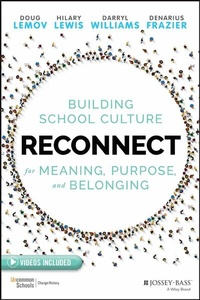
Reconnect
Description

In Reconnect: Building School Culture for Meaning, Purpose, and Belonging, a team of distinguished educators from Teach Like a Champion and Uncommon Schools deliver practical guidance and concrete advice for teachers, administrators, and community members who seek to dramatically improve the lives of children and young people by fostering a sense of belonging in schools. In the book, you'll find hands-on solutions to build or rebuild students' sense of shared work and community in an era of increasing isolation and disconnections.
The authors draw on extensive experience with high-performing schools to show you how to build environments that allow young people to thrive and socialize them to become citizens who seek the well-being of those around them. You'll also get:
* Complimentary access to videos and downloadable assets via https://www.wiley.com/go/reconnect that can be used both within and outside of the classroom
* Actionable strategies for countering the increasing isolation of students that has been aggravated by remote learning
* Useful ways to facilitate positive and beneficial peer-to-peer interactions between students
A can't-miss resource for K-12 teachers and administrators working in public, private, or charter schools, especially those in underserved communities, Reconnect will also prove a practical guide for parents and community members involved in the education of local children and young people.
More details
Other editions
Additional editions
Persons
HILARY LEWIS is the Senior Director of Consulting and Partnerships on the Teach Like a Champion team. Hilary attributes her love of education to her first and best teacher--her mother.
DARRYL WILLIAMS is is the CEO of the Teach Like a Champion team. He previously served as the Chief Officer, Office of School Leadership for Houston Independent School District.
DENARIUS FRAZIER is the Principal of Uncommon Collegiate Charter High School in Brooklyn, NY, and serves as a Senior Advisor on the Teach Like a Champion Partnerships and Consulting Team.
Content
About the Authors xi
Introduction: What's the Problem? xiii
1 How We're Wired Now 1
2 A Great Unwiring 31
3 Rewiring the Classroom: Teaching That Amplifies the Signals of Belonging 75
4 Wiring the School for Socioemotional Learning 129
5 Case Studies in the Process of Rewiring 173
Afterword: How We Choose 215
Index 225
Chapter 1
How We're Wired Now
The beauty and tragedy of the modern world is that it eliminates many situations that require people to demonstrate a commitment to collective good.
-Sebastian Junger
In the introduction, we laid out three major challenges facing our students and schools: our need for belonging in an age of individualism, the smart-phone induced mental health crisis, and a broader lack of trust in institutions. Those arguments will inform the solutions we outline in the rest of this book. In this chapter, we'll explain the challenges they pose in greater depth and begin to explore some ways schools can use an understanding of them to rewire the ways they design interactions with students and even with their families.
ARGUMENT ONE: THE IMPERATIVE OF BELONGING
One of the most important things to understand about human beings is that we have evolved to form ourselves into groups with mutual responsibility and shared purpose, and to crave the feelings of belonging, meaning, and community such group membership creates. This profoundly shapes our motivations and desires-even when, as is often the case, we don't realize it.
The desire for belonging comes to us via a million or so years of evolution-both human and, before that, hominid. When we glance backwards at that process, we tend to see it through the lens of our contemporary individualism. That is, we explain the processes of becoming "us" by focusing on the critical role of individual traits and characteristics. In the simplest possible terms, we believe that we prospered thanks to our big brains, bipedal posture, and opposable thumbs. And while that's undoubtedly true, it's only part of the story. Just as crucial to the success of our ancestors was the building of purposeful, cooperative, and mutually responsible groups.
Through eons of prehistory, to be a hominid standing alone on the grassland with a big brain and a host of exceptional attributes was nonetheless to starve to death or become something else's meal, probably very quickly. Humans alone are weak and slow and far outclassed by a host of rivals in the tools of hunting and defense. But to be standing on the grassland as part of a small group of humans capable of sustained coordination, loyalty, and cooperation-a group that could successfully pursue prey in a coordinated manner for hours at a stretch; a group that would stick together when something with claws and teeth attacked-to form such a group was to become, suddenly, an apex predator. The apex predator.
For the overwhelming majority of our existence, only humans who were able to form productive groups and facilitate their successful inclusion in them survived. Those who failed to join, those who made groups that splintered, those who were kicked out of groups, did not survive. We are individualists now, all of us-particularly those of us in the United States and the United Kingdom-but for most of our evolution, too much individualism was a death sentence.
Across thousands of generations of selection, the imperative of group formation was wired into us as strongly and profoundly as the instincts to mate and nurture our young. That's the way evolution works. We must be drawn to the survival imperatives without knowing it. It has to be bred in the bone.
The importance of rock throwing, described by William von Hippel in his remarkable study of evolutionary group dynamics, The Social Leap, is a case study. Rock throwing, or more precisely group rock throwing, is "the most important military invention of all time," von Hippel argues, and one of the most critical breakthroughs in the cognitive development of humankind.
We no longer think of rocks as deadly weapons, but well into the 19th century, von Hippel points out, professional soldiers bearing firearms were frequently forced to retreat with casualties in the face of indigenous peoples armed with nothing other than rocks. Even a rifle column was occasionally no match for a score of individuals who had cleverly surrounded it and were pelting away with brutal accuracy from carefully coordinated positions.
In the context of evolutionary history, von Hippel writes, cooperative rock throwing allowed a weaker species to defend itself from, and even to hunt, bigger, faster, or stronger adversaries for the first time. Suddenly humans could attack or defend from a distance-a position that allows for far greater safety. Fifteen humans might prevail over a lion in close combat but only at the likely cost of several members of the group, but fifteen humans throwing rocks at the lion offers a potential triumph at defense or even conquest, with far better odds of survival for each individual and therefore more reliably, more effectively, and more aggressively. It turns prey into predator. At last humans were not among the weakest species-if and only if they could achieve mutual cooperation.1
Individuals who learned to work cooperatively in this manner were at an enormous advantage, and, von Hippel notes, "evolution would have favored any subsequent psychological changes that supported the quality of the group's collective response. Our ancestors who could be counted on by others to be cooperative reaped a great reward as a result." Soon enough the competition was among groups within the species, and once again selection would have rewarded those groups that were most successful at cooperation and reciprocity.
The individuals who survived and thrived were those who were able to form groups that stuck together even under duress, but this only worked if the overwhelming majority of group members could be relied upon to embrace mutualism. We evolved to constantly seek groups where we feel the pull of mutual responsibility, where we see evidence that complex tasks can be achieved reliably, where trust and cooperation are understood. Once we find such a group, we continually look for confirmation that we are members in good standing or, on the other hand, signs that we may be pushed out. To our evolutionary selves, being cast out is a death sentence. To a slightly lesser degree, so is being in a group not capable of mutual defense, coordination, and loyalty. Groupishness was (and is) of the highest importance to us because it was so utterly central to our survival.
Only in the plural form were humans the winners of natural selection, in other words, and even if the importance of the group to our success now seems far less relevant to us, we are wired still to attend powerfully to group norms and to fear isolation, separation, and the possibility that we might be ostracized. "Individuals aren't really individuals," observes Sandy Pentland, director of Connection Science at MIT,2 or at least not exclusively so. Of course, throughout evolution we also competed as individuals within groups at the same time as we competed among groups: we competed for status within the group, for the right to choose mates.3 But better from a selection perspective to be a mid-status member of a close-knit group than the alpha in a group that could not marshal unity and cooperation.
Evidence that the social nature of evolution is wired into us isn't far beneath the surface. Social isolation is stressful to us, and people who experience sustained loneliness and social disconnection suffer in both physical and mental health. BYU psychologist Julianne Holt-Lunstad studied the relationship of social connections to mortality rates and found that having a lack of social connections was equivalent to smoking 15 cigarettes a day.4 Similarly, UCLA professor of medicine Steven Cole found that the immune systems of socially isolated individuals were less robust and less able to fight pathogens effectively.
Our anger is often another example of our groupishness. Humans are quickly angered by "free-riders"-those who break the code of mutualism and seek to reap the benefits of group membership without doing their part to contribute. Far more cultures are permissive of theft, for example-or fail to conceive of it as a problem-than are tolerant of free riding. Its censure is nearly universal, says von Hippel. When we sense that mutualism is breaking down, our instincts tell us that the group could come apart. That's among the biggest threats we can imagine.
We feel far safer when we constantly receive signals of reciprocity and belonging and-perhaps more interesting-when we send them. Generosity-especially generosity within close-knit groups-also exists in every culture on earth. It is almost always accompanied by feelings of satisfaction and happiness. We are happy and feel safe when we reconfirm our own connection to the group. After a few thousand generations, the psychological and emotional well-being that accompanies such behaviors has become deeply encoded.
Small Moments and the Gestures of Belonging
Belonging is among the most powerful human emotions, and Daniel Coyle discusses its role in modern group formation in his book The Culture Code: The Secrets of Highly Successful Groups. Belonging, he notes, is often built via small moments and seemingly insignificant gestures. In fact, it is mostly built that way. Cohesion and trust occur when group members send and receive small, frequently occurring signals of belonging. The accrual of these signals is almost assuredly more influential than grand statements of togetherness or...
