

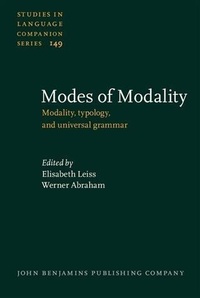
Modes of Modality
Modality, typology, and universal grammar
1st Edition
Published on 24. January 2014
VI, 511 pages
978-90-272-7079-5 (ISBN)
Description

The volume aims at a universal definition of modality or "illocutionary/speaker's perspective force" that is strong enough to capture the entire range of different subtypes and varieties of modalities in different languages. The central idea is that modality is all-pervasive in language. This perspective on modality allows for the integration of covert modality as well as peripheral instances of modality in neglected domains such as the modality of insufficieny, of attitudinality, or neglected domains such as modality and illocutionary force in finite vs. nonfinite and factive vs. non-factive subordinated clauses. In most languages, modality encompasses modal verbs both in their root and epistemic meanings, at least where these languages have the principled distribution between root and epistemic modality in the first place (which is one fundamentally restricted, in its strict qualitative and quantitative sense, to the Germanic languages). In addition, this volume discusses one other intricate and partially highly mysterious class of modality triggers: modal particles as they are sported in the Germanic languages (except for English). It is argued in the contributions and the languages discussed in this volume how modal verbs and adverbials, next to modal particles, are expressed, how they are interlinked with contextual factors such as aspect, definiteness, person, verbal factivity, and assertivity as opposed to other attitudinal types. An essential concept used and argued for is perspectivization (a sub-concept of possible world semantics). Language groups covered in detail and compared are Slavic, Germanic, and South East Asian. The volume will interest researchers in theoretical and applied linguistics, typology, the semantics/pragmatics interface, and language philosophy as it is part of a larger project developing an alternative approach to Universal Grammar that is compatible with functionalist approaches.
More details
Other editions
Additional editions
Book
01/2014
John Benjamins Publishing Co
€111.30
Shipment within 10-15 days
Persons
Content
- Modes of Modality
- Editorial page
- Title page
- LCC data
- Table of contents
- Introduction
- Elisabeth Leiss & Werner Abraham
- part i
- Formal properties of modality
- Interpreting modals by phase heads*
- Daigo Akiba
- Evidentiality straddling T- and C-domains*
- Nadia Varley
- part ii
- Typological surveys
- The syntax of modal polyfunctionality revisited
- Evidence from the languages of Europe
- Björn Hansen
- Mora da as a marker of modal meanings in Macedonian
- On correlations between categorial restrictions and morphosyntactic behaviour*
- Björn Wiemer
- Modal semantics and morphosyntax of the Latvian DEBITIVE
- Ilze Lokmane & Andra Kalnaca
- Deontic or epistemic? habere as a modal marker of future certainty in Macedonian
- Liljana Mitkovska & Eleni Buzarovska
- Epistemic, evidential and attitudinal markers in clause-medial position in Cantonese
- Foong Ha Yap & Winnie Oi-Wan Chor
- part iii
- Interfaces between mood and modality
- Modal particles in rationale clauses and related constructions*
- Patrick Grosz
- Modal particles in causal clauses
- The case of German weil wohl*
- Mathias Schenner & Frank Sode
- part iv
- Modality conceptualizations
- Enablement and possibility
- Raphael Salkie
- The modal category of sufficiency
- Chantal Melis
- part v
- Diachronic derivation
- From agent-oriented modality to sequential
- The polysemy of the marker ni in Kakabe (Mande)
- Alexandra Vydrina
- part vi
- Covert modality
- A rare case of covert modality
- Spoken Polish and the novel periphrastic past with miec 'have'
- Werner Abraham & Jadwiga Piskorz
- (C)Overt epistemic modality and its perspectival effects on the textual surface*
- Sonja Zeman
- Dimensions of implicit modality in Igbo
- Chinedu Uchechukwu
- Introduction
- 1. General background
- 2. Formal properties of root vs. epistemic and evidential modality
- 3. Modality in typological survey
- 4. Interfaces between speech act, conditional, and modality
- 5. Modality reconceptualized
- 6. Covert modality
- References
- Interpreting modals by phase heads*
- 1. Introduction
- 2. Root vs. epistemic modals
- 2.1 Structural positions
- 2.2 Scope
- 2.2.1 Tense
- 2.2.2 Adverbs
- 2.2.3 Quantifiers
- 2.3 Interim summary
- 3. The phase-based approach to modal interpretations
- 3.1 Phase-by-phase modal interpretation
- 3.2 Butler's (2003) analysis
- 3.3 Modal interpretations by phase heads
- 4. Conclusion
- Abbreviations
- References
- Evidentiality straddling T- and C-domains*
- 1. Introduction
- 2. Approaching the object of inquiry
- 2.1 What is evidentiality?
- 2.2 Evidential types
- 2.3 The ASP/TNS/Mood triplet and evidentiality
- 2.3.1 Theoretical background
- 2.3.2 The perfect paradigm and evidentiality
- 2.3.3 Usages of the -l morpheme in Bulgarian
- 2.3.4 On mirativity
- 2.3.5 Modality and evidentiality
- 3. The proposal
- 3.1 Speas (2004)
- 3.2 Deixis
- 3.3 On the 1/2PRSN vs. 3PRSN asymmetry
- 3.4 Person geometry and evidential "vouchers"
- 3.5 The structural position(s) of evidentiality
- 3.5.1 Epistemic and root modality
- 3.5.2 A pervasive asymmetry: i-EVID vs. h-EVID
- 3.5.2.1 The doings of the left periphery. The main claim of this paper is that there is a sharp distinction to be drawn between hearsay/quotative evidentiality and inferential evidentiality (with mirativity yet a way higher, cf. §2.3.4). This also means t
- 3.5.2.2 Explaining (and redressing) the 'boojum'. In a sequence of papers, Friedman (1982, 1986, 2001) consistently argues that the Bulgarian evidential is an elusive 'boojum', and auxiliary suppliance in conjunction with -l participles subject to (styli
- 3.6 Interim considerations
- 4. Crossroads of evidentiality
- 4.1 Logophoricity, logophoric domains, and control
- 5. Concluding remarks
- Abbreviations
- References
- The syntax of modal polyfunctionality revisited
- 0. Introduction
- 1. The typological data
- 2. Approaches to modal polyfunctionality
- 2.1 The tradition in Germanic linguistics
- 2.2 The typological perspective
- 3. A classificatory typology of modal constructions
- 3.1 Subject encoding
- 3.2 INFL: Subject-predicate agreement
- 3.2.1 Subject-predicate agreement marking in modal constructions without copula
- 3.2.2 Subject-predicate agreement marking in modal constructions with copula
- 3.3 INFL: Tense (TAM) marking
- 4. Searching for syntactic features that correlate with modal polyfunctionality
- 4.1 Modals and the auxiliary-main verb distinction
- 4.2 Modals and complexity mismatch (raising vs. control)
- 4.3 Modals and the coherence of verbal complexes
- 5. Conclusion
- Abbreviations
- References
- Mora da as a marker of modal meanings in Macedonian
- 1. Introduction and formulation of the task
- 2. Mac. mora (da): A survey of its meaning range and syntactic behaviour
- 2.1 On the Macedonian system of TAM-forms and grammatical evidentiality
- 2.2 mora da and restrictions on AT-forms
- 2.2.1 The perfects
- 2.2.2 Aspect (pfv.: Ipfv.) in the present tense
- 2.2.3 Confirmative past tenses
- 2.2.4 Future and conditional/potential
- 2.2.5 Interim summary
- 3. Lexical vs. grammatical status of mora (da)
- 3.1 Stepwise reduction of verbal features on mora
- 3.2 Other distributional facts
- 4. Conclusions
- Abbreviations in glosses (not covered by the Leipzig Glossing Rules)
- References
- Modal semantics and morphosyntax of the Latvian DEBITIVE
- 1. Introduction
- 2. The grammatical moods in Latvian
- 3. Description of the Latvian debitive
- 3.1 Sub-moods of the debitive
- 3.1.1 Combination of the debitive and oblique
- 3.1.2 Combination of the debitive and conditional
- 3.2 The debitive in the passive voice
- 3.3 Problems of description of the debitive in Latvian grammars
- 4. The debitive and modality
- 4.1 The root modality reading
- 4.2 The epistemic modality reading
- 4.3 Modal and evidential meanings of the debitive combinations
- 5. Distributional traits of the debitive
- 5.1 The argument structure in debitive constructions
- 5.2 The choice between the Nominative or Accusative argument
- 5.3 The debitive and patterns of agreement
- 6. Concluding remarks
- Abbreviations
- References
- Deontic or epistemic? habere as a modal marker of future certainty in Macedonian
- 1. Introduction
- 2. Theoretical background
- 3. Goals and methodology
- 4. Grammaticalization of ima
- 4.1 Components of ima da-constructions
- 4.2 Overview of the grammaticalization stages
- 5. The semantics of uninflected ima
- 5.1 Uninflected ima compared to closely related modal expressions
- 5.2 The meaning of 'future certainty' as a distinctive mark of uninflected ima
- 6. Semantic differences between inflected and uninflected constructions
- 7. Conclusion: Uninflected ima as a marker of futural epistemic necessity
- Abbreviations
- References
- Epistemic, evidential and attitudinal markers in clause-medial position in Cantonese
- 1. Introduction
- 2. Epistemic, evidential and attitudinal parentheticals derived from complement-taking psych verbs
- 2.1 Parenthetical epistemic marker ngo5 gok3dak1 'I feel/think'
- 2.2 Parenthetical epistemic and evidential marker (ngo5) paa3 'I'm afraid'
- 2.3 Parenthetical attitudinal marker (ngo5) m4zi1 ('I don't know')
- 2.4 Insubordination, subject ellipsis, topic constructions, and the grammaticalization of parenthetical stance markers
- 3. Postverbal directional particles as attitudinal markers
- 3.1 Postverbal faan1 as a marker of speaker's positive evaluation
- 3.2 Postverbal maai4 as a marker of speaker's pejorative attitude
- 3.3 Verbal complementation and the emergence of postverbal attitudinal particles
- 4. Summary discussion and conclusion
- Acknowledgements
- Abbreviations
- References
- Modal particles in rationale clauses and related constructions*
- 1. Background: On the connection between force, modality and mood
- 2. The core puzzle: 'Imperative particles' in rationale clauses
- 2.1 Introducing the German particles 'ruhig', 'JA' and 'bloß'
- 2.2 Rationale clauses with 'ruhig', 'ja' and 'bloß' - The empirical scope
- 2.3 Rationale clauses with 'ruhig', 'JA' and 'bloß' - The core puzzle
- 3. The solution in a nutshell
- 4. Rationale clauses as modalized expressions
- 4.1 Introducing the rationale clause modal
- 4.2 The variable nature of the rationale clause modal
- 5. bloß/JA/ruhig as modal modifiers
- 5.1 The general pattern
- 5.2 The semantics of 'bloß'/'JA'/'ruhig'
- 5.3 A note on the formal implementation
- 6. Alternative views
- 6.1 Portner (2012)
- 6.2 Schwager (2010)
- 7. Conclusion
- References
- Modal particles in causal clauses
- 1. Introduction
- 2. Theoretical background
- 2.1 Causal clauses
- 2.2 Modal particles
- 3. Modal particles in causal clauses
- 3.1 Modal particles and Force-based licensing
- 3.2 Causal clauses may contain illocutionary wohl
- 3.3 On the semantic clash of weil and wohl
- 4. Dynamics to the rescue: Toward solving the puzzle
- 5. Conclusion and further directions
- References
- Enablement and possibility
- 0. Introduction
- 1. Enablement
- 2. Enablement in different languages
- 3. Theoretical implications
- 3.1 Necessary conditions
- 3.2 Does can express a type of "root" modality?
- 3.3 Impliciture, saturation and free enrichment
- 3.4 Types of possibility
- 3.5 Modality, semantics and pragmatics
- 4. Previous treatments of can and may
- 5. Conclusion
- References
- Appendix - More corpus examples
- The modal category of sufficiency
- 1. Introduction
- 2. The quantitative dimension
- 3. The modal component: Antecedents
- 4. Proposal
- 5. Enough and so . that constructions
- 6. Insufficiency and excess
- 7. Polar adjectives
- 8. Implicative readings
- 9. Conclusions
- References
- From agent-oriented modality to sequential
- 1. Introduction
- 2. Kakabe predicative categories
- 3. The primary uses of ni
- 4. Predicative marker ni after clauses with the temporal-conditional predicative marker mani
- 4.1 Semantics of the predicative marker mani
- 4.2 The predicative marker ni in the mani construction with deontic modal meaning
- 4.3 The predicative marker ni in the mani construction with the meaning of entailed result
- 4.4 The predicative marker ni in the mani construction with past iterative meaning
- 4.5 The predicative marker ni in the mani construction with past (non-iterative) meaning
- 5. Interpretation
- 5.1 Semantic bleaching
- 5.2 The increase of meaning scope, subjectification (from statement about external world to speaker's assessment of the situation)
- 5.3 From propositional to textual meaning and the development of a clause linker
- 5.4 Comparative evidence
- 5.5 Modality and clause linking
- 6. Conclusions
- References
- A rare case of covert modality
- 1. Introduction
- 2. The grammaticalization of a new periphrastic past in Polish. A contribution to the evolutionary logic of temporal and modal periphrasis
- 3. Signs of a newly emerging analytic past in spoken Polish
- 4. Grammaticalizing into the new analytic active past in Modern Polish
- 5. Signals testifying to the new development of analytic tensing in Polish
- 6. miec+V as modal construal in root and epistemic interpretation
- 7. The logic underlying covert modality
- 7.1 A few words ahead
- 7.2 Covert epistemics presupposes finiteness - the "epistemic non-finiteness gap"
- 7.3 BE-TO- and HAVE-TO-infinitive
- 7.4 Old High German 'sein + zu-infinitive'
- 7.5 Summary: Form and morphologically explicit modality early on: HAVE/BE(+DP)+zu-infinitive
- 8. The miec+PP past and its covert modality
- 8.1 The facts without the infinitival preposition
- 8.2 The facts with the infinitival preposition do German "zu", English "to"
- 8.3 Attempt at an explanation of the covert modality of miec+PP/non-finite V
- 8.4 Summary: The grammaticalizing features of miec + PP and the derived classification
- 9. Conclusions: Criticism - and its status after this
- 9.1 Resultative Past or Resultative Passive?
- 9.2 Periphrastic cycle in Polish?
- 9.3 The role of transitivity in grammaticalization?
- 9.4 Is miec a true modal verb?
- 9.5 miec by itself is not a modal verb
- 9.6 All root modal is futural, while epistemic modality is not
- 9.7 Factors weakening the "Aspect-Modality-Correlation Generalization"
- 9.8 Is epistemic modality really a derivative of root modality?
- 9.9 Pure reliance on usage obscures the need to search for profound, cross-linguistically more generalizable links
- 9.10 Are the Polish modals calques from German?
- 9.11 The wide range of epistemicity in Polish
- 9.12
- Primary sources
- References
- (C)Overt epistemic modality and its perspectival effects on the textual surface*
- 0. The universal character of modality
- 1. What is (c)overt modality?
- 2. The essence of modality2
- 3. Perswpectival effects of (c)overt modality2 in grammar, sentence, text
- 3.1 (C)Overt modality2 and its effects of perspectivization in grammar
- 3.2 (C)Overt modality2 and its perspectival effects on the sentence level
- 3.3 (C)Overt modality2 on the textual surface
- 4. Conclusion: The silent ubiquity of epistemic meaning in human language
- References
- Dimensions of implicit modality in Igbo
- 1. Modality in Igbo: The gradual history of recognition of a grammatical category
- 2. Covert and implicit modality
- 3. The explicit modal structures of the Igbo language
- 4. In search of covert modality in Igbo
- 4.1 Translational covert modals
- 4.1.1 Wh-infinitival complements Wh-complement construction
- 4.1.2 Subject infinitival relatives Simple relative construction
- 4.1.3 Purpose clauses
- 4.2 More generally, Igbo covert modal structures
- 4.2.1 Covert Modality in the verb -kwé 'agree, admit'
- 4.2.2 Covert modality with the BVC
- 4.2.2.1 The Characterization of BVC in Igbo Linguistics
- 5. Summary and Conclusion
- References
- Index
