

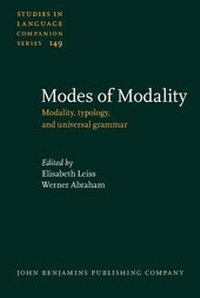
Modes of Modality
Modality, typology, and universal grammar
Published on 24. January 2014
Book
Hardback
511 pages
978-90-272-0616-9 (ISBN)
Description
The volume aims at a universal definition of modality or "illocutionary/speaker's perspective force" that is strong enough to capture the entire range of different subtypes and varieties of modalities in different languages. The central idea is that modality is all-pervasive in language. This perspective on modality allows for the integration of covert modality as well as peripheral instances of modality in neglected domains such as the modality of insufficieny, of attitudinality, or neglected domains such as modality and illocutionary force in finite vs. nonfinite and factive vs. non-factive subordinated clauses. In most languages, modality encompasses modal verbs both in their root and epistemic meanings, at least where these languages have the principled distribution between root and epistemic modality in the first place (which is one fundamentally restricted, in its strict qualitative and quantitative sense, to the Germanic languages). In addition, this volume discusses one other intricate and partially highly mysterious class of modality triggers: modal particles as they are sported in the Germanic languages (except for English). It is argued in the contributions and the languages discussed in this volume how modal verbs and adverbials, next to modal particles, are expressed, how they are interlinked with contextual factors such as aspect, definiteness, person, verbal factivity, and assertivity as opposed to other attitudinal types. An essential concept used and argued for is perspectivization (a sub-concept of possible world semantics). Language groups covered in detail and compared are Slavic, Germanic, and South East Asian. The volume will interest researchers in theoretical and applied linguistics, typology, the semantics/pragmatics interface, and language philosophy as it is part of a larger project developing an alternative approach to Universal Grammar that is compatible with functionalist approaches.
More details
Series
Language
English
Place of publication
Amsterdam
Netherlands
Target group
Professional and scholarly
Illustrations
+ index
Weight
1060 gr
ISBN-13
978-90-272-0616-9 (9789027206169)
Copyright in bibliographic data and cover images is held by Nielsen Book Services Limited or by the publishers or by their respective licensors: all rights reserved.
Schweitzer Classification
Other editions
Additional editions
E-Book
01/2014
1st Edition
John Benjamins Publishing Company
€130.99
Available for download
Persons
Content
1. Introduction (by Leiss, Elisabeth); 2. Part I. Formal properties of modality; 3. 1 Formal properties of modality; 4. Interpreting modals by phase heads (by Akiba, Daigo); 5. Evidentiality straddling T- and C-domains (by Varley, Nadia); 6. Part II. Typological surveys; 7. The syntax of modal polyfunctionality revisited: Evidence from the languages of Europe (by Hansen, Bjorn); 8. Mora da as a marker of modal meanings in Macedonian: On correlations between categorial restrictions and morphosyntactic behaviour (by Wiemer, Bjorn); 9. Modal semantics and morphosyntax of the Latvian DEBITIVE (by Lokmane, Ilze); 10. Deontic or epistemic? habere as a modal marker of future certainty in Macedonian (by Mitkovska, Liljana); 11. Epistemic, evidential and attitudinal markers in clause-medial position in Cantonese (by Yap, Foong Ha); 12. Part III. Interfaces between mood and modality; 13. Modal particles in rationale clauses and related constructions (by Grosz, Patrick Georg); 14. Modal particles in causal clauses: The case of German weil wohl (by Schenner, Mathias); 15. Part IV. Modality conceptualizations; 16. Enablement and possibility (by Salkie, Raphael); 17. The modal category of sufficiency (by Melis, Chantal); 18. Part V. Diachronic derivation; 19. From agent-oriented modality to sequential: The polysemy of the marker ni in Kakabe (Mande) (by Vydrina, Alexandra); 20. Part VI. Covert modality; 21. A rare case of covert modality: Spoken Polish and the novel periphrastic past with miec 'have' (by Abraham, Werner); 22. (C)Overt epistemic modality and its perspectival effects on the textual surface (by Zeman, Sonja); 23. Dimensions of implicit modality in Igbo (by Uchechukwu, Chinedu); 24. Index