

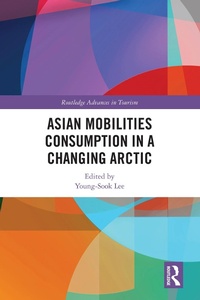
Asian Mobilities Consumption in a Changing Arctic
Description

This book provides an in-depth examination of the growing Asian tourism market and consumption in Arctic destinations.
Through five parts, the book covers Asian mobilities consumption as an extension of Arctic international politics, the transportation sector and green cruise tourism, and ethnicity, culture, and history. It contributes to further understanding of the impacts of increased tourism in these polar regions by exploring climate change, debates around emerging economies and global power roles in the political, socio-economic, security and legal issues of the Arctic and Antarctic and associated polar strategies and policy. By drawing on a range of disciplines and with contributions from experts in Arctic destinations or who are associated with the Arctic, it further provides a holistic framing of emerging demand and mobility patterns of Asian tourists in a polar context.
Asian Mobilities Consumption in a Changing Arctic will be valuable reading for students and academics across the fields of tourism, economics, sustainability, development studies as well as other social science disciplines.
Reviews / Votes
„Asian tourists are interested in the Arctic and travelled to the Arctic in large numbers until the corona-pandemic temporarily closed down international travelling in 2020/21. There are reasons to believe that we soon will see numerous Asian tourists in the Arctic again. Asian Mobilities Consumption in a Changing Arctic brings many of the leading researchers in Arctic tourism together to provide a varied and interesting state of the art view of the phenomenon. It provides a rich reference source for the tourism industry, researchers and students in the field.” – Anne Husebekk, Rector (University President), UiT The Arctic University of Norway
„The book represents a timely, interesting, and important investigation of Asian mobilities. The terms Arctic, conspicuous mobilities, consumption, sustainability, politics, and urbanisation appear to be at odds with each other at first glance. However, the discussion sets the foundation for a multitude of exciting research agenda and provides a fresh perspective for practitioners. Not only is this a reference book for researchers, practitioners should benefit tremendously from the insights presented.” – Cathy H.C. Hsu, Professor, The Hong Kong Polytechnic University, PRC.
More details
Other editions
Additional editions
Person
Young-Sook Lee is professor in tourism management at the School of Business and Economics, UiT The Arctic University of Norway.
As a Korean-Australian (moved to Australia after her first degree), she completed her PhD in Sociology (applied in tourism) at the University of Queensland, Australia. She worked as a tourism management academic in Australia (Griffith University) for over 15 years before relocating to Norway in 2014.
Content
Part 1 Setting the scene: Asian mobilities consumption and the Arctic
- Asia, mobilities, consumption power and the Arctic
Young-Sook Lee - A critique on the non-critical application of Veblen´s conspicuous consumption: A perspective on Asian mobilities in the Arctic
Young-Sook Lee
Part 2 Arctic politics and Asia mobilities
- Chinese tourism consumption vis-à-vis tourism development strategies in the Arctic
Emma Björner, Elena Dybtsyna and Erik Lundberg - Chinese tourism in the Russian Arctic and Far East: Implications of a China-Russia political partnership
Mariia Kobzeva - Greenland, the Faroe Islands, Chinese tourism – sustainable development in the face of otherness, growth, and power
Nathan Reigner, Gestur Hovgaard and Firouz Gaini
Part 3 Green cruise tourism and the potential new sea route between Asia and the Arctic
- Renewable energy-based cruise tourism for Asians in the Arctic: A perspective from northern Norway
Odin Foldvik Eikeland and Matteo Chiesa - The Northeast Passage: Connecting China and the Arctic through cruise tourism?
Minna-Liina Ojala, Juulia Räikkönen and Tuomas Kiiski
Part 4 Ethnicity, culture, experiences and urbanisation
- "When I hear there’s going to be an Asian tourist ... ": The role of Asian ethnicity in the planning process of guided tours in Svalbard
Eva Kotašková and Matouš Jelínek - Thai mobility and consumerism at North Cape, Norway: Zooming in on a stone at a tourist Site
Line Mathisen and Siri Ulfsdatter Søreng - Learning from an Arctic adventure tourism guide: An exploratory study of emotional labour when leading Chinese consumers
Wilson Wai Yin Cheung - The Chinese riddle: Tourism, China and Svalbard
Zdenka Sokolickova - Embracing Chinese tourists in Iceland: The response of the tourism industry
Vera Vilhjálmsdóttir, Guðrún Þóra Gunnarsdóttir and Rosemary Black - Designing winter cities: Arctic urbanisation and Asian mobilities consumption
David Chapman, Young-Sook Lee and Agneta Larsson
Part 5 Closing
- Sustainable mobilities consumption and Asia in a global Arctic: Observations and ways forward
Young-Sook Lee
