

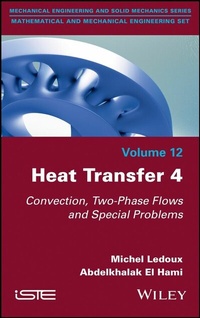
Heat Transfer 4
Description

Heat transfers are, by nature, classified as conduction, convection (which inserts conduction into fluid mechanics) and radiation. The importance of these three transfer methods has resulted - justifiably - in a separate volume being afforded to each of them, with the subject of convection split into two volumes. This fourth volume is dedicated to convection, more specifically, the problem of particular convective transfers. Twophase convection is considered and a more recent and much lesser-known field is presented, that of phase change transfer. Particular significance is given to numerical applications, allowing the reader to handle orders of magnitude, an important point in all physics.
Heat Transfer 4 combines a basic approach with a deeper understanding of the discipline and will therefore appeal to a wide audience, from technician to engineer, from doctoral student to teacher-researcher.
More details
Other editions
Additional editions
Persons
Michel Ledoux was Professor and Vice-President at the University of Rouen, France. He was also Director of the UMR CNRS CORIA, then Regional Delegate for Research and Technology in Upper Normandy, France. Specializing in fluid mechanics and transfers, he has worked in the fields of reactive boundary layers and spraying. Currently retired, he is an adviser to the Conservatoire National des Arts et Métiers in Normandy, collaborating with the Institute of Industrial Engineering Techniques (ITII) in Vernon, France.
Abdelkhalak El Hami is Full Professor of Universities at INSA-RouenNormandie, France. He is the author/co-author of several books and is responsible for several European pedagogical projects. He is a specialist in fluid structure interaction and problems of optimization and reliability in multi physical systems.
Content
Preface ix
Introduction xi
List of Notations xix
Chapter 1 Concepts of Gas-Liquid Flows 1
1.1 Introduction and basic concepts 1
1.2 Gas-liquid flows 2
1.2.1 The physics of two-phase flows 3
1.2.2 Classification of flows 16
1.2.3 Topologies of a heated vertical flow 23
1.2.4 Calculation of fluxes 27
1.3 Dispersed phase flows: mists and sprays 35
1.3.1 Mist 35
1.3.2 Spray generation 37
1.3.3 Spray characterization: particle sizing 38
1.3.4 Spray vaporization: the case of the isolated drop 42
1.4 Several examples 43
Chapter 2 Convection of Species 63
2.1 Introduction 63
2.2 Characterization of a mixture: definitions 63
2.3 Law of diffusive transfer: Fick's law 64
2.4 Similarity of transport equations 66
2.5 Solving the equations of diffusive transport 69
2.5.1 Analogies 69
2.5.2 Non-reactive boundary layer: concentration fixed at the wall 71
2.5.3 Non-reactive boundary layer: wall catalysis 73
2.5.4 Reactive boundary layer 79
Chapter 3 Phase Change Materials 81
3.1 Introduction 81
3.2 PCM for cooling mechatronics devices 84
3.2.1 Description of heat transfer and PCM behavior 85
3.2.2 PCM behavior 87
3.3 Numerical model 88
3.3.1 Description of the 3D model 88
3.3.2 Heat sink without PCMs 90
3.3.3 Heat sink with PCMs 91
3.4 Conclusion 95
Chapter 4 Electro-Thermo-Mechanical Modeling of Systems 97
4.1 Introduction 97
4.2 Theory of electro-thermo-mechanical coupling 98
4.2.1 Electro-thermal phenomena 98
4.2.2 Numerical formulation of the electro-thermo-mechanical coupling 100
4.3 Finite element simulation of the electro-thermo-mechanical behavior 103
4.3.1 Strong coupling of the electro-thermo-mechanical modeling 104
4.3.2 Weak coupling of the electro-thermo-mechanical modeling 105
4.4 Example of electro-thermo-mechanical simulation of an HBT transistor 105
4.4.1 Global model of HPA 106
4.4.2 Local model of an HBT transistor 110
4.5 Modal analysis of mechatronic components 113
4.5.1 Writing the equation of the vibration problem 113
4.5.2 Variational formulation 115
4.5.3 Finite element approximation 115
4.5.4 Resolution in the frequency domain 117
4.6 Stochastic modal analysis of mechatronics components 118
4.7. Numerical identification of the elastic parameters of electronic components 119
4.8 Example of modeling and simulation of the vibratory behavior of mechatronic components 120
4.9 Conclusion 127
Appendices 129
Appendix 1 Physical Properties of Common Fluids 131
Appendix 2 Physical Properties of Common Solids 133
Appendix 3 Thermodynamic Properties of Water Vapor 137
Appendix 4 Table of Functions: erf (x) erfc(x) and ierfc(x) 141
References 143
Index 151
Introduction
I.1. Preamble
Thermal energy was probably first perceived (if not identified) by humanity, through the Sun. The themes of night and day are found at the center of most ancient myths. Humanity's greatest fear was probably that the Sun would not return again in the morning. Fire became controlled in approximately 400,000 BP. Thermal transfer was therefore a companion of Homo ergaster, long before Homo sapiens sapiens.
However, it took a few hundred thousand years before so-called "modern" science was born. Newtonian mechanics dates from three centuries ago. Paradoxically, another century and a half passed by before energy was corrections perceived by scientists, in terms of the new field of thermodynamics. Furthermore, a systematic study of heat transfer mechanisms was carried out at the end of the 19th century, and even later for the study of limit layers, the basis of convection.
Heating, lighting and operating the steam engines of the 19th century were all very prosaic concerns. Yet this is where revolutions in the history of physics began: the explosion of statistical thermodynamics driven by Boltzmann's genius, and quantum mechanics erupted with Planck, again with Boltzmann's involvement.
Advances in radiation science, particularly in sensor technology, has enabled us to push back our "vision" of the universe by a considerable number of light years. To these advances we owe, in particular, the renewed interest in general relativity that quantum mechanics had slightly eclipsed, through demonstration of black holes, the physics of which may still hold further surprises for us.
Closer to home, fundamental thermal science, where it is conduction, convection or radiation, contributes to the improvement of our daily lives. This is particularly true in the field of housing where it contributes, under pressure from environmental questions, to the evolution of new concepts such as the active house.
The physics that we describe in this way, and to which we will perhaps introduce some readers, is therefore related both to the pinnacles of knowledge and the banality of our daily lives. Modestly, we will place our ambition in this latter area.
There are numerous heat transfer textbooks in different formats: "handbooks" attempting to be exhaustive are an irreplaceable collection of correlations. High-level courses, at universities or engineering schools, are also quite exhaustive, but they remain demanding for the listener or the reader. Specialist, more empirical thematic manuals are still focused on specialists in spite of all this.
So why do we need another book?
The authors have taught at university level and in prestigious French engineering schools, and have been involved in the training of engineers on block-release courses. This last method of teaching, which has been gaining popularity in recent years, particularly in Europe, incorporates a distinctive feature from an educational point of view. Its practice has, in part, inspired this book.
The aim is to help learners who have not had high-level mathematical training in their first years following the French Baccalaureate (therefore accessible to apprentices), and pupils with more traditional profiles. At the same time, we would like to show this broad audience the very new possibilities in the field of digital processing of complex problems.
When a miner wants to detach a block of coal or precious mineral from a wall, they pick up a pneumatic drill. If we want to construct a tunnel, we must use dynamite. The same is true for physicists.
Whether they are researchers, engineers or simply teachers, scientists have two tools in their hands: a calculator and a computer (with very variable power). Since both authors are teacher researchers, they know they owe everything to the invention of the computer. From the point of view of teaching, however, each one of the two authors has remained specialist, one holding out for the calculator and "back-of-the-napkin" calculations, and the other one using digital calculations.
The revolution that digital tools has generated in the world of "science" and "technical" fields, aside from the context of our daily lives, no longer needs to be proved. We are a "has been" nowadays if we do not talk about Industry 4.0. The "digital divide" is bigger than the social divide, unless it is part of it.
Indeed, the memory of this revolution is now fading. Have students today ever had a "slide rule" in their hands? Do they even know what it is? Yet, all the physicists behind the laws of thermal science had only this tool in hand, giving three significant figures (four with good visibility and tenacity), leaving the user to find a power of ten of the result. It goes without saying that a simple calculation of a reversible adiabatic expansion became an ordeal, which played a part in degrading the already negative image of thermodynamics held by the average student.
This reminder will seem useless to some; slide rules are at best sleeping in drawers. But there is a moral to this story: no matter what type of keyboard we type on, a calculator or a computer, our head must have control over our fingers. This book has been written on the basis of this moral.
A good physicist must have a perfect understanding of the idea of an "order of magnitude". For this, the tool is a calculator. We always do a rough sizing of a project before moving on to detailed modeling and numerical calculations.
The two authors belong to the world of engineering sciences, meaning most of their PhD students have entered the private sector. One of them, having moved into the aerospace sector, came back to see us very surprised by the recurrence of "back-of-the-napkin" calculations in his day-to-day work.
Fundamental or "basic physics" concepts are taken from a type of manual that is resolutely different from those dedicated to the numerical approach. In this case, the authors allow themselves to believe that it is no bad thing to collect them all together in a single book, for once. This is a significant difference that will surprise some and, without doubt, be criticized by others. Nevertheless, when reading this book, an "average" student will be initiated to a field that teaching models generally promised "for later on" (or never if they never go beyond a certain level of education). It is also true that fully immersed in equations and complex calculations, specialist readers will be able to "be refreshed" when faced with the short exercises, which can sometimes surprise and encourage them - why not - to go back to their roots (assuming they had indeed been there).
Another significant difference is that this book is directed at a large scientific audience, which covers possibly the entire field: researchers, PhD students or those who have obtained Confirmation and are just starting out in the field, technicians, students or professionals, engineers. This last type of scientist is perhaps the main target of this book.
Dividing the study of thermal science into three volumes is the result of logic. Presenting this work in four volumes is somewhat arbitrary; in our opinion, however, this split was necessary in order to keep the volumes in the collection a reasonable size.
The first volume, entitled Heat Transfer 1, is dedicated to "classic" approaches (analytical treatment) to conduction, which will be of greater interest to readers who are looking for "simple" prediction methods.
The second volume, entitled Heat Transfer 2, is dedicated to "classic" approaches (analytical treatment) of radiation, and assembles digital approaches of these various transfer modes. It is aimed at engineers or researchers who want to resolve more complex problems.
The third and fourth volumes, entitled Heat Transfer 3 and Heat Transfer 4 are focused on convection transfers. Heat Transfer 3 deals with the fundamentals, integrating various modes of approach, both empirical and theoretical (boundary layer), and gives an introduction to the theory of exchangers. As we have already pointed out, all of these transport operations are rarely pure and lead to problems that involve three inter-connecting transfer modes, conduction, convection and radiation.
Heat Transfer 4 aims to broaden the reader's horizon to more complex transfer modes, such as two-phase transfers. It looks at mass transfer, often in analogy with heat transfer, and explores less-known fields, such as phase change materials. It also introduces the electro-thermo-mechanical modeling of systems.
So, what is this book for?
Above all, it contains problems to be worked on, of which most are accessible to all, from the level of an apprentice technician upwards, either one or two years after the Baccalaureate. This book was written in France, where scientific teaching is structured around universities, engineering Grandes Écoles, engineering training through apprenticeships and two types of technician training sections at high schools or universities. In countries with simpler models, readers should also find it useful.
It seems necessary to surround these problems with strong reminders of past learning, so that the reader does not need to permanently refer back to their manuals. We see two advantages in this: a presentation of the scientific material focusing on the problems, and a second chance for readers to integrate...
