

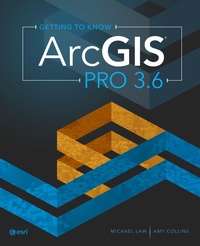
Getting to Know ArcGIS Pro 3.6
Description

Learn how to use ArcGIS Pro with this best-selling, step-by-step workbook and desk reference.
Getting to Know ArcGIS Pro 3.6 explains the basics of how a geographic information system (GIS) works as it teaches readers how to use ArcGIS Pro, the world's most powerful desktop GIS software.
Readers will follow simple step-by-step instructions, accompanied by more than 300 full-color images, to learn core analytic and mapmaking skills.
Topics include:
- ArcGIS and ArcGIS Online basics
- Geospatial data management, geoprocessing, and Python tools
- Map layouts
- Spatial analysis
Throughout the book, case studies of real-world GIS applications show how ArcGIS Pro has been used to solve complex issues. Each chapter uses a real-world exercise dataset, and the chapters are designed to build on each other, providing practical, progressive learning. At the conclusion of every chapter, a summary reinforces the skills covered. The book also includes a glossary of technical terms.
Getting to Know is the best-selling series that has been guiding readers in learning about GIS for more than 20 years. Ideal for students, self-learners, and professionals who want to learn the premier GIS desktop application, Getting to Know ArcGIS Pro 3.6 is a textbook and desk reference designed to show users how to use ArcGIS Pro successfully.
More details
Other editions
Additional editions
Persons
Michael Law is a cartographer and GIS professional. He lives in Toronto, Canada.
Content
Preface
Chapter 1: Introducing GIS
Exercise 1: Explore ArcGIS Online
Chapter 2: A first look at ArcGIS Pro
Exercise 2a: Learn some basics
Exercise 2b: Go beyond the basics
Exercise 2c: Experience 3D GIS
Chapter 3: Exploring geospatial relationships
Exercise 3a: Extract part of a dataset
Exercise 3b: Incorporate tabular data
Exercise 3c: Calculate data statistics
Exercise 3d: Connect spatial datasets
Chapter 4: Creating and editing spatial data
Exercise 4a: Build a geodatabase
Exercise 4b: Create features
Exercise 4c: Modify features
Chapter 5: Facilitating workflows
Exercise 5a: Manage a repeatable workflow using tasks
Exercise 5b: Create a geoprocessing model
Exercise 5c: Run a Python command and script tool
Chapter 6: Geoenabling your project
Exercise 6a: Prepare project data
Exercise 6b: Geocode location data
Exercise 6c: Use geoprocessing tools to analyze vector data
Chapter 7: Analyzing spatial and temporal patterns
Exercise 7a: Create a kernel density map
Exercise 7b: Perform a hot spot analysis
Exercise 7c: Explore the results in 3D
Exercise 7d: Animate the data
Chapter 8: Determining suitability
Exercise 8a: Prepare project data
Exercise 8b: Derive new surfaces
Exercise 8c: Create a weighted suitability model
Chapter 9: Presenting your project
Exercise 9a: Apply detailed symbology
Exercise 9b: Label features
Exercise 9c: Create a page layout
Exercise 9d: Share your project
Glossary
Task index
Data source credits
