

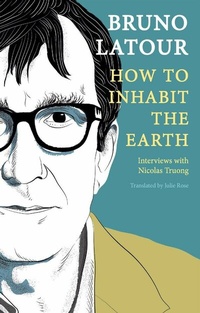
How to Inhabit the Earth
Description

This poignant reflection on the greatest challenge of our time was also an opportunity for Latour to explain the underlying thread that guided his work throughout his career, from his pathbreaking research on the social construction of scientific knowledge to his last writings on the Anthropocene.
More details
Other editions
Additional editions
Persons
Content
Changing worlds
The end of modernity
Gaia puts us on notice
Where do we land?
The new ecological class
Inventing collective apparatuses
The truth of the religious
Science in action
The modes of existence
The circle of politics
Philosophy is so beautiful!
Letter to Lilo
Thanks
Introduction
Nicolas Truong
Wanting to pass on, to explain. To explain himself, as well, meaning to explain how coherent his thought actually was, a fact that had partly been masked by its apparently wide-ranging nature and the variety of subjects he tackled. In his Paris apartment, Bruno Latour threw himself into this series of interviews with a simplicity, an exuberance, and a force that only comes to the fore in moments when you know that life, and notably the life of the mind, is being cut short. There was a deep calm linked to a sense of urgency, an immanence indissociable from imminence, and the need to bring everything together, to sum it up, get it out there. A concern for clarity, a pleasure in conversation, that performance art. As if everything was becoming clearer as the end drew near. Bruno Latour died on 9 October 2022 at the age of seventy-five. He is one of the most important French intellectuals of his generation. 'France's most famous and misunderstood philosopher,' wrote the New York Times on 25 October 2018.
A celebrity and celebrated abroad, recipient of the Holberg Prize (2013) and the Kyoto Prize (2021) for his whole body of work, Bruno was, indeed, misunderstood for a time in France, so disparate did his objects of study seem. It must be said that he delved into almost all realms of knowledge: ecology, the law, modernity, religion, and, of course, the sciences and technologies with his inaugural and explosive studies of laboratory life.
Bruno was all the more misunderstood as, with the notable exception of Michel Serres, with whom he conducted a round of interviews, Eclaircissements,1 philosophy in France has often steered clear of the theory and practice of the sciences.
'He was the first to feel that the whole challenge for politics lay in the issue of ecology,' recalls sociologist Bruno Karsenti, as was attested, as early as 1999, by the publication of Politiques de la nature,2 written in consonance with Serres's Le contrat naturel (1990).3
An iconoclastic sociologist
But without a doubt it was two books dedicated to ecology, and delivered in the form of questions, Où atterir? (Where do we land?)4 and Où suis-je? (Where am I?),5 that brought this iconoclastic sociologist to a much broader public.
Born on 22 June 1947 in Beaune (Côte-d'Or) into a large bourgeois family of wine merchants, Bruno Latour grew to become one of the most influential philosophers of our time, inspiring a new generation of intellectuals, artists, and activists anxious to do something about the ecological disaster.
Ever since 'the intrusion of Gaia', in the words of the philosopher Isabelle Stengers,6 with whom he enjoyed an enduring intellectual friendship, one chronicled by Philippe Pignarre in Latour-Stengers, un double vol enchevetré,7 Bruno never stopped thinking about the 'new climate regime' we live in.8 For 'we have changed worlds', he explained, since we entered the Anthropocene Age, in which man becomes a geological force. 'We're not living on the same Earth,' he maintained.9
From the 17th century on, the Moderns believed that the separation between nature and culture, between objects and subjects, was real. They contended that 'non-humans' were things that were alien to us, even though they never stopped engaging with them. This is the sense in which 'we have never been modern', as Bruno proclaimed in his book of the same name.10
The living manufacture their own conditions of existence
But one discovery, possibly 'as important as that of Galilleo in his time',11 he said, was made by the British physiologist, chemist and engineer James Lovelock (1919-2022), author of Gaia, a New Look at Life on Earth:12 living beings make their own conditions of existence. The atmosphere is not given, homeostatic, but produced by all the living beings that populate the Earth, as affirmed in her turn by the microbiologist Lynn Margulis (1938-2011).
And so, we live on this varnish, this fine skin a few kilometres thick that covers the terrestrial globe and that certain scientists, like geochemist Jérôme Gaillardet, professor at the Institut de physique du globe, Paris, call 'the critical zone'. An envelope on which we must now 'land', instead of living an uprooted existence, so as to maintain the conditions that make that envelope habitable, enabling life to continue. It's this envelope to which Bruno gives the name Gaia, taking up a scientific hypothesis but also a myth that comes down to us from Ancient Greece and that refers to 'the mother goddess', matrix of all the deities.
For we have also changed cosmologies. The way we represent the world and the beings that surround us is no longer the same. In bringing planet Earth closer to the other celestial bodies, the Galilean revolution allowed us to go 'from a closed world to the infinite universe', as the philosopher of the sciences Alexandre Koyré (1892-1964) said.13 Galileo looked up to the sky, Lovelock looked down to the ground. 'To complete the picture, we had to supplement Galileo's Earth that moves with Lovelock's Earth that is moved,' as Bruno sums it up.
This is why his philosophy allows us to think about the ecological crisis anew. But also to act so as to 'land on this new Earth'. How? Through self-description, which consists for each and every one of us as citizens in 'describing not where you live, but who you live off',14 and in mapping the territory you depend on. His model? The lists of grievances of the French Revolution which provided the Third Estate with an opportunity precisely to depict their territory and allowed them to catalogue the inequalities they suffered. Because 'a people who know how to describe themselves are capable of reorienting themselves politically'.
His method? The inquiry, whose power he never ceased asserting and proving.15 A pragmatist as a person and an empiricist as a philosopher, he teamed up with the consortium 'Où atterrir?' after the 'Gilets jaunes' crisis, and led a series of self-description workshops in France in La Châtre (Indre), Saint-Junien (Haute-Vienne), Ris-Orangis (Essonne), and Sevran (Seine-Saint-Denis). 'Who do you depend on to exist?' proved to be the central question that needs to be asked to 'go from inarticulate complaint to the grievance', the query needed so as to form new alliances.
This art of questioning was condensed into a 'questionnaire' in the form of an aid to the self-description experiment and launched during the first lockdown. It had a resounding effect, opening as it does with a question that got a lot of confined people thinking: 'What are some of the suspended activities that you would like to see not coming back?'16
A kind of collective thinking
'Où atterrir? (Where do we land?) is a fundamental research device just like others this collective thinker has never ceased putting in place, such as two recent exhibitions he curated. One of these, 'Critical Zones', was put together at the ZKM in Karlsruhe in 2020 with the collaboration of Austrian artist Peter Weibel; the other, 'Toi et moi, on ne vit pas sur la même planète' ('We don't live on the same planet, you and I), was mounted at the Centre Pompidou Metz, with Martin Guinard and Eva Lin.
Composed of installations and performances intended not to illustrate an idea or to stage a philosophy but to produce a 'thought experiment', these two shows hooked other disciplines up to artistic practices in an association that promoted reflection on the new cosmology. 'I don't know how to solve certain questions I put to myself,' Bruno liked to say, 'so I appeal to experts who know more about it than I do, as well as to artists whose sensibility is very different, and the friction allows us to produce thought.'
It must be said that Bruno thinks in groups and reflects in teams, with the aid of collectives and collective experiments. Such as at Sciences Po, within several programmes he founded when he was the school's scientific director (2007-12), including: Medialab, an interdisciplinary laboratory created in 2009 which conducts research on the relations between the digital and societies and is currently directed by sociologist Dominique Cardon; SPEAP, a school of political arts launched in 2010, now headed by historian of the sciences and playwright Frédérique Aït-Touati, who staged an impressive performance-reading of Bruno's Moving Earths (2019).
Bruno also initiated an innovative masters course at Sciences Po, the Mapping Controversies project (or FORCCAST),17 designed to analyse the sciences and technologies, and first run by sociologist Nicolas Benvegnu. This aims to explore and visualize the complexity of public debates which mash together issues that are every bit as social as spatial, every bit as geographic as scientific, as in the case of the controversy over invasive plant species, which he recently seized on.
He also...
