

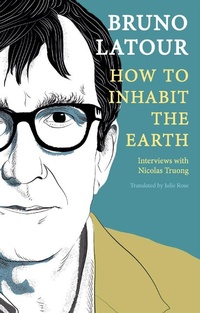
How to Inhabit the Earth
Interviews with Nicolas Truong
Published on 27. October 2023
Book
Hardback
112 pages
978-1-5095-5946-6 (ISBN)
Description
In a series of televised interviews in spring 2022, Bruno Latour explained, in clear and straightforward terms, how humans have changed the planet and why environmental disasters are an intrinsic part of modern life. We have now come to realize that all life depends on a thin skin of our planet that is only few kilometres thick - what scientists call the 'critical zone'. Our capacity to continue to live on a planet we are transforming is now at risk and if we wish to survive as a species, we must put an end to the mechanisms of destruction, rethink our connection to living beings and face head-on the confrontation between the extractivists who are exploiting the Earth's resources and the ecologists.
This poignant reflection on the greatest challenge of our time is also an opportunity for Latour to explain the underlying thread that guided his work throughout his career, from his pathbreaking research on the social construction of scientific knowledge to his last writings on the Anthropocene.
In a series of televised interviews in spring 2022, Bruno Latour explained, in clear and straightforward terms, how humans have changed the planet and why environmental disasters are an intrinsic part of modern life. We have now come to realize that all life depends on a thin skin of our planet that is only few kilometres thick - what scientists call the 'critical zone'. Our capacity to continue to live on a planet we are transforming is now at risk and if we wish to survive as a species, we must put an end to the mechanisms of destruction, rethink our connection to living beings and face head-on the confrontation between the extractivists who are exploiting the Earth's resources and the ecologists.
This poignant reflection on the greatest challenge of our time is also an opportunity for Latour to explain the underlying thread that guided his work throughout his career, from his pathbreaking research on the social construction of scientific knowledge to his last writings on the Anthropocene.
This poignant reflection on the greatest challenge of our time is also an opportunity for Latour to explain the underlying thread that guided his work throughout his career, from his pathbreaking research on the social construction of scientific knowledge to his last writings on the Anthropocene.
In a series of televised interviews in spring 2022, Bruno Latour explained, in clear and straightforward terms, how humans have changed the planet and why environmental disasters are an intrinsic part of modern life. We have now come to realize that all life depends on a thin skin of our planet that is only few kilometres thick - what scientists call the 'critical zone'. Our capacity to continue to live on a planet we are transforming is now at risk and if we wish to survive as a species, we must put an end to the mechanisms of destruction, rethink our connection to living beings and face head-on the confrontation between the extractivists who are exploiting the Earth's resources and the ecologists.
This poignant reflection on the greatest challenge of our time is also an opportunity for Latour to explain the underlying thread that guided his work throughout his career, from his pathbreaking research on the social construction of scientific knowledge to his last writings on the Anthropocene.
More details
Edition
1
Language
English
Place of publication
Oxford
United Kingdom
Publishing group
John Wiley and Sons Ltd
Dimensions
Height: 218 mm
Width: 140 mm
Thickness: 13 mm
Weight
259 gr
ISBN-13
978-1-5095-5946-6 (9781509559466)
Copyright in bibliographic data and cover images is held by Nielsen Book Services Limited or by the publishers or by their respective licensors: all rights reserved.
Schweitzer Classification
Other editions
Additional editions
Book
10/2023
Polity Press
€16.50
Shipment within 15-20 days
E-Book
10/2023
1st Edition
Wiley
€12.99
Available for download
Persons
Bruno Latour's transdisciplinary work, ranging across philosophy, history, anthropology and sociology, positioned him as one of the world's most influential thinkers. After teaching at the Ecole des Mines in Paris from 1982 to 2006, he was appointed Professor at the Institut d'etudes politiques (Sciences Po), where he served as vice-president for research from 2007 to 2013. His many books include Laboratory Life, We Have Never Been Modern, Facing Gaia, Down to Earth and After Lockdown.
Bruno Latour's transdisciplinary work, ranging across philosophy, history, anthropology and sociology, positioned him as one of the world's most influential thinkers. After teaching at the Ecole des Mines in Paris from 1982 to 2006, he was appointed Professor at the Institut d'etudes politiques (Sciences Po), where he served as vice-president for research from 2007 to 2013. His many books include <i>Laboratory Life</i>, <i>We Have Never Been Modern</i>, <i>Facing Gaia</i>, <i>Down to Earth</i> and <i>After Lockdown<i>.</i></i>
Bruno Latour's transdisciplinary work, ranging across philosophy, history, anthropology and sociology, positioned him as one of the world's most influential thinkers. After teaching at the Ecole des Mines in Paris from 1982 to 2006, he was appointed Professor at the Institut d'etudes politiques (Sciences Po), where he served as vice-president for research from 2007 to 2013. His many books include <i>Laboratory Life</i>, <i>We Have Never Been Modern</i>, <i>Facing Gaia</i>, <i>Down to Earth</i> and <i>After Lockdown<i>.</i></i>
Content
Introduction by Nicolas Truong
Changing worlds
The end of modernity
Gaia puts us on notice
Where do we land?
The new ecological class
Inventing collective apparatuses
The truth of the religious
Science in action
The modes of existence
The circle of politics
Philosophy is so beautiful!
Letter to Lilo
<i>Thanks</i>