

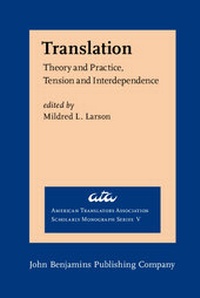
Translation
Theory and Practice, Tension and Interdependence
1st Edition
Published on 1. January 1991
VIII, 270 pages
978-90-272-8594-2 (ISBN)
Description

This book is a collection of articles which highlight the fact that good translation theory is based on information gained from practice. At the same time, good practice is based on carefully worked-out theory. The two are interdependent. The authors who have contributed are persons who know the importance of both theory and practice and the tension between the two. They are not only translators but also have long experience in training others.
The articles cover a wide variety of topics grouped in five sections. The first presents four graphic descriptions of what happens when one translates. The second looks at aspects of the application of theory from the backgrounds of European and Asian translation practices. The third has excellent articles which apply theory to the fields of poetry, opera, drama, and humor. The fourth section provides four ways of putting theory into practice. The fifth gives language specific examples and the last section deals with the application of theory and practice to teaching in an academic context.
The articles cover a wide variety of topics grouped in five sections. The first presents four graphic descriptions of what happens when one translates. The second looks at aspects of the application of theory from the backgrounds of European and Asian translation practices. The third has excellent articles which apply theory to the fields of poetry, opera, drama, and humor. The fourth section provides four ways of putting theory into practice. The fifth gives language specific examples and the last section deals with the application of theory and practice to teaching in an academic context.
More details
Other editions
Additional editions
Book
01/1991
John Benjamins Publishing Co
€116.60
Shipment within 10-15 days
Person
Content
- Translation: Theory and Practice,Tension and Interdependence
- Editorial page
- Title page
- Copyright page
- Table of contents
- Editor's Note: The Interdependence of Theory and Practice
- NOTES
- Seeking Synapses: Translators Describe Translating
- A. Step 1: Comprehending the Source Text
- B. Step 2. The Actual Transfer
- C. Step 3: Expression
- NOTES
- Translation and the Space Between: Operative Parameters of an Enterprise
- NOTES
- REFERENCES
- Some Images and Analogies for the Process of Translation
- Simple Images: Meshes, Grids, and Gauges
- Intermediate Images: Puzzles, Construction Toys, and Animal Anatomy
- Advanced Analogies: Music and Stage Illusion
- NOTES
- REFERENCES
- The Unit of Translation Revisited
- The Formal-Linguistic Approach
- The Textual-Semantic Approach
- The Binary Approach
- Translation Equivalence and the Unit of Translation: The Transleme
- Translational Relations and the Transleme
- Conclusion
- REFERENCES
- The Soviet Concept of Time and Space
- REFERENCES
- Ever Since Yan Fu and His Criteria of Translation
- 1. Translation Criteria: Debate on Xin, Da and Ya
- 2. Methods of Translating: Zhiyi vs. Yiyi
- 3. Style and Translation: Evolution of Ya into Style
- 4. Conclusion: Yan, Tytler, Nida, and Newmark
- NOTES
- REFERENCES
- Categorization and Translation
- 1. Introduction
- 2. Classical Categorization
- 3. Natural Categorization
- 4. Consequences of Classical and Natural Categorization for the Lexicon
- 5. A Two-Cycle Model of Grammar (TCM) and the Structure of the Lexicon
- 5.1 LEXICAL SYSTEMS
- 5.2 TAXONOMIES
- 5.3 LEXICAL DOMAINS
- 5.4 THE STRUCTURE OF THE LEXICON
- 6. Pet, huisdier, lievelingsdier, and troeteldier
- 7. Summary
- NOTES
- REFERENCES
- The Translation of Poetry
- REFERENCES
- Opera Translation
- Should Opera Be Translated?
- Rhythm
- Rhyme
- Sound
- Repetition
- Final Remarks
- REFERENCES
- Translation and Social Discourse: Shakespeare, A Playwright After Québec's Heart
- NOTES
- REFERENCES
- Cultural Transfers in the Translating of Humor
- 1. Introduction
- 2. Humor
- 2.1 DEFINITION.
- 2.2 DIVERSITY OF HUMOR.
- 2.3 HUMOR AND CULTURE.
- 3. Translating and Interpreting
- 3.1 CULTURAL TRANSFER.
- 3.2 TRANSFER PROCESS.
- 4. Biculturalism
- 4.1 TRANSFER OF HUMOR AND BICULTURALISM.
- 4.2 BICULTURAL TRANSLATORS AND INTERPRETERS.
- 4.3 FOREIGN LANGUAGE PROGRAMS AND BICULTURALISM.
- 5. Experiment
- 5.1 DESIGN.
- 5.2 RESULTS.
- 5.2.1 Values.
- 5.2.2 Humor and Translation.
- 5.2.3 Cross-Cultural Translations.
- 6. Some Examples of Cultural Transfer
- 6.1 ADAPTATIONS.
- 6.2 COMPONENTIAL ANALYSIS.
- 6.3 DUAL SCRIPTS.
- REFERENCES
- TABLES
- Translation in Theory and Practice
- Importance of the English && French Language Pair
- Two Remarks at the Outset
- Theory and Practice of Translation
- Prevention Instead of Cure
- Which Theory?
- Equivalence
- Translation Limits
- Voyage to the End of the Translation
- NOTES
- REFERENCES
- Semantic and Communicative Translation: Two Approaches, One Method
- NOTE
- REFERENCES
- A Communication-Oriented Analysis of Quality in Nonliterary Translation and Interpretation
- 1. Professional Translation: An Act of Communication
- 2. Components of Communication Acts in Translation
- 2.1 AIMS AND INTENTIONS.
- 2.2 CONTENT AND PACKAGE.
- 2.3 SUCCESSFUL COMMUNICATION
- 3. Professional Loyalty
- 4. Quality
- 4.1 THE CRITERIA
- 4.2 THE COMPONENTS
- 4.3 THE PERCEPTION OF QUALITY: POSITIONS
- 4.4 THE PERCEPTION OF QUALITY: MOTIVATION AND ATTENTION
- 5. Conclusion
- REFERENCES
- Checking Translation for Meaning
- REFERENCES
- Translation of Prose Fiction from English to Hebrew: A Function of Norms (1960s and 1970s)
- 1. Publishing Policy in the 1960s and 1970s
- 2. The Translation Norms
- 2.1 THE AMOUNT OF MATERIAL TO BE TRANSLATED AND ITS SEGMENTATION
- 2.2 THE LANGUAGE NORM
- 2.3 ENGLISH INTERFERENCE
- 2.4 EXPLICITATION
- 3. The Comments on Translation
- NOTES
- REFERENCES
- The Translator as Editor: Beginnings and Endings in Japanese-English Translation
- Introduction
- Opening Paragraphs
- Concluding Paragraphs
- Discussion
- NOTES
- REFERENCES
- Case Studies in Teaching Translation
- Introduction
- 1. The Case-Study Method and its Variants
- 2. Case Studies in Translation: Theoretical Considerations
- 2.1 "THE CASE FOR 'CASE'
- 2.1.1 The Use of Authentic Practical Cases.
- 2.1.2 The View of Translation as a Decision-Making Process
- 2.1.3 The Integration of Theory and Practice.
- 2.2 DIDACTIC PHASES IN TRANSLATION
- 3. The MARC O'POLO Case
- 3.1 THE SAMPLE CASE DOCUMENTATION
- 3.1.1 Abstract: Worksheet.
- 3.1.2 The Case Report.
- 3.1.3 Case Technical Note.
- 3.1.4 Teaching Information.
- 3.2 The Case Method Applied: Summary Description
- 4. Concluding Remarks
- NOTES
- REFERENCES
- Human Rights Applied to Translation: A Case for Language Learners' Right to Translate
- Introduction
- Making a Case for Learners' Right to Translate
- Applying Translating Rights: A Checklist for Teachers
- Conclusions
- REFERENCES
- Contributors
- ATA Corporate Members
- ATA Institutional Members
- American Translators Association Officers and Board of Directors, 1991
- The series American Translators Association Scholarly Monograph Series
