

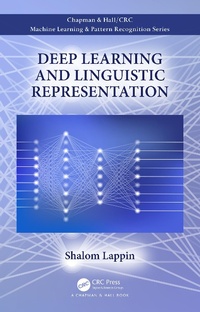
Deep Learning and Linguistic Representation
1st Edition
Published on 26. April 2021
168 pages
978-1-000-38033-0 (ISBN)
Description

The application of deep learning methods to problems in natural language processing has generated significant progress across a wide range of natural language processing tasks. For some of these applications, deep learning models now approach or surpass human performance. While the success of this approach has transformed the engineering methods of machine learning in artificial intelligence, the significance of these achievements for the modelling of human learning and representation remains unclear.
Deep Learning and Linguistic Representation looks at the application of a variety of deep learning systems to several cognitively interesting NLP tasks. It also considers the extent to which this work illuminates our understanding of the way in which humans acquire and represent linguistic knowledge.
Key Features:
combines an introduction to deep learning in AI and NLP with current research on Deep Neural Networks in computational linguistics.
is self-contained and suitable for teaching in computer science, AI, and cognitive science courses; it does not assume extensive technical training in these areas.
provides a compact guide to work on state of the art systems that are producing a revolution across a range of difficult natural language tasks.
Deep Learning and Linguistic Representation looks at the application of a variety of deep learning systems to several cognitively interesting NLP tasks. It also considers the extent to which this work illuminates our understanding of the way in which humans acquire and represent linguistic knowledge.
Key Features:
combines an introduction to deep learning in AI and NLP with current research on Deep Neural Networks in computational linguistics.
is self-contained and suitable for teaching in computer science, AI, and cognitive science courses; it does not assume extensive technical training in these areas.
provides a compact guide to work on state of the art systems that are producing a revolution across a range of difficult natural language tasks.
Reviews / Votes
This book is a very timely synthesis of classical linguistics that the author has worked in for several decades and the modern revolution in NLP enabled by Deep Learning. It also asks provocative foundational questions about whether traditional grammars are the most suitable representations of linguistic structure or if we need to go beyond them.-- Devdatt Dubhashi, Professor, Chalmers University
Deep neural networks are having a tremendous impact on applied natural language processing. In this clearly written book, Shalom Lappin tackles the novel and exciting question of what are their implications for theories of language acquisition, representation and usage. This will be an enlightening reading for anybody interested in language from the perspectives of theoretical linguistics, cognitive science, AI and the philosophy of science.
-- Marco Baroni, ICREA Research Professor, Facebook AI Research Scientist
More details
Series
Edition
1. Auflage
Language
English
Place of publication
London
United Kingdom
Publishing group
Taylor & Francis Ltd
Target group
College/higher education
Professional and scholarly
Product notice
Reflowable
Illustrations
23 Tables, black and white; 55 Illustrations, black and white
ISBN-13
978-1-000-38033-0 (9781000380330)
Copyright in bibliographic data and cover images is held by Nielsen Book Services Limited or by the publishers or by their respective licensors: all rights reserved.
Schweitzer Classification
Other editions
Additional editions
Shalom Lappin
Deep Learning and Linguistic Representation
Book
04/2021
1st Edition
Chapman & Hall/CRC
€85.50
Shipment within 15-20 days
Shalom Lappin
Deep Learning and Linguistic Representation
Book
04/2021
1st Edition
Chapman & Hall/CRC
€190.20
Shipment within 15-20 days
Person
Shalom Lappin is Professor of Natural Language Processing at Queen Mary University of London, Professor of Computational Linguistics at the University of Gothenburg and Emeritus Professor of Computational Linguistics at King's College London.
Content
Chapter 1 Introduction: Deep Learning in Natural Language Processing
1.1 OUTLINE OF THE BOOK
1.2 FROM ENGINEERING TO COGNITIVE SCIENCE
1.3 ELEMENTS OF DEEP LEARNING
1.4 TYPES OF DEEP NEURAL NETWORKS
1.5 AN EXAMPLE APPLICATION
1.6 SUMMARY AND CONCLUSIONS
Chapter 2 Learning Syntactic Structure with Deep Neural Networks
2.1 SUBJECT-VERB AGREEMENT
2.2 ARCHITECTURE AND EXPERIMENTS
2.3 HIERARCHICAL STRUCTURE
2.4 TREE DNNS
2.5 SUMMARY AND CONCLUSIONS
Chapter 3 Machine Learning and The Sentence Acceptability Task
3.1 GRADIENCE IN SENTENCE ACCEPTABILITY
3.2 PREDICTING ACCEPTABILITY WITH MACHINE LEARNING MODELS
3.3 ADDING TAGS AND TREES
3.4 SUMMARY AND CONCLUSIONS
Chapter 4 Predicting Human Acceptability Judgments in Context
4.1 ACCEPTABILITY JUDGMENTS IN CONTEXT
4.2 TWO SETS OF EXPERIMENTS
4.3 THE COMPRESSION EFFECT AND DISCOURSE COHERENCE
4.4 PREDICTING ACCEPTABILITY WITH DIFFERENT DNN MODELS
4.5 SUMMARY AND CONCLUSIONS
Chapter 5 Cognitively Viable Computational Models of Linguistic Knowledge
5.1 HOW USEFUL ARE LINGUISTIC THEORIES FOR NLP APPLICATIONS?
5.2 MACHINE LEARNING MODELS VS FORMAL GRAMMAR
5.3 EXPLAINING LANGUAGE ACQUISITION
5.4 DEEP LEARNING AND DISTRIBUTIONAL SEMANTICS 1
5.5 SUMMARY AND CONCLUSIONS
Chapter 6 Conclusions and Future Work
6.1 REPRESENTING SYNTACTIC AND SEMANTIC KNOWLEDGE
6.2 DOMAIN SPECIFIC LEARNING BIASES AND LANGUAGE ACQUISITION
6.3 DIRECTIONS FOR FUTURE WORK
REFERENCES
Author Index
Subject Index
1.1 OUTLINE OF THE BOOK
1.2 FROM ENGINEERING TO COGNITIVE SCIENCE
1.3 ELEMENTS OF DEEP LEARNING
1.4 TYPES OF DEEP NEURAL NETWORKS
1.5 AN EXAMPLE APPLICATION
1.6 SUMMARY AND CONCLUSIONS
Chapter 2 Learning Syntactic Structure with Deep Neural Networks
2.1 SUBJECT-VERB AGREEMENT
2.2 ARCHITECTURE AND EXPERIMENTS
2.3 HIERARCHICAL STRUCTURE
2.4 TREE DNNS
2.5 SUMMARY AND CONCLUSIONS
Chapter 3 Machine Learning and The Sentence Acceptability Task
3.1 GRADIENCE IN SENTENCE ACCEPTABILITY
3.2 PREDICTING ACCEPTABILITY WITH MACHINE LEARNING MODELS
3.3 ADDING TAGS AND TREES
3.4 SUMMARY AND CONCLUSIONS
Chapter 4 Predicting Human Acceptability Judgments in Context
4.1 ACCEPTABILITY JUDGMENTS IN CONTEXT
4.2 TWO SETS OF EXPERIMENTS
4.3 THE COMPRESSION EFFECT AND DISCOURSE COHERENCE
4.4 PREDICTING ACCEPTABILITY WITH DIFFERENT DNN MODELS
4.5 SUMMARY AND CONCLUSIONS
Chapter 5 Cognitively Viable Computational Models of Linguistic Knowledge
5.1 HOW USEFUL ARE LINGUISTIC THEORIES FOR NLP APPLICATIONS?
5.2 MACHINE LEARNING MODELS VS FORMAL GRAMMAR
5.3 EXPLAINING LANGUAGE ACQUISITION
5.4 DEEP LEARNING AND DISTRIBUTIONAL SEMANTICS 1
5.5 SUMMARY AND CONCLUSIONS
Chapter 6 Conclusions and Future Work
6.1 REPRESENTING SYNTACTIC AND SEMANTIC KNOWLEDGE
6.2 DOMAIN SPECIFIC LEARNING BIASES AND LANGUAGE ACQUISITION
6.3 DIRECTIONS FOR FUTURE WORK
REFERENCES
Author Index
Subject Index
