

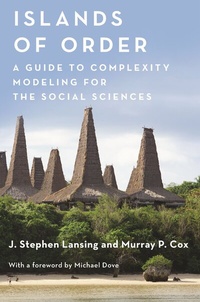
Islands of Order
A Guide to Complexity Modeling for the Social Sciences
1st Edition
Published on 21. October 2019
248 pages
978-0-691-19753-1 (ISBN)
Description

Two pioneering anthropologists reveal how complexity science can help us better understand how societies change over time
Over the past two decades, anthropologist J. Stephen Lansing and geneticist Murray Cox have explored dozens of villages on the islands of the Malay Archipelago, combining ethnographic research with research into genetic and linguistic markers to shed light on how these societies change over time. Islands of Order draws on their pioneering fieldwork to show how the science of complexity can be used to better understand unstable dynamics in culture, language, cooperation, and the emergence of hierarchies.
Complexity science has opened exciting new vistas in physics and biology, but poses challenges for social scientists. What triggers fundamental, discontinuous social change? And what brings stable patterns-islands of order-into existence? Lansing and Cox begin with an incisive and accessible introduction to models of change, from simple random drift to coupled interactions, phase transitions, co-phylogenies, and adaptive landscapes. Then they take readers on a series of journeys to the islands of the Indo-Pacific to demonstrate how social scientists can harness these powerful tools to discover out-of-equilibrium social dynamics. Lansing and Cox address empirical questions surrounding the colonization of the Pacific, the relationship of language to culture, the emergence and disappearance of male and female hierarchies, and more.
Unlocking new possibilities for the social sciences, Islands of Order is accompanied by an interactive companion website that enables readers to explore the models described in the book.
Over the past two decades, anthropologist J. Stephen Lansing and geneticist Murray Cox have explored dozens of villages on the islands of the Malay Archipelago, combining ethnographic research with research into genetic and linguistic markers to shed light on how these societies change over time. Islands of Order draws on their pioneering fieldwork to show how the science of complexity can be used to better understand unstable dynamics in culture, language, cooperation, and the emergence of hierarchies.
Complexity science has opened exciting new vistas in physics and biology, but poses challenges for social scientists. What triggers fundamental, discontinuous social change? And what brings stable patterns-islands of order-into existence? Lansing and Cox begin with an incisive and accessible introduction to models of change, from simple random drift to coupled interactions, phase transitions, co-phylogenies, and adaptive landscapes. Then they take readers on a series of journeys to the islands of the Indo-Pacific to demonstrate how social scientists can harness these powerful tools to discover out-of-equilibrium social dynamics. Lansing and Cox address empirical questions surrounding the colonization of the Pacific, the relationship of language to culture, the emergence and disappearance of male and female hierarchies, and more.
Unlocking new possibilities for the social sciences, Islands of Order is accompanied by an interactive companion website that enables readers to explore the models described in the book.
More details
Language
English
Place of publication
Princeton, NJ
United States
Publishing group
De Gruyter
Target group
Professional and scholarly
Edition type
Digital original
Product notice
Reflowable
Illustrations
64 b/w illus. 8 tables. 6 maps
ISBN-13
978-0-691-19753-1 (9780691197531)
Schweitzer Classification
Other editions
Additional editions
J. Stephen Lansing | Murray P. Cox
Islands of Order
A Guide to Complexity Modeling for the Social Sciences
Book
10/2019
Princeton University Press
€29.50
Shipment within 10-20 days
J. Stephen Lansing | Murray P. Cox
Islands of Order
A Guide to Complexity Modeling for the Social Sciences
Book
10/2019
Princeton University Press
€88.00
Shipment within 10-20 days
Persons
J. Stephen Lansing is Director of the Complexity Institute and Professor in the Asian School of the Environment at Nanyang Technological University in Singapore. His books include Perfect Order: Recognizing Complexity in Bali (Princeton). Murray P. Cox is Professor of Computational Biology at Massey University in New Zealand.
Content
- Cover
- Contents
- List of Figures
- List of Tables
- Foreword: The Malay Archipelago Revisited by Michael R. Dove
- Preface
- 1. Models of Change
- A point of departure
- The origins of order
- A clock that keeps good time
- Neutral drift
- Nonlinear systems
- Triggers for nonlinear transitions
- Complex adaptive systems
- Discovering islands of order
- Conclusion
- 2. Discovering Austronesia
- Introduction
- Dubois' remarkable discovery
- The first migration of modern humans
- The second migration: Austronesians
- Surprises in the data
- The toolkits: Population genetics and kinship
- The implications of matrilocality
- First model: Sex bias and language replacement
- Why the barrier in Wallacea?
- Second model: Demographic skew
- Generations of butterfly effects
- Conclusion
- 3. Dominance, Selection, and Neutrality
- Introduction
- Selection for dominance?
- The meek shall inherit. . .
- Neutral tests and the neutral theory: From genetics to ecology
- Transience and time scales: Baby names
- Transience and time scales: Potsherds and archaeology
- Conclusion
- 4. Language and Kinship in Deep Time
- Return to Wehali
- Cophylogenies of languages and genes
- The implications of host switching
- Kinship and language transmission
- Language and kinship in deep time
- Zooming in to the community scale
- Conclusion
- 5. Islands of Cooperation
- Prelude: How Bali became Bali
- Introduction
- Terracing volcanoes
- Ecology of the rice terraces
- A cooperation game
- Testing the game-theoretical model
- An agent-based model of the coupled system
- Conclusion
- 6. Adaptive Self-Organized Criticality
- Mosaics and power laws
- Universal Bali: A lattice model
- Results of the lattice model
- Comparison with satellite imagery
- Why power laws?
- Conclusion
- 7. Transition Paths
- Introduction
- Does age matter?
- A pilot study of cooperation
- Results of the pilot study
- Exploring differences in regimes
- Conclusion
- 8. From the Other Shore
- Revisiting the Austronesian expansion
- The protosystem and the structural core
- Phase portraits
- Sex and power, revisited
- Reflections on stone boats
- Emergence of a new synchronic whole in Bali
- Afterword
- Appendix A. Correlation Functions
- Appendix B. Game and Lattice Models
- Appendix C. Intra- and Intersubak Coordination of Irrigation
- Appendix D. Fisher Information
- Appendix E. Energy Landscape Analysis
- Appendix F. Survey Questions Used in Chapter 7
- Index
