

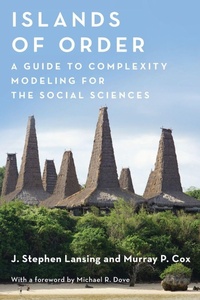
Islands of Order
A Guide to Complexity Modeling for the Social Sciences
Published on 8. October 2019
Book
Paperback/Softback
248 pages
978-0-691-19294-9 (ISBN)
Description
Two pioneering anthropologists reveal how complexity science can help us better understand how societies change over time
Over the past two decades, anthropologist J. Stephen Lansing and geneticist Murray Cox have explored dozens of villages on the islands of the Malay Archipelago, combining ethnographic research with research into genetic and linguistic markers to shed light on how these societies change over time. Islands of Order draws on their pioneering fieldwork to show how the science of complexity can be used to better understand unstable dynamics in culture, language, cooperation, and the emergence of hierarchies.
Complexity science has opened exciting new vistas in physics and biology, but poses challenges for social scientists. What triggers fundamental, discontinuous social change? And what brings stable patterns-islands of order-into existence? Lansing and Cox begin with an incisive and accessible introduction to models of change, from simple random drift to coupled interactions, phase transitions, co-phylogenies, and adaptive landscapes. Then they take readers on a series of journeys to the islands of the Indo-Pacific to demonstrate how social scientists can harness these powerful tools to discover out-of-equilibrium social dynamics. Lansing and Cox address empirical questions surrounding the colonization of the Pacific, the relationship of language to culture, the emergence and disappearance of male and female hierarchies, and more.
Unlocking new possibilities for the social sciences, Islands of Order is accompanied by an interactive companion website that enables readers to explore the models described in the book.
Over the past two decades, anthropologist J. Stephen Lansing and geneticist Murray Cox have explored dozens of villages on the islands of the Malay Archipelago, combining ethnographic research with research into genetic and linguistic markers to shed light on how these societies change over time. Islands of Order draws on their pioneering fieldwork to show how the science of complexity can be used to better understand unstable dynamics in culture, language, cooperation, and the emergence of hierarchies.
Complexity science has opened exciting new vistas in physics and biology, but poses challenges for social scientists. What triggers fundamental, discontinuous social change? And what brings stable patterns-islands of order-into existence? Lansing and Cox begin with an incisive and accessible introduction to models of change, from simple random drift to coupled interactions, phase transitions, co-phylogenies, and adaptive landscapes. Then they take readers on a series of journeys to the islands of the Indo-Pacific to demonstrate how social scientists can harness these powerful tools to discover out-of-equilibrium social dynamics. Lansing and Cox address empirical questions surrounding the colonization of the Pacific, the relationship of language to culture, the emergence and disappearance of male and female hierarchies, and more.
Unlocking new possibilities for the social sciences, Islands of Order is accompanied by an interactive companion website that enables readers to explore the models described in the book.
Reviews / Votes
"A major achievement. The breadth and depth of this brilliant book, from rich ethnography to elaborate agent-based models, are awe inspiring and standard setting."-Scott E. Page, author of The Diversity Bonus: How Great Teams Pay Off in the Knowledge Economy "This exceptional book is chock-full of ideas that can inspire a new generation of researchers in the study of human societies using the framework of complex systems."-Mark Moritz, Ohio State UniversityMore details
Series
Language
English
Place of publication
New Jersey
United States
Target group
College/higher education
Professional and scholarly
Product notice
Paperback (trade)
Illustrations
64 b/w illus. 8 tables. 6 maps
Dimensions
Height: 234 mm
Width: 159 mm
Thickness: 17 mm
Weight
350 gr
ISBN-13
978-0-691-19294-9 (9780691192949)
Copyright in bibliographic data and cover images is held by Nielsen Book Services Limited or by the publishers or by their respective licensors: all rights reserved.
Schweitzer Classification
Other editions
Additional editions
J. Stephen Lansing | Murray P. Cox
Islands of Order
A Guide to Complexity Modeling for the Social Sciences
E-Book
10/2019
1st Edition
Princeton University Press
€30.49
Available for download
Persons
J. Stephen Lansing is Director of the Complexity Institute and Professor in the Asian School of the Environment at Nanyang Technological University in Singapore. His books include Perfect Order: Recognizing Complexity in Bali (Princeton). Murray P. Cox is Professor of Computational Biology at Massey University in New Zealand.