

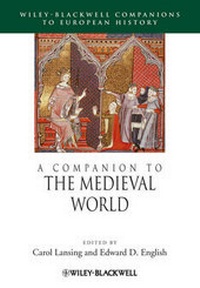
A Companion to the Medieval World
Description

Reviews / Votes
A Companion to the Medieval World is a valuable reference book forstudents engaged in medieval studies at honours or postgraduate levelseeking in-depth information on sources for essays and theses. It is usefulfor teachers and lecturers of medieval history (like me) striving to keep upto-date with the state of the discipline. Many of the essays would also be ofinterest to intelligent 'general readers' who wish to extend their knowledgeof the medieval world.Susan Mary Withycombe "...a valuable reference book for students engaged in medieval studies at honours or postgraduate level seeking in-depth information on sources for essays and theses. It is useful for teachers and lecturers of medieval history (like me) striving to keep upto-date with the state of the discipline. Many of the essays would also be of interest to intelligent 'general readers' who wish to extend their knowledge of the medieval world." - St. Mark's Review, August 2016 issue "Nonetheless, this Companion is an excellent manual for those who have never (or only partially) studied medieval history, as it provides clear outlines of extremely complex issues, a thought-provoking insight into historiographical and methodological trends, as well as an extremely rich bibliography to assist further investigation." - English Historical Review, January 2013 issue 'A Companion to the Medieval World will be of greatvalue for instructors who want to pull their own thoughts togetherand to have a model for a concise explication of complicatedtopics. It will also bring home to students and general readersthat there is no "party line" on the medieval world and that thepast, as an intellectual and cultural construct, is very muchalive.' --The Medieval ReviewMore details
Other editions
Additional editions

Persons
Content
Notes on Contributors
John Arnold is Professor in the School of History, Classics, and Archaeology, Birkbeck, University of London. He is the author of Belief and Unbelief in Medieval Europe (London: Edward Arnold, 2005); co-edited with K. J. Lewis, A Companion to the Book of Margery Kempe (Woodbridge, Suffolk: Boydell, 2004); Inquisition and Power: Catharism and the Confessing Subject in Medieval Languedoc (Philadelphia: University of Pennsylvania Press, 2001); History: A Very Short Introduction (Oxford: Oxford University Press, 2000); co-edited with S. Ditchfield and K. Davies, History and Heritage: Consuming the Past in Contemporary Culture (Lower Coombe, Dorset: Donhead, 1998); and most recently What is Medieval History? (Cambridge: Polity, 2008).
Richard E. Barton is Associate Professor at the University of North Carolina, Greensboro. He is the author of "Making a Clamor to the Lord: Noise, Justice and Power in Eleventh- and Twelfth-Century France," in Feud, Violence and Practice: Essays in Medieval Studies in Honor of Stephen D. White, ed. B. Tuten and T. Billado (Aldershot: Ashgate, forthcoming); "Gendering Anger: Ira, Furor and Discourses of Power and Masculinity in the 11th and 12th Centuries," in In the Garden of Evil: the Vices in the Middle Ages, ed. Richard Newhauser (Toronto: University of Toronto Press, 2005), 371-392; and Lordship in the County of Maine, c. 890-1160 (Woodbridge, Suffolk: Boydell Press, 2004).
Constance H. Berman is Professor of History at the University of Iowa. She is the editor and a contributor to Medieval Religion: New Approaches (London: Routledge, 2005); The Cistercian Evolution: The Invention of a Religious Order in Twelfth-Century Europe (University of Pennsylvania Press, 2000); a co-editor of Medieval Agriculture, the Southern-French Countryside, and the Early Cistercians. A Study of Forty-three Monasteries (Philadelphia: American Philosophical Society, 1986); co-editor of The Worlds of Medieval Women: Creativity, Influence, Imagination (Morgantown: West Virginia University Press, 1985); the editor and translator of Women and Monasticism in Medieval Europe: Sisters and Patrons of the Cistercian Order, (Kalamazoo, MI: Medieval Institute Publications, 2002) and has two works in progress: The White Nuns: Cistercian Abbeys for Women and Their Property and After the Millennium: Women's Work and European Economic Growth, 1050-1250.
Richard Britnell is emeritus professor of economic history at the University of Durham, fellow of the British Academy and co-editor of the Surtees Society. He is the author of many articles, editions, and Growth and Decline in Colchester, 1300-1525 (Cambridge: Cambridge University Press, 1986, reprint 2008); The Commercialisation of English Society, 1000-1500 (Cambridge: Cambridge University Press, 1993; 2nd edn, 1996); co-edited with B. M. S. Campbell, A Commercialising Economy: England 1086 to c. 1300 (Manchester: Manchester University Press, 1995); co-edited with A. J. Pollard, The McFarlane Legacy: Studies in Late Medieval Politics and Society (Stroud: Alan Sutton, 1995); The Closing of the Middle Ages? England, 1471-1529 (Oxford: Blackwell, 1997); edited Pragmatic Literacy, East and West, 1200-1330 (Woodbridge: Boydell and Brewer, 1997); and Britain and Ireland 1050-1530: Economy and Society (Oxford: Oxford University Press, 2004).
James W. Brodman is a Professor of History at the University of Central Arkansas, a past President of the American Academy of Research Historians of Medieval Spain, and founder and director of LIBRO: The Library of Iberian Resources Online. He has published Ransoming Captives in Crusader Spain: The Order of Merced on the Christian-Islamic Frontier (Philadelphia: University of Pennsylvania Press, 1986); L'Ordre de la Merce: El rescat de captius a l'Espanya de les croades (Barcelona: Edicions dels Quaderns Crema, 1990); Charity and Welfare: Hospitals and the Poor in Medieval Catalonia. The Middle Ages Series (Philadelphia: University of Pennsylvania Press, 1998); and Charity and Religion in Medieval Europe. Washington, DC: The Catholic University of America Press, 2009.
Olivia Remie Constable is Professor of History at the University of Notre Dame. She has published Trade and Traders in Muslim Spain: The Commercial Realignment of the Iberian Peninsula 900-1500 (Cambridge: Cambridge University Press, 1994); Medieval Iberia: Readings from Christian, Muslim, and Jewish Sources (Philadelphia: University of Pennsylvania Press, 1997); Housing the Stranger in the Mediterranean World: Lodging, Trade, and Travel in Late Antiquity and the Middle Ages (Cambridge: Cambridge University Press, 2003); and a new book project entitled Muslims in Medieval Europe.
Robert W. Dyson was Lecturer in the School of Government and International Affairs and a member of the Centre for Medieval and Renaissance Studies and the Centre for the History of Political Thought at the University of Durham. Among his numerous publications are St. Augustine of Hippo and the Christian Transformation of Political Philosophy (London: Continuum Press, 2005); Giles of Rome's "On Ecclesiastical Power": A Medieval Theory of World Government (New York: Columbia University Press, 2005); St Thomas Aquinas: The Political Writings (Cambridge: Cambridge University Press, 2002); St Augustine of Hippo: The City of God Against the Pagans (Cambridge: Cambridge University Press, 1998); James of Viterbo On Christian Government (Woodbridge, Suffolk: Boydell Press, 1995); and Giles of Rome on Ecclesiastical Power (Woodbridge, Suffolk: Boydell Press, 1986).
Edward D. English is Executive Director of Medieval Studies and Adjunct Associate Professor of History at the University of California, Santa Barbara. He is finishing the first of two volumes on the society and politics of Siena in the fourteenth century. His other publications include Enterprise and Liability in Sienese Banking, 1230-1350 (Cambridge: Medieval Academy of America, 1988) and The Encyclopedia of the Medieval World, 2 volumes (New York: Facts-on-File, 2005).
Stephen Gersh is Professor of Medieval Studies in the Medieval Institute at the University of Notre Dame. His publications include: Kinesis Akinetos. A Study of Spiritual Motion in the Philosophy of Proclus (Leiden: Brill 1973); From Iamblichus to Eriugena. An Investigation of the Prehistory and Evolution of the Pseudo-Dionysian Tradition (Leiden: Brill 1978); Middle Platonism and Neoplatonism. The Latin Tradition, 2 volumes (Notre Dame: University of Notre Dame Press, 1986); Concord in Discourse. Harmonics and Semiotics in Late Classical and Early Medieval Platonism (Berlin: Mouton-De Gruyter 1996); and with Maarten J. F. M. Hoenen, Plato in the Middle Ages. A Doxographical Approach (Berlin: De Gruyter 2002).
Yitzhak Hen is Associate Professor at Ben-Gurion University of the Negev. He has published Culture and Religion in Merovingian Gaul, A.D. 481-751 (Leiden: Brill, 1995); The Sacramentary of Echternach, Henry Bradshaw Society, 110 (London: Boydell and Brewer, 1997); co-edited with Matthew Innes, The Uses of the Past in the Early Middle Ages (Cambridge: Cambridge University Press, 2000); De Sion Exibit Lex et Verbum Domini de Hierusalem. Studies on Medieval Law, Liturgy and Literature in Honour of Amnon Linder, Cultural Encounters in Late Antiquity and the Middle Ages, 1 (Turnhout: Brepols, 2001); The Royal Patronage of Liturgy in Frankish Gaul to the Death of Charles the Bald (877), Henry Bradshaw Society Subsidia series, 3 (London: Boydell and Brewer, 2001); co-edited with Rob Meens, The Bobbio Missal: Liturgy and Religious Culture in Merovingian Gaul, (Cambridge: Cambridge University Press, 2004); Roman Barbarians: The Royal Court and Culture in the Early Medieval West (London: Palgrave, 2007); and is General Editor of the Series "Cultural Encounters in Late Antiquity and the Middle Ages" for Brepols.
Martha C. Howell is Miriam Champion Professor of History in Columbia University. She has published From Reliable Sources with Walter Prevenier (Ithaca: Cornell University Press, 2001); The Marriage Exchange: Property, Social Place and Gender in Cities of the Low Countries, 1300-1550 (Chicago: University of Chicago Press, 1998); and Women, Production, and Patriarchy in Late Medieval Cities (Chicago: University of Chicago Press, 1986); with Marc Boone, In But Not of the Market: Movable Goods in the Late Medieval and Early Modern Economy (2007), and Commerce before Capitalism in Europe, 1300-1600. (Cambridge: Cambridge University Press, 2010).
Hans Hummer is an Associate Professor in History at Wayne State University. He has published Politics and Power...
