

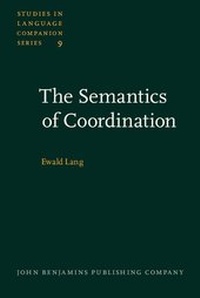
The Semantics of Coordination
1st Edition
Published on 1. January 1984
300 pages
978-90-272-8314-6 (ISBN)
Description

This study is an attempt to explain coordinate conjoining as a rule-governed process of establishing specific semantic relations within and between sentences. Coordination is thus conceived of both as a basic device of linguistic complex formation and as a rather fundamental principle underlying the creation of the text. From the point of view of achieving coherence, coordinate conjoining is described in this monograph as an integrative process. Described are the conditions governing this process, the rules according to which take place, in short: the complex interaction of various linguistically identifiable features displayed by coordinate structures. Coordinate conjoining is regarded here as the result of the interplay of three factors which belong to distinct levels of semantic description: the meaning of the conjuncts, the relation between the meaning of the conjuncts and the meaning of the connectors. The step-by-step explication of the interaction of these levels in determining the semantic interpretation of coordinate structures forms the core of the present study.
More details
Other editions
Additional editions
Ewald Lang
The Semantics of Coordination
(English transl. by John Pheby from the German orig. ed. 'Semantik der koordinativen Verknüpfung', Berlin, 1977)
Book
01/1984
John Benjamins Publishing Co
€121.90
Shipment within 10-15 days
Persons
Content
- THE SEMANTICS OF COORDINATION
- Editorial page
- Title page
- Copyright page
- Table of contents
- Foreword
- Acknowledgements
- Introduction
- 1. The Problem and its background
- 2. The specific object of investigation
- I. Towards a theory of coordination : Some basic assumptions
- 1. Raw material and definition of coordination
- 2. Characteristics of coordination
- 2.1. Preliminary considerations
- 2.2. Sentence vs. utterance, grammar vs. communication
- 2.3. Coordination as integration
- 2.4. Basic assumptions
- 2.5. Heuristic and method of enquiry
- 3. Aspects of conjoining
- 3.1. Homogeneousness of conjuncts
- 3.2. Parallelization effect of coordination
- 3.3. Further surface effects of coordination
- 3.4. The role of connectors in conjoining
- 3.5. Common Integrator (CI) of the conjunct-meanings
- 3.6. Syndesis vs. asyndesis. Symmetry vs. asymmetry
- 3.7. ,Sentential conjunction' vs. ,Phrasal conjunction'
- 4. Where are the limits to the scope of a linguistic description of the semantics of coordination?
- 5. The structure of the proposed theory of the semantics of coordination
- II. Relations between conjunct-meanings
- 1. Distinctness of conjunct-meanings
- 2. Semantic inclusion of conjunct-meanings
- 3. Incompatibility between conjunct-meanings
- III. Outline of the semantics of coordinate conjoining
- 0. Introduction
- 1. Logical characterization of coordinate conjoinings
- 1.1. Inventory of examples
- 1.2. Logical characterization of semantic relations between conjunct-sentences
- 1.3. Logical characterization of the connector-meanings
- 1.4. Logical characterization of coordinate conjoinings
- 2. Linguistic interpretation of the logical characterization of coordinate conjoinings
- 2.1. Logical and linguistic properties of conjoinings
- 2.2. Contextual conditions for connectors
- 2.3. Components of connector-meanings
- 2.4. Contradiction vs. incomprehensibility
- 2.5. Tautology vs. Redundancy
- 2.6. Contingent conjoinings
- 2.7. Summary
- 2.8. Aspects of connector universals
- 3. Some properties of the connectors but and for
- 3.1. but
- 3.2. for
- 4. Survery of connector-meanings
- 4.0. Preliminaries
- 4.1. Notation
- 4.2. Connector-meanings
- 4.3. Interrelations of connector-meanings: a case study on DE MORGAN'S laws
- IV. Coordinate structures with modal verbs
- 0. Introduction
- 1. The raw material
- 1.1. German modal verbs
- 1.2. The representation of the conjuncts
- 1.3. Meaning postulates
- 1.4. Interpretation of the modal predicates
- 1.5. Semantic networks
- 2. Coordinate conjoinings with modal verbs
- 2.1. Notation
- 2.2. Conjoinings with ,und'
- 2.3. Common Integrator in conjoinings with modal verbs
- 2.4. Conjoinings with aber [but]
- 2.5. Conjoinings with denn [for]
- 2.6. Conjoinings with oder [or]
- 2.7. Conjoinings with entweder - oder [either - or]
- 2.8. Conjoinings with nicht - sondern [not - but]
- 2.9. nicht - sondern vs. nicht - aber: ,correction' vs. ,contrast'
- V. Discussing and extending the notion ,Common Integrator'
- 1. ,Common Integrator' in comparison to related concepts of A. WIERZBICKA, J. D. MCCAWLEY, and R. LAKOFF
- 1.1. ,Common Denominator' in WIERZBICKA (1967/1972) and (1980)
- 1.2. ,General Formula' and , General proposition' in MCCAWLEY (1973) and (1981)
- 1.3. ,Common Topic' in R. LAKOFF (1971)
- 2. Common Integrator in word formation
- 2.1. Coordinate compounds in German
- 2.2. Coordinate compounds in Chinese
- 3. Common Integrator in other connections
- VI. Some applications
- 1. Exemplification as a stylistic device
- 2. Reconstruction of ideological background
- 3. Demagogy
- 4. Jewish Joke
- Bibliography
- Subject Index
- Name Index
