

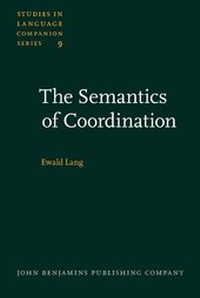
The Semantics of Coordination
(English transl. by John Pheby from the German orig. ed. 'Semantik der koordinativen Verknüpfung', Berlin, 1977)
Published on 1. January 1984
Book
Hardback
300 pages
978-90-272-3008-9 (ISBN)
Description
This study is an attempt to explain coordinate conjoining as a rule-governed process of establishing specific semantic relations within and between sentences. Coordination is thus conceived of both as a basic device of linguistic complex formation and as a rather fundamental principle underlying the creation of the text. From the point of view of achieving coherence, coordinate conjoining is described in this monograph as an integrative process. Described are the conditions governing this process, the rules according to which take place, in short: the complex interaction of various linguistically identifiable features displayed by coordinate structures. Coordinate conjoining is regarded here as the result of the interplay of three factors which belong to distinct levels of semantic description: the meaning of the conjuncts, the relation between the meaning of the conjuncts and the meaning of the connectors. The step-by-step explication of the interaction of these levels in determining the semantic interpretation of coordinate structures forms the core of the present study.
More details
Series
Language
English
Place of publication
Amsterdam
Netherlands
Target group
College/higher education
Professional and scholarly
Dimensions
Height: 245 mm
Width: 164 mm
Weight
510 gr
ISBN-13
978-90-272-3008-9 (9789027230089)
Copyright in bibliographic data and cover images is held by Nielsen Book Services Limited or by the publishers or by their respective licensors: all rights reserved.
Schweitzer Classification
Other editions
Additional editions
Ewald Lang
The Semantics of Coordination
E-Book
01/1984
1st Edition
John Benjamins Publishing Company
€144.99
Available for download
Persons
Content
1. Foreword; 2. Acknowledgements; 3. Introduction; 4. 1. The problem and its background; 5. 2. The specific object of investigation; 6. Chapter I: Towards a theory of coordination: Some basic assumptions; 7. 1. Raw material and definition of coordination; 8. 2. Characteristics of coordination; 9. 3. Aspects of conjoining; 10. 4. Where are the limits to the scope of a linguistic description of the semantics of coordination?; 11. 5. The structure of the proposed theory of the semantics of coordination; 12. Chapter II: Relations between conjunct-meanings; 13. 1. Distinctness of conjunct-meanings; 14. 2. Semantic inclusion of conjunct-meanings; 15. 3. Incompatibility between conjunct-meanings; 16. Chapter III: Outline of the semantics of coordinate conjoining; 17. 0. Introduction; 18. 1. Logical characterization of coordinate conjoinings; 19. 2. Linguistic interpretation of the logical characterization of coordinate conjoinings; 20. 3. Some properties of the connectors but and for; 21. 4. Survey of connector-meanings; 22. Chapter IV: Coordinate structures with modal verbs; 23. 0. Introduction; 24. 1. The raw material; 25. 2. Coordinate conjoinings with modal verbs; 26. Chapter V: Discussing and extending the notion 'Common Integrator'; 27. 1. 'Common Integrator' in comparison to related concepts; 28. 2. Common Integrator in word formation; 29. 3. Common Integrator in other connections; 30. Chapter VI: Some applications; 31. 1. Exemplification as a stylistic device; 32. 2. Reconstruction of ideological background; 33. 3. Demagogy; 34. 4. Jewish joke; 35. Bibliography; 36. Subject Index; 37. Name Index