

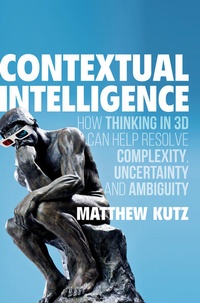
Contextual Intelligence
Description

This book offers a structured framework for critical thinking and decision making that shows how to use hindsight, insight, and foresight to navigate through complexity.
Every organization and every person faces rapid change and complexity. Contextual intelligence - understanding fully the context in which one is operating - teaches the reader how to navigate that complexity and respond appropriately in the face of change (expected and unexpected).
The Three-Dimensional (3D) ThinkingT framework helps structure critical thinking by showing how to appropriately bring past experience, present intuition, and future ambiguity- in other words: hindsight, insight, and foresight - to bear on any given problem.
Kutz offers a way to rationally organize difficult concepts such as complexity, tacit knowledge, and synchronicity into usable and understandable language, but more importantly teaches the reader how to apply these concepts in a very practical and meaningful way with measurable and tangible outcomes.
The book also describes in detail 12 behaviors associated with contextual intelligence. Four behaviors are associated with hindsight, four behaviors are associated with insight, and four behaviors are associated with foresight. The book takes the reader through the 12 behaviors and how they relate to 3D Thinking.
Cases and anecdotes are used generously to provide examples. Chapters are followed by critical thinking questions and questions related to the cases in the chapters. Furthermore, questions and practical tools are introduced that help the reader assess and determine their level of contextual intelligence.More details
Other editions
New editions
Additional editions
Person
Matt Kutz is a tenured associate professor at Bowling Green State University and serves as a consultant and corporate trainer to several multinational and Fortune 500 organizations including Procter & Gamble and Marathon Petroleum. Matt is the author of the widely used text book in healthcare management. His teaching, research, and leadership development interests are in reaching the highest levels of organizational performance and facilitating all facets of leadership and change initiatives. Matt has been the recipient of several honors including faculty award for outstanding research and scholarship, teaching, faculty service and service-learning. Matt is a Fulbright Scholar with the United States Department of State Bureau of Educational and Cultural Affairs and has worked and lectured in a dozen different countries and universities around the world.
Content
1. What is Contextual Intelligence?.- 2. Using Contextual Intelligence at Work and Life.- 3. Putting the Contextual Intelligence Model Together.- 4. Leveraging Complexity.- 5. Leveraging Experience.- 6. Leveraging Learning.- 7. 3D Thinking: A Different Orientation to Time.- 8. Leading in a Variable-Rich Context.- 9. Implementing Contextual Intelligence.- 10. Disruptors of 3D Thinking.- 11. Overcoming Obstacles Contextual Intelligence.- 12. Recommendations and Action Steps of for Implementing Contextual Intelligence.
