

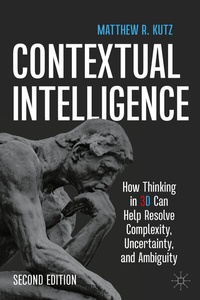
Contextual Intelligence
Description

This book presents a structured framework for decision-making and leadership in turbulent environments, focusing on the Three-Dimensional (3D) Thinking FrameworkT-the use of hindsight, insight, and foresight-to navigate complexity.
Contextual intelligence helps readers respond to rapid changes in organizational and personal settings. Dr. Kutz's 3D Thinking FrameworkT and R4 ProcessT (recognize, reorder, respond, reflect) integrate past insights, present intuition, and future aspirations into problem-solving strategies.
Kutz simplifies complex concepts like VUCA (volatility, uncertainty, complexity, ambiguity), synchronicity, and tacit knowledge into actionable insights. This updated edition offers expanded content, practical examples, and new chapters on behaviors linked to contextual intelligence, enhancing 3D thinking.
Full of cases and anecdotes, each chapter concludes with critical thinking questions and tools to assess and enhance contextual intelligence, guiding leaders in mastering complexity and leading with confidence.
More details
Other editions
Additional editions
Previous edition
Person
Matthew R. Kutz, Ph.D., ATC, FNAP is a Clinical Professor at Florida International University and serves as a consultant and corporate trainer to multinational and Fortune 500 companies. His teaching, research, and professional interests are in helping people reach their highest levels of leadership performance.
Content
Part I. The Contextual Intelligence Model.- Chapter 1. What Is Contextual Intelligence.- Chapter 2. Using Contextual Intelligence At Work And Life.- Chapter 3. Developing Contextual Intelligence.- Chapter 4. The Contextual Intelligence Behaviors.- Part II. Three Mental Models Of Contextual Intelligence.- Chapter 5. Embracing Complexity.- Chapter 6. Reframing Experience.- Chapter 7. Leveraging Learning.- Part III. The 3d Thinking Framework.- Chapter 8. 3d Thinking: Hindsight, Foresight, & Insight.- Chapter 9. Enhancing 3d Thinking.- Chapter 10. Burning The Past To Build The Future.- Chapter 11. Decision-Making In A Variable Rich Context.- Chapter 12. Learning Contextual Intelligence.- Part IV. Obstacles And Recommendations.- Chapter 13. Disruptors Of 3d Thinking.- Chapter 14. Overcoming The Obstacles To Contextual Intelligence.- Chapter 15. Twelve Action Steps For Implementation Of Ci.
