

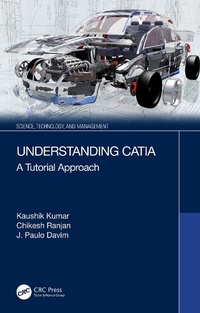
Understanding CATIA
A Tutorial Approach
1st Edition
Published on 8. April 2021
260 pages
978-1-000-37081-2 (ISBN)
Description

This book provides a key understanding of CATIA which is a solid modeling software. By using screen shots of step-by-step training, the reader will obtain comprehensive knowledge of all tools provided in CATIA for use in a variety of engineering fields.
The book introduces CATIA basics, covers part design, discusses sheet metal design, talks about assembly, presents drawings and shows modeling of an engineered component.
The primary aim of this book is to assist in learning the use of CATIA software through examples taken from various areas of engineering. The content and treatment of the subject matter is most appropriate for university students studying engineering and practicing engineers who wish to learn the use of CATIA.
The book introduces CATIA basics, covers part design, discusses sheet metal design, talks about assembly, presents drawings and shows modeling of an engineered component.
The primary aim of this book is to assist in learning the use of CATIA software through examples taken from various areas of engineering. The content and treatment of the subject matter is most appropriate for university students studying engineering and practicing engineers who wish to learn the use of CATIA.
More details
Series
Edition
1. Auflage
Language
English
Place of publication
London
United Kingdom
Publishing group
Taylor & Francis Ltd
Target group
College/higher education
Product notice
Reflowable
Illustrations
12 Line drawings, black and white; 425 Halftones, black and white; 437 Illustrations, black and white
ISBN-13
978-1-000-37081-2 (9781000370812)
Copyright in bibliographic data and cover images is held by Nielsen Book Services Limited or by the publishers or by their respective licensors: all rights reserved.
Schweitzer Classification
Other editions
Additional editions
Book
10/2024
1st Edition
CRC Press
€70.20
Shipment within 15-20 days
Book
04/2021
1st Edition
CRC Press
€159.50
Shipment within 15-20 days
Persons
Kaushik Kumar, B.Tech (Mechanical Engineering, REC (Now NIT), Warangal), MBA (Marketing, IGNOU) and Ph.D (Engineering, Jadavpur University), is presently an Associate Professor in the Department of Mechanical Engineering, Birla Institute of Technology, Mesra, Ranchi, India. He has 19 years of Teaching & Research and over 11 years of industrial experience in a manufacturing unit of Global repute. His areas of teaching and research interest are Composites, Optimization, Non-conventional machining, CAD / CAM, Rapid Prototyping and Quality Management Systems. He has 9 Patents, 35+ Book, 30 Edited Book, 55 Book Chapters, 150 international Journal publications, 22 International and 1 National Conference publications to his credit. He is on the editorial board and review panel of 7 International and 1 National Journals of repute. He has been felicitated with many awards and honours. (Web of Science core collection (102 publications/h-index 10+, SCOPUS/h-index 10+, Google Scholar/h-index 23+).
Chikesh Ranjan, (BE, Mechanical Engineering, Marathwara Institute of Technology, Aurangabad, Maharastra, India), M.E. (Design of Mechanical Equipment, BIT Mesra), presently pursuing PhD (BIT Mesra). He is presently an Assistant Professor in the Department of Mechanical Engineering, RTC Institute of Technology, Ranchi, India. He has over 7 years of Teaching and Research experience. His areas of interests are Product and Process Design, CAD/CAM/CAE, Rapid prototyping and Composites. He has 11 Books, 15 international journal and 4 International Conference publications to his credit.
J. Paulo Davim is a Full Professor at the University of Aveiro, Portugal. He is also distinguished as honorary professor in several universities/colleges in China, India and Spain. He received his Ph.D. degree in Mechanical Engineering in 1997, M.Sc. degree in Mechanical Engineering (materials and manufacturing processes) in 1991, Mechanical Engineering degree (5 years) in 1986, from the University of Porto (FEUP), the Aggregate title (Full Habilitation) from the University of Coimbra in 2005 and the D.Sc. (Higher Doctorate) from London Metropolitan University in 2013. He is Senior Chartered Engineer by the Portuguese Institution of Engineers with an MBA and Specialist titles in Engineering and Industrial Management as well as in Metrology. He is also Eur Ing by FEANI-Brussels and Fellow (FIET) of IET-London. He has more than 30 years of teaching and research experience in Manufacturing, Materials, Mechanical and Industrial Engineering, with special emphasis in Machining & Tribology. He has also interest in Management, Engineering Education and Higher Education for Sustainability. He has guided large numbers of postdoc, Ph.D. and master's students as well as has coordinated and participated in several financed research projects. He has received several scientific awards and honors. He has worked as evaluator of projects for ERC-European Research Council and other international research agencies as well as examiner of Ph.D. thesis for many universities in different countries. He is the Editor in Chief of several international journals, Guest Editor of journals, books Editor, book Series Editor and Scientific Advisory for many international journals and conferences. Presently, he is an Editorial Board member of 30 international journals and acts as reviewer for more than 100 prestigious Web of Science journals. In addition, he has also published as editor (and co-editor) more than 150 books and as author (and co-author) more than 15 books, 100 book chapters and 500 articles in journals and conferences (more than 250 articles in journals indexed in Web of Science core collection/h-index 56+/10000+ citations, SCOPUS/h-index 61+/12500+ citations, Google Scholar/h-index 78+/20500+ citations).
Chikesh Ranjan, (BE, Mechanical Engineering, Marathwara Institute of Technology, Aurangabad, Maharastra, India), M.E. (Design of Mechanical Equipment, BIT Mesra), presently pursuing PhD (BIT Mesra). He is presently an Assistant Professor in the Department of Mechanical Engineering, RTC Institute of Technology, Ranchi, India. He has over 7 years of Teaching and Research experience. His areas of interests are Product and Process Design, CAD/CAM/CAE, Rapid prototyping and Composites. He has 11 Books, 15 international journal and 4 International Conference publications to his credit.
J. Paulo Davim is a Full Professor at the University of Aveiro, Portugal. He is also distinguished as honorary professor in several universities/colleges in China, India and Spain. He received his Ph.D. degree in Mechanical Engineering in 1997, M.Sc. degree in Mechanical Engineering (materials and manufacturing processes) in 1991, Mechanical Engineering degree (5 years) in 1986, from the University of Porto (FEUP), the Aggregate title (Full Habilitation) from the University of Coimbra in 2005 and the D.Sc. (Higher Doctorate) from London Metropolitan University in 2013. He is Senior Chartered Engineer by the Portuguese Institution of Engineers with an MBA and Specialist titles in Engineering and Industrial Management as well as in Metrology. He is also Eur Ing by FEANI-Brussels and Fellow (FIET) of IET-London. He has more than 30 years of teaching and research experience in Manufacturing, Materials, Mechanical and Industrial Engineering, with special emphasis in Machining & Tribology. He has also interest in Management, Engineering Education and Higher Education for Sustainability. He has guided large numbers of postdoc, Ph.D. and master's students as well as has coordinated and participated in several financed research projects. He has received several scientific awards and honors. He has worked as evaluator of projects for ERC-European Research Council and other international research agencies as well as examiner of Ph.D. thesis for many universities in different countries. He is the Editor in Chief of several international journals, Guest Editor of journals, books Editor, book Series Editor and Scientific Advisory for many international journals and conferences. Presently, he is an Editorial Board member of 30 international journals and acts as reviewer for more than 100 prestigious Web of Science journals. In addition, he has also published as editor (and co-editor) more than 150 books and as author (and co-author) more than 15 books, 100 book chapters and 500 articles in journals and conferences (more than 250 articles in journals indexed in Web of Science core collection/h-index 56+/10000+ citations, SCOPUS/h-index 61+/12500+ citations, Google Scholar/h-index 78+/20500+ citations).
Content
Section I: Introduction
Ch1: Introducing CATIA Basics
Section II: Sketcher
Ch2: Sketcher Workbench
Ch3: Operation Toolbar
Ch4: Constraints Toolbar
Section III: Part Design
Ch5: Part Design
Section IV: Assembly
Ch6: Assembly Design
Section V: Drafting
Ch7: Drafting
Section VI: Case Study
Ch8: Case Study - 1
Ch9: Case Study - 2
Index.
Ch1: Introducing CATIA Basics
Section II: Sketcher
Ch2: Sketcher Workbench
Ch3: Operation Toolbar
Ch4: Constraints Toolbar
Section III: Part Design
Ch5: Part Design
Section IV: Assembly
Ch6: Assembly Design
Section V: Drafting
Ch7: Drafting
Section VI: Case Study
Ch8: Case Study - 1
Ch9: Case Study - 2
Index.
