

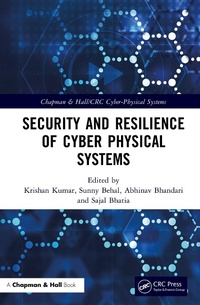
Security and Resilience of Cyber Physical Systems
1st Edition
Published on 19. August 2022
126 pages
978-1-000-63073-2 (ISBN)
Description

In this era of 5G digital communication, the implementation of industry 4.0 is the need of the hour. The main aim of this industrial revolution is to completely automate the industry for better productivity, correct decision making and increased efficiency. All the concepts of industry 4.0 can only be implemented with the help of Cyber Physical System aka CPS. This is a smart system in which complete mechanism is monitored and controlled by computer-based algorithms.
Confidentiality, Integrity and Availability are the three major concern for providing the add on security to any organization or a system. It has become a biggest challenge among the security professionals to secure these cyber physical systems. Hackers and bad guys are planning various kinds of attacks on daily basis on these systems.
This book addresses the various security and privacy issues involved in the cyber physical system. There is need to explore the interdisciplinary analysis to ensure the resilience of these systems including different types of cyber threats to these systems. The book highlights the importance of security in preventing, detecting, characterizing and mitigating different types of cyber threats on CPS. The book offers a simple to understand various organized chapters related to the CPS and their security for graduate students, faculty, research scholars and industry professionals.
The book offers comprehensive coverage of the most essential topics, including:
Cyber Physical Systems and Industrial Internet of Things (IIoT)
Role of Internet of Things and their security issues in Cyber Physical Systems.
Role of Big data analytic to develop real time solution for CPS.
DDoS attacks and their solutions in CPS.
Emulator Mininet for simulating CPS.
Spark-based DDoS Classification System for Cyber-Physical Systems
Confidentiality, Integrity and Availability are the three major concern for providing the add on security to any organization or a system. It has become a biggest challenge among the security professionals to secure these cyber physical systems. Hackers and bad guys are planning various kinds of attacks on daily basis on these systems.
This book addresses the various security and privacy issues involved in the cyber physical system. There is need to explore the interdisciplinary analysis to ensure the resilience of these systems including different types of cyber threats to these systems. The book highlights the importance of security in preventing, detecting, characterizing and mitigating different types of cyber threats on CPS. The book offers a simple to understand various organized chapters related to the CPS and their security for graduate students, faculty, research scholars and industry professionals.
The book offers comprehensive coverage of the most essential topics, including:
Cyber Physical Systems and Industrial Internet of Things (IIoT)
Role of Internet of Things and their security issues in Cyber Physical Systems.
Role of Big data analytic to develop real time solution for CPS.
DDoS attacks and their solutions in CPS.
Emulator Mininet for simulating CPS.
Spark-based DDoS Classification System for Cyber-Physical Systems
More details
Series
Edition
1. Auflage
Language
English
Place of publication
London
United Kingdom
Publishing group
Taylor & Francis Ltd
Target group
College/higher education
Professional and scholarly
Illustrations
12 Tables, black and white; 11 Line drawings, black and white; 18 Halftones, black and white; 29 Illustrations, black and white
ISBN-13
978-1-000-63073-2 (9781000630732)
Copyright in bibliographic data and cover images is held by Nielsen Book Services Limited or by the publishers or by their respective licensors: all rights reserved.
Schweitzer Classification
Other editions
Additional editions
Krishan Kumar | Sunny Behal | Abhinav Bhandari
Security and Resilience of Cyber Physical Systems
Book
10/2024
1st Edition
Chapman & Hall/CRC
€78.70
Shipment within 10-20 days
Krishan Kumar | Sunny Behal | Abhinav Bhandari
Security and Resilience of Cyber Physical Systems
Book
08/2022
1st Edition
Chapman & Hall/CRC
€125.60
Shipment within 10-20 days
Persons
Dr. Krishan Kumar has done Bachelor of Technology in Computer Science and Engineering from National Institute of Technology, Hamirpur in 1995. He finished his Masters in Software Systems from BITS Pilani in 2001. He completed his Ph. D. from Department of Electronics and Computer Engineering at Indian Institute of Technology, Roorkee in 2008. Currently, he is working as Professor in Information Technology department at U.I.E.T, Panjab University, Chandigarh, India. His general research Interests are in the areas of Information Security and Computer Networks. He has published around 200 + research papers in different International Journals and Conferences of Repute including more than 1500 citations.
Dr. Sunny Behal has done Bachelor of Technology in Computer Science and Engineering from Shaheed Bhagat Singh College of Engineering and Technology, Ferozepur, Punjab, India in 2002. He completed his Masters in Computer Science and Engineering from Guru Nanak Dev Engineering College, Ludhiana, Punjab, India in 2010. He completed his PhD in May 2018 from IKG PTU, Kapurthala, India. His Research interests include Botnets, DDoS attacks, Information and Network Security. Currently, He is working as Associate Professor in Computer Science and Engineering department at Shaheed Bhagat Singh State University, Ferozepur, Punjab, India and have published more than 70 Research papers in different International Journals and Conferences of repute.
Dr. Abhinav Bhandari has done B.Tech in Computer Science and Engineering from G.T.B.K.I.E.T, Malout in 2001. He has completed his M.Tech in Computer Science and Engineering from D.A.V.I.E.T. Jalandhar in 2008 and Ph.D. from Dr. B.R Ambedkar National Institute of Technology Jalandhar in 2017. He has worked as a Head of Department in Lala Lajpat Rai Institute of Engineering and Technology Moga from 2006 to 2010. Dr. Bhandari is currently working as an Assistant Professor Department of Computer Engineering Punjabi University Patiala since 2012. His area of interest is computer networks and network security. He has guided more than 20 M.Tech students for their dissertation work. He has published more than 50 research papers in reputed journals and national/international conferences. He has acted as a guest editor for special issue of Scopus Indexed journal for International Conference on Applications on AI and Machine Learning ICAML-2020 and ICAML-2021 organized at Department of CSE, Punjabi University, Patiala, India.
Dr. Sajal Bhatia is an Assistant Professor (Cybersecurity) and Director of Cybersecurity programs within the School of Computer Science and Engineering at Sacred Heart University. His primary research interest revolves around Network Security, in particular areas such as Denial-of-Service (DoS) attacks, synthetic traffic generation, critical infrastructure security, and intrusion detection. More recently he has been interested in exploring industrial control system security, cyber-physical system security, and cybersecurity education. Dr. Bhatia's teaching interests include network security, intrusion detection, capstone and senior projects, network penetration testing, and computer networks. Prior to joining Sacred Heart in 2017, Dr. Bhatia worked as Postdoctoral Faculty and Visiting Assistant Professor at Fordham University and as Postdoctoral Research Scholar at Vanderbilt University where he was exploring the area of secure and resilient cyber-physical systems. Sajal obtained his PhD from the Information Security Research Institute at Queensland University of Technology, Brisbane, Australia in 2013. Sajal holds bachelor's degree in Communication and Computer Engineering awarded by the LNM Institute of Information Technology, India in 2008. Prior to starting his doctoral studies, he worked as a Project Associate at IIT Kanpur.
Dr. Sunny Behal has done Bachelor of Technology in Computer Science and Engineering from Shaheed Bhagat Singh College of Engineering and Technology, Ferozepur, Punjab, India in 2002. He completed his Masters in Computer Science and Engineering from Guru Nanak Dev Engineering College, Ludhiana, Punjab, India in 2010. He completed his PhD in May 2018 from IKG PTU, Kapurthala, India. His Research interests include Botnets, DDoS attacks, Information and Network Security. Currently, He is working as Associate Professor in Computer Science and Engineering department at Shaheed Bhagat Singh State University, Ferozepur, Punjab, India and have published more than 70 Research papers in different International Journals and Conferences of repute.
Dr. Abhinav Bhandari has done B.Tech in Computer Science and Engineering from G.T.B.K.I.E.T, Malout in 2001. He has completed his M.Tech in Computer Science and Engineering from D.A.V.I.E.T. Jalandhar in 2008 and Ph.D. from Dr. B.R Ambedkar National Institute of Technology Jalandhar in 2017. He has worked as a Head of Department in Lala Lajpat Rai Institute of Engineering and Technology Moga from 2006 to 2010. Dr. Bhandari is currently working as an Assistant Professor Department of Computer Engineering Punjabi University Patiala since 2012. His area of interest is computer networks and network security. He has guided more than 20 M.Tech students for their dissertation work. He has published more than 50 research papers in reputed journals and national/international conferences. He has acted as a guest editor for special issue of Scopus Indexed journal for International Conference on Applications on AI and Machine Learning ICAML-2020 and ICAML-2021 organized at Department of CSE, Punjabi University, Patiala, India.
Dr. Sajal Bhatia is an Assistant Professor (Cybersecurity) and Director of Cybersecurity programs within the School of Computer Science and Engineering at Sacred Heart University. His primary research interest revolves around Network Security, in particular areas such as Denial-of-Service (DoS) attacks, synthetic traffic generation, critical infrastructure security, and intrusion detection. More recently he has been interested in exploring industrial control system security, cyber-physical system security, and cybersecurity education. Dr. Bhatia's teaching interests include network security, intrusion detection, capstone and senior projects, network penetration testing, and computer networks. Prior to joining Sacred Heart in 2017, Dr. Bhatia worked as Postdoctoral Faculty and Visiting Assistant Professor at Fordham University and as Postdoctoral Research Scholar at Vanderbilt University where he was exploring the area of secure and resilient cyber-physical systems. Sajal obtained his PhD from the Information Security Research Institute at Queensland University of Technology, Brisbane, Australia in 2013. Sajal holds bachelor's degree in Communication and Computer Engineering awarded by the LNM Institute of Information Technology, India in 2008. Prior to starting his doctoral studies, he worked as a Project Associate at IIT Kanpur.
Content
1. The Cyber Physical Systems and Industrial Internet of Things (IIoT): A Revolution. 2. Role of Internet of Things and their security issues in Cyber Physical Systems. 3. Blind Signature Schemes for Secure and Trusted Electrical Voting and Cashing Systems: A Survey. 4. Investigating Convergence of Cyber Physical Systems and Big Data Analytics to develop Realtime Defense Solution. 5. Recent advancements in state of cloud security in Cyber-Physical Systems. 6. A comprehensive review: Detection and Mitigation solutions of DDoS attacks in Cyber Physical Systems. 7. S-DDoS-CPS: Spark-based DDoS Classification System for Cyber-Physical Systems. 8. Mininet-Wifi as Software Defined Wireless Network Testing Platform. 9. Application of Cognitive Internet of Things (IoT) for COVID-19 Pandemic.
