

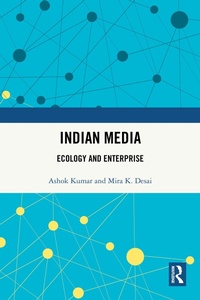
Indian Media
Ecology and Enterprise
1st Edition
Will be published approx. on 20. July 2026
224 pages
978-1-040-95764-6 (ISBN)
Description

This book offers an extensive study of Indian media, exploring its development through socio-cultural, economic, and political lenses while connecting these interrelated spheres. It inspects the history, geography, economics, sociology, and politics of Indian media, presenting a refined understanding of its evolution over time and across India, which is a sub-continent in itself.
The book examines how the Indian media has transformed into an enterprise dominated by private players, while remaining deeply influenced by government interventions, creating a dynamic landscape with diverse stakeholders. It explores various dimensions of Indian media-historical, socio-cultural, political, religious, economic, and ethical-using specific examples from varied geographies and contexts. Additionally, it reflects on the regional differences within India's federal structure, offering insights into the complexities of media across the nation.
Adopting a media ecology approach, this book provides a fresh perspective on the Indian media landscape, making it an important resource for students of media studies, communication studies, journalism and advertising, mass communication, media management, entertainment management and film studies. It will also appeal to general readers interested in understanding the multifaceted nature of Indian media.
The book examines how the Indian media has transformed into an enterprise dominated by private players, while remaining deeply influenced by government interventions, creating a dynamic landscape with diverse stakeholders. It explores various dimensions of Indian media-historical, socio-cultural, political, religious, economic, and ethical-using specific examples from varied geographies and contexts. Additionally, it reflects on the regional differences within India's federal structure, offering insights into the complexities of media across the nation.
Adopting a media ecology approach, this book provides a fresh perspective on the Indian media landscape, making it an important resource for students of media studies, communication studies, journalism and advertising, mass communication, media management, entertainment management and film studies. It will also appeal to general readers interested in understanding the multifaceted nature of Indian media.
More details
Edition
1. Auflage
Language
English
Place of publication
London
United Kingdom
Publishing group
Taylor & Francis Ltd
Target group
College/higher education
Professional and scholarly
Illustrations
11 Tables, black and white; 10 Line drawings, black and white; 10 Halftones, black and white; 20 Illustrations, black and white
File size
7,24 MB
ISBN-13
978-1-040-95764-6 (9781040957646)
Copyright in bibliographic data and cover images is held by Nielsen Book Services Limited or by the publishers or by their respective licensors: all rights reserved.
Schweitzer Classification
Other editions
Additional editions
Book
approx. 07/2026
1st Edition
Routledge
€191.50
Not yet published
Persons
Ashok Kumar is a media communications professional with 40 years of industry and academic experience. He has served as faculty at the FTII, Pune; Professor and Head of Media at MICA, Ahmedaba; and Professor and Head of Screenwriting and Advertising Creativity at Ramoji Film City, Hyderabad. Currently, he focuses on creative writing and has three novels to his credit. His short stories appear regularly in literary magazines and his poetry is available on www.rekhta.org.
Mira K Desai is a Professor in Communication Technology and Head of the University Department of Extension & Communication, S.N.D.T. Women's University, Mumbai. Prior to entering academia, she worked across multiple media environments. She has authored eight books, along with multiple journal papers, book chapters, and self-learning materials. As a social researcher with over three decades of experience, her interests lie in research and practices on gender, development, technology and culture.
Mira K Desai is a Professor in Communication Technology and Head of the University Department of Extension & Communication, S.N.D.T. Women's University, Mumbai. Prior to entering academia, she worked across multiple media environments. She has authored eight books, along with multiple journal papers, book chapters, and self-learning materials. As a social researcher with over three decades of experience, her interests lie in research and practices on gender, development, technology and culture.
Content
List of figures. List of tables. Preface. PREAMBLE: An Overview of Indian Media 1. The Socio-political Spheres and Media 2. Media and The Cultural Sphere 3. Media and the Religious Sphere 4. Health and Wellness and Media 5. Media and The Economy 6. Media Commodity 7. Pandemic & Indian Media 8. Indian Media & AI 9. Media and Law 10. Media and Ethics 11. Indian Media: The Elephant Index.
