

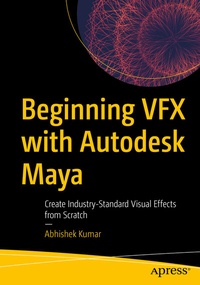
Beginning VFX with Autodesk Maya
Description

You will start with the fundamentals of visual effects, including a history of VFX, tools and techniques for creating believable visual effects, and popular tools used in the industry. Next, you are introduced to Autodesk Maya and its various components that make it a favorite among professionals. You will learn how to create rigid body collisions and simulate realistic particles such as dust, fire, water, and more.
This book also presents strategies for creating a vortex, rain, hair, fluids, and other soft body simulations and also demonstrates nature element simulations for computer-generated production.
At the end of the book, there is a capstone project to make your own visual effects scene in a practical way. After going through this book, you will be able to start building computer-generated visual effects from your imagination through to production.
What You Will Learn
-
Understand the basic physics behind effect creation
- Create 3D visual effects scenes from scratch
- Know the details of dynamic simulation in the computer generation space using various functionalities available in Autodesk Maya
Who This Book Is For
Beginning-level users; students from the field of visual effects design, 3D modeling, and simulation; game designers; those creating computer graphics; FX artists and aspirants looking for a career in the field of 3D
More details
Other editions
Additional editions
Person
Dr Abhishek Kumar is an Apple Certified Associate, Adobe Education Trainer, and certified by Autodesk. He received a PhD in computer applications and a master's degree in animation and computer science. He also received a post-doctoral fellowship at Imam Mohammad Ibn Saud Islamic University, Saudi Arabia.
Dr Kumar is actively involved in course development in animation and design engineering for various institutions and universities. He has published a number of research papers and covered a wide range of topics in various digital scientific areas (image analysis, visual identity, graphics, digital photography, motion graphics, 3D animation, visual effects, editing, composition). He holds 10 patents in the field of AI, design, and IoT.
Dr Kumar has delivered sessions for more than 100 workshops and seminars as a subject matter expert and resource person at universities, institutes, and colleges such as Delhi University, GGU Central University, Savitribai Phule University, Anna University, Rajiv Gandhi Central University, Allahabad University, Banaras Hindu University, MANNU Hyderabad, Gujrat Technological University ,TMU, GIET University, NIT's, IIT's, and several international institutes and universities to make career opportunities and immersive technology opportunities for educators in awareness about the future of elearning, MOOCs, virtual reality, animation design, and the VFX industry.
