

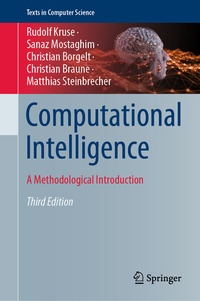
Computational Intelligence
Description

Features: provides supplementary material at an associated website; contains numerous classroom-tested examples and definitions throughout the text; presents useful insights into all that is necessary for the successful application of computational intelligence methods; explains the theoretical background underpinning proposed solutions to common problems; discusses in great detail the classical areas of artificial neural networks, fuzzy systems and evolutionary algorithms; reviews the latest developments in the field, covering such topics as ant colony optimization and probabilistic graphical models.
Reviews / Votes
"The book presents a thorough exposition of the main concepts of computational intelligence. . It is an interesting book that may serve very well a wide audience, providing material for researchers, students as well as people working in industry." (Catalin Stoean, zbMATH 1500.68001, 2023)"The authors have written Computational intelligence in such a way that it can serve as both a textbook and a helpful reference book for students and practitioners of computing science and related fields. The presentation is careful and friendly yet technically sound." (Soubhik Chakraborty, Computing Reviews, March 7, 2023)
More details
Other editions
Additional editions
Previous edition
Persons
Dr. Rudolf Kruse is the former leader of the Computational Intelligence Research Group and now Emeritus Professor of the Department of Computer Science at the University of Magdeburg, Germany. Dr. Sanaz Mostaghim is a full Professor of Computer Science and Dr. Christian Braune is a Senior Lecturer at the same institution. Dr. Christian Borgelt is a Professor of Data Science at the Paris Lodron University of Salzburg, Austria. Dr. Matthias Steinbrecher is a Development Architect at SAP SE, Potsdam, Germany.
Content
Introduction.-
Part I: Neural Networks.-
Introduction.- Threshold Logic Units.- General Neural Networks.- Multi-Layer Perceptrons.- Radial Basis Function Networks.- Self-Organizing Maps.- Hopfield Networks.- Recurrent Networks.- Mathematical Remarks for Neural Networks.-
Part II: Evolutionary Algorithms.-
Introduction to Evolutionary Algorithms.- Elements of Evolutionary Algorithms.- Fundamental Evolutionary Algorithms.- Computational Swarm Intelligence.-
Part III: Fuzzy Systems.-
Fuzzy Sets and Fuzzy Logic.- The Extension Principle.- Fuzzy Relations.- Similarity Relations.- Fuzzy Control.- Fuzzy Data Analysis.- Part IV: Bayes and Markov Networks.- Introduction to Bayes Networks.- Elements of Probability and Graph Theory.- Decompositions.- Evidence Propagation.- Learning Graphical Models.- Belief Revision.- Decision Graphs.
