

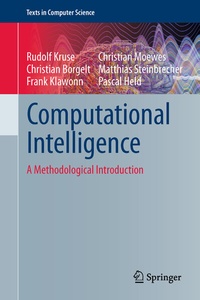
Computational Intelligence
Description

Reviews / Votes
From the reviews:
"This book teaches computational intelligence (CI) in a thorough, methodological manner that is theoretically profound and educationally oriented. . this book is well designed for the independent student who wishes to learn the fundamentals of CI without the need for an instructor. The organization and thorough step-by-step methodology makes it an excellent startup guide for someone who wants to learn CI . . This book is targeted at beginners, students, or professionals who wish to understand CI." (Mario Antoine Aoun, Computing Reviews, February, 2014)
"The book under review is a textbook that features sub-symbolic approaches developed within the field of Artificial Intelligence . . It can be used as a companion book for lectures, with exercises and slides to be found on the book's website. With its focus on sub-symbolic approaches, it presents a comprehensive and detailled source of information complementary to other commonly used textbooks in Artificial Intelligence that mostly focus on symbolic approaches." (Jana Köhler, zbMATH, Vol. 1283, 2014)
"The book is a comprehensive treatise on computational intelligence with a focus on the underlying methodology and algorithms. . The reader can enjoy a comprehensive and systematically arranged exposure of the material. . The references following each chapter can serve as a list of introductory readings on the individual areas of computational intelligence. . the reader gains a good sense of computational intelligence as an important endeavor supporting analysis and synthesis of intelligent systems. . a useful compendium of knowledge for a broad audience." (Witold Pedrycz, Mathematical Reviews, November, 2013)More details
Other editions
New editions
Additional editions
Persons
Rudolf Kruse is a full professor at the Department of Computer Science of the Otto-von-Guericke University of Magdeburg, Germany, where he leads the working group on computational intelligence. Christian Moewes and Pascal Held are research assistants at the same institution. Christian Borgelt is a principal researcher at the European Centre for Soft Computing, Mieres, Spain. Frank Klawonn is a Professor at the Department of Computer Science of Ostfalia University of Applied Sciences, Wolfenbüttel, Germany. Matthias Steinbrecher is a member of the SAP Innovation Center, Potsdam, Germany.
Content
Introduction.- Part I: Neural Networks.- Introduction.- Threshold Logic Units.- General Neural Networks.- Multi-Layer Perceptrons.- Radial Basis Function Networks.- Self-Organizing Maps.- Hopfield Networks.- Recurrent Networks.- Mathematical Remarks.- Part II: Evolutionary Algorithms. - Introduction to Evolutionary Algorithms.- Elements of Evolutionary Algorithms.- Fundamental Evolutionary Algorithms.- Special Applications and Techniques.- Part III: Fuzzy Systems. - Fuzzy Sets and Fuzzy Logic.- The Extension Principle.- Fuzzy Relations.- Similarity Relations.- Fuzzy Control.- Fuzzy Clustering.- Part IV: Bayes Networks. - Introduction to Bayes Networks.- Elements of Probability and Graph Theory.- Decompositions.- Evidence Propagation.- Learning Graphical Models.
