
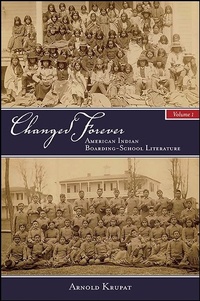
Changed Forever
Description
Alles über E-Books | Antworten auf Fragen rund um E-Books, Kopierschutz und Dateiformate finden Sie in unserem Info- & Hilfebereich.
The first in-depth study of a range of literature written by Native Americans who attended government-run boarding schools.
Changed Forever is the first study to gather a range of texts produced by Native Americans who, voluntarily or through compulsion, attended government-run boarding schools in the last decades of the nineteenth and the first decades of the twentieth centuries. Arnold Krupat examines Hopi, Navajo, and Apache boarding-school narratives that detail these students' experiences. The book's analyses are attentive to the topics (topoi) and places (loci) of the boarding schools. Some of these topics are: (re-)Naming students, imposing on them the regimentation of Clock Time, compulsory religious instruction and practice, and corporal punishment, among others. These topics occur in a variety of places, like the Dormitory, the Dining Room, the Chapel, and the Classroom. Krupat's close readings of these narratives provide cultural and historical context as well as critical commentary. In her study of the Chilocco Indian School, K. Tsianina Lomawaima asked poignantly, "What has become of the thousands of Indian voices who spoke the breath of boarding-school life?" Changed Forever lets us hear some of them.
All prices
More details
Other editions
Additional editions
Person
Arnold Krupat is Professor Emeritus, Sarah Lawrence College and the author of many books, including "That the People Might Live": Loss and Renewal in Native American Elegy.
Content
List of Illustrations
Acknowledgments
Introduction
Part I. Hopi Boarding-School Autobiographies
1. Edmund Nequatewa's Born a Chief
2. Albert Yava's Big Falling Snow
3. Don Talayesva's Sun Chief
4. Polingaysi Qoyawayma's No Turning Back
5. Helen Sekaquaptewa's Me and Mine
6. Fred Kabotie's Hopi Indian Artist
Part II. Navajo Boarding-School Autobiographies
7. Frank Mitchell's Navajo Blessingway Singer
8. Irene Stewart's A Voice in Her Tribe
9. Kay Bennett's Kaibah
10. Stories of Traditional Navajo Life and Culture
11. George P. Lee's Silent Courage
Appendix A The Orayvi Split
Appendix B The Navajo Autobiographical Canon
Appendix C Apache Boarding-School Autobiographies
Notes
Works Cited
Index

System requirements
File format: ePUB
Copy protection: Adobe-DRM (Digital Rights Management)
System requirements:
- Computer (Windows; MacOS X; Linux): Install the free reader Adobe Digital Editions prior to download (see eBook Help).
- Tablet/smartphone (Android; iOS): Install the free app Adobe Digital Editions or the app PocketBook before downloading (see eBook Help).
- E-reader: Bookeen, Kobo, Pocketbook, Sony, Tolino and many more (not Kindle).
The file format ePub works well for novels and non-fiction books – i.e., „flowing” text without complex layout. On an e-reader or smartphone, line and page breaks automatically adjust to fit the small displays.
This eBook uses Adobe-DRM, a „hard” copy protection. If the necessary requirements are not met, unfortunately you will not be able to open the eBook. You will therefore need to prepare your reading hardware before downloading.
Please note: We strongly recommend that you authorise using your personal Adobe ID after installation of any reading software.
For more information, see our ebook Help page.
File format: ePUB
Copy protection: Watermark-DRM (Digital Rights Management)
System requirements:
- Computer (Windows; MacOS X; Linux): Use a reading software that can process the file format ePUB: e.g., Adobe Digital Editions or FBReader – both free (see eBook Help).
- Tablet/Smartphone (Android; iOS): Before downloading, install the free app Adobe Digital Editions (see eBook Help).
- E-reader: Bookeen, Kobo, Pocketbook, Sony, Tolino and many more (not Kindle).
The file format ePUB works well for novels and non-fiction books – i.e., „flowing” text without complex layout. On an e-reader or smartphone, line and page breaks automatically adjust to fit the small displays.
This eBook uses Watermark-DRM, a „soft” copy protection. This means that there are no technical restrictions to prevent illegal distribution. However, there is a personalised watermark embedded in the eBook that can be used to identify the purchaser of the eBook in the event of misuse and to provide evidence for legal purposes.
For more information, see our eBook Help page.