

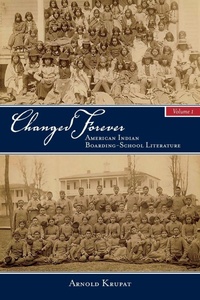
Changed Forever
American Indian Boarding-School Literature
Published on 2. January 2019
Book
Paperback/Softback
406 pages
978-1-4384-6914-0 (ISBN)
Description
The first in-depth study of a range of literature written by Native Americans who attended government-run boarding schools.
Changed Forever is the first study to gather a range of texts produced by Native Americans who, voluntarily or through compulsion, attended government-run boarding schools in the last decades of the nineteenth and the first decades of the twentieth centuries. Arnold Krupat examines Hopi, Navajo, and Apache boarding-school narratives that detail these students' experiences. The book's analyses are attentive to the topics (topoi) and places (loci) of the boarding schools. Some of these topics are: (re-)Naming students, imposing on them the regimentation of Clock Time, compulsory religious instruction and practice, and corporal punishment, among others. These topics occur in a variety of places, like the Dormitory, the Dining Room, the Chapel, and the Classroom. Krupat's close readings of these narratives provide cultural and historical context as well as critical commentary. In her study of the Chilocco Indian School, K. Tsianina Lomawaima asked poignantly, "What has become of the thousands of Indian voices who spoke the breath of boarding-school life?" Changed Forever lets us hear some of them.
Changed Forever is the first study to gather a range of texts produced by Native Americans who, voluntarily or through compulsion, attended government-run boarding schools in the last decades of the nineteenth and the first decades of the twentieth centuries. Arnold Krupat examines Hopi, Navajo, and Apache boarding-school narratives that detail these students' experiences. The book's analyses are attentive to the topics (topoi) and places (loci) of the boarding schools. Some of these topics are: (re-)Naming students, imposing on them the regimentation of Clock Time, compulsory religious instruction and practice, and corporal punishment, among others. These topics occur in a variety of places, like the Dormitory, the Dining Room, the Chapel, and the Classroom. Krupat's close readings of these narratives provide cultural and historical context as well as critical commentary. In her study of the Chilocco Indian School, K. Tsianina Lomawaima asked poignantly, "What has become of the thousands of Indian voices who spoke the breath of boarding-school life?" Changed Forever lets us hear some of them.
Reviews / Votes
"Krupat's volumes, almost needless to say, constitute a vital contribution to resuscitating 'the thousands of Indian voices who spoke the breath of boarding-school life.'" - American Indian Quarterly"Changed Forever encourages and prepares readers to read and remember boarding-school autobiographies more accurately. Krupat offers a seemingly encyclopedic guide for students and scholars alike to deepen their engagement with this and other genres of boarding-school literatures." - MELUS
"refreshing and challenging. Highly recommended." - American Literary History
More details
Language
English
Place of publication
Albany, NY
United States
Target group
Professional and scholarly
US School Grade: College Graduate Student and over
Product notice
Paperback (trade)
Illustrations
15 Illustrations, black and white
Dimensions
Height: 229 mm
Width: 152 mm
Thickness: 24 mm
Weight
657 gr
ISBN-13
978-1-4384-6914-0 (9781438469140)
Copyright in bibliographic data and cover images is held by Nielsen Book Services Limited or by the publishers or by their respective licensors: all rights reserved.
Schweitzer Classification
Other editions
Additional editions
E-Book
04/2018
1st Edition
State University of New York Press
from
€91.99
Available for download
Person
Arnold Krupat is Professor Emeritus, Sarah Lawrence College and the author of many books, including "That the People Might Live": Loss and Renewal in Native American Elegy.
Content
List of Illustrations
Acknowledgments
Introduction
Part I. Hopi Boarding-School Autobiographies
1. Edmund Nequatewa's Born a Chief
2. Albert Yava's Big Falling Snow
3. Don Talayesva's Sun Chief
4. Polingaysi Qoyawayma's No Turning Back
5. Helen Sekaquaptewa's Me and Mine
6. Fred Kabotie's Hopi Indian Artist
Part II. Navajo Boarding-School Autobiographies
7. Frank Mitchell's Navajo Blessingway Singer
8. Irene Stewart's A Voice in Her Tribe
9. Kay Bennett's Kaibah
10. Stories of Traditional Navajo Life and Culture
11. George P. Lee's Silent Courage
Appendix A The Orayvi Split
Appendix B The Navajo Autobiographical Canon
Appendix C Apache Boarding-School Autobiographies
Notes
Works Cited
Index
Acknowledgments
Introduction
Part I. Hopi Boarding-School Autobiographies
1. Edmund Nequatewa's Born a Chief
2. Albert Yava's Big Falling Snow
3. Don Talayesva's Sun Chief
4. Polingaysi Qoyawayma's No Turning Back
5. Helen Sekaquaptewa's Me and Mine
6. Fred Kabotie's Hopi Indian Artist
Part II. Navajo Boarding-School Autobiographies
7. Frank Mitchell's Navajo Blessingway Singer
8. Irene Stewart's A Voice in Her Tribe
9. Kay Bennett's Kaibah
10. Stories of Traditional Navajo Life and Culture
11. George P. Lee's Silent Courage
Appendix A The Orayvi Split
Appendix B The Navajo Autobiographical Canon
Appendix C Apache Boarding-School Autobiographies
Notes
Works Cited
Index